
HOME >> BUSINESS
Chinese prop up Greek real estate
By Ma Jingjing Source:Global Times Published: 2019/11/11 20:33:40
Favorable policies to attract additional FDI expected
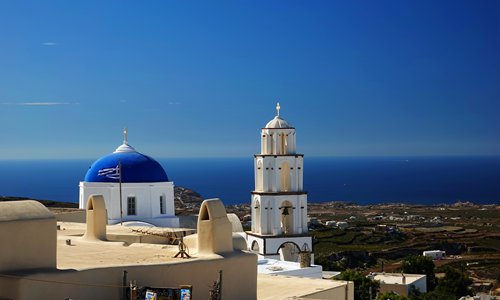
A view of the Santorini island in Greece Photo: VCG
Thousands of Golden-Visa-wielding Chinese travelers have become the recipe to fix Greece's decade-long financial woes, Chinese experts said on Monday.
"Greek people should thank the Chinese because the arrival of Chinese has helped prop up Greece's real estate market. Without the Chinese, Greece can't repay its debts in many years," Wang Rongzhen, 45, told the Global Times on Monday.
Wang, his wife and son, from Shanghai, are among thousands of Chinese who got Greece's Golden Visa in recent years, attracted by what Wang said was one of the most attractive visa programs in Europe. This trend resulted in exploding property and business investment in the southern European country.
To attract foreign investment to sustain the economy, the Mediterranean country introduced the "Golden Visa" program in 2013, granting residence permits for five years to foreigners and their family members, if they purchase real estate valued at a minimum of 250,000 euros ($275,575). The visa is subject to renewal if the property is retained.
The relatively low threshold, along with high education and a friendly atmosphere, attracts an increasing number of Chinese. "About two to three years ago, it took only one month to get your Greece visa fingerprints collected, but now you have to wait for more than six months," Wang said, noting that the number of Golden Visas granted to Chinese ranked No.1, followed by Russia.
Since the start of the program, 4,537 visas have been issued, 60 percent to Chinese, Greek news site ekathimerini.com reported in September.
With the influx of Chinese, Wang's family business shifted its focus from China to Greece in 2017. "Our family has invested tens of millions of euros in Greece. As Greece's financial crisis left many unfinished houses, we buy these properties from banks and then sell the finished houses, making a reasonable profit," he said.
Wang is deputy manager of his family company named Ou Jia Investments, which he said means "the best investment destination in Europe."
The property market in Athens, capital of Greece, is especially hot, according to Wang. "Our house projects in Alimos, southern Athens, were sold at about 260,000 euros at the end of 2018, but the price has increased to a little more than 300,000 euros now," he said, noting that Chinese who move to Greece tend to set up supermarkets, restaurants and construction businesses to make a living, or just lease their houses.
To attract more foreign direct investment (FDI), Greece may pass a bill to allow payment of the 250,000 euros via a certified bank check, or by a credit or debit card at point-of-service terminals, Greek financial newspaper Naftemporiki reported in October.
Greece found the proper prescription to revive its economy, Zhao Junjie, a research fellow at the Chinese Academy of Social Sciences' Institute of European Studies, told the Global Times on Monday. "Though Greece has survived the most difficult period, it will still have trouble depending on more domestic consumption to drive its economy. It needs Chinese investment and travelers," he said.
Data from the Chinese Ministry of Commerce showed that so far, Chinese investments in Greece have exceeded $2 billion, providing over 3,000 direct jobs in Greece.
Apart from Greece, other European countries including Italy and Spain all welcome Chinese visitors to contribute to their economies, Zhao said.
Posted in: ECONOMY,BIZ FOCUS