
Economic woes trigged by coronavirus outbreak temporary and will be eventually curbed
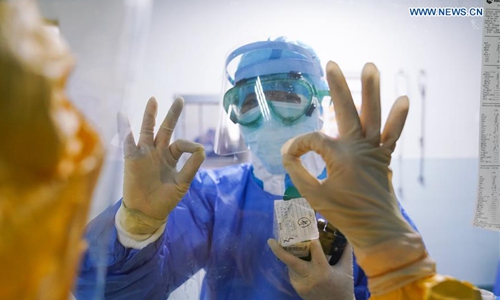
(Photo by Xiao Heyong/Xinhua)
The unexpected pummeling of the novel coronavirus on China will undercut the growth momentum of the world's second-largest economy in at least two to three months. But starting mid-April when the weather warms up and the deadly virus loses its vapor of survival, economic activities will gradually rebound and gain impetus in the summertime.
After the virus subsides under the scalding sun in June, Chinese people's consumption will bounce back with a vengeance, who are now forced to stay indoors to avert the coronavirus onslaught.
The country's GDP growth is expected to be dented by up to 2 percent in the first quarter and 1 percent in the first half of the year, as the contagious virus impedes Chinese consumers' spending on transport, outing and sightseeing, retail and entertainment. However, in the second half of 2020, China will be able to attain a growth rate of 6.5-7 percent. So, there is no need to be overly pessimistic about the temporary woes.
However, the Chinese government must not be mere spectators and wait for the coronavirus to sink on its own.
To assuage the current difficulties faced by hundreds of thousands of small and medium-sized businesses, the central and provincial authorities need to slash discretionary taxes and fees levied on them, and the state-owned banks need to defer loans to these firms with extraordinarily low rates. Rentals for small businesses' offices or operating spaces should also come down. After all, the survival of these enterprises during the first half of the year has a crucial bearing with an economic rebound in the second half.
The virus outbreak is wreaking havoc now, particularly on Central China's Hubei Province from where it originated. The lockdown of Hubei to stop the epidemic from spreading freely and wildly to other provinces and cities was a prompt and aggressive measure. The draconian step will effectively aid other regions to contain virus spread and bring it under control at the earliest.
The measure will also help China's three powerful manufacturing clusters, namely the Yangtze River Delta centering Shanghai, the Pearl River Delta centering Shenzhen, and the northern Beijing-Tianjin-Hebei region, to avoid dreadful virus contagions, and the country's major industrial and commercial powerhouses are to resume production earlier.
After the ferocity of the virus attack edges down in a week or two, Chinese workers in the three major manufacturing clusters and throughout other provinces, apart from Hubei, could wear masks and resume their normal working schedules. As the media reported, many workers on a slew of infrastructure projects like urban subways, high-speed rails, airports, reservoirs and water-diversion canals have already resumed work. Besides, major online shipping platforms have begun operations.
To restrict the chilling shock of the virus on China's economy, the People's Bank of China, the central bank, has injected $1.7 trillion of liquidity into the monetary system in a massive reverse repo program by Tuesday. Following a broad selloff, China's equities market is expected to stabilize in the coming days, with the buttress of strong central bank support.
But the injection may not be enough to cheer up the market mood. It is pertinent for the central bank to seriously consider reducing the benchmark interest rates by a quarter percentage points.
Also, the fiscal policy should be used to ram up deficit spending to downsize current economic woes. Only with convergence and integration of the monetary and fiscal measures, the rapid downward spiral of China's economic activities can be stopped.
Facing a crisis of this magnitude, China must act, and act fast enough to bail out troubled businesses, prevent a meltdown of the economy, and control the impact of negative waves triggered by the coronavirus outbreak.