
HOME >> SOURCE
Chilled auto market set to rally after virus
By Zhang Hongpei Source:Global Times Published: 2020/2/4 22:43:42
Temporary impact won’t change industry development direction: analysts
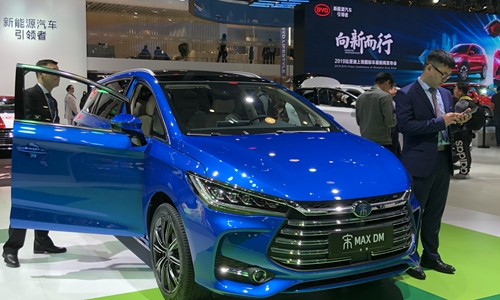
A view of a BYD model during the Shanghai Auto Show in April 2019 Photo: Zhang Hongpei/GT
The novel coronavirus has gripped China and caused more than 420 deaths, wreaking havoc on domestic auto production and sales, yet it is also highlighting the significance of owning a private vehicle, said automakers and industry analysts.
All 25 auto-manufacturing provinces and municipalities across the country, with the exception of Northwest China's Xinjiang Uygur Autonomous Region, have announced work will not resume until February 10, according to the China Passenger Car Association (CPCA).
Central China's Hubei Province, the epicenter of the deadly coronavirus outbreak, says its businesses will not reopen until February 14 at the earliest.
A total of 11 provinces and municipalities including Hubei are normally responsible for over two-thirds of the country's vehicle production. Among that number, East China's Zhejiang and Anhui provinces and South China's Guangdong Province rank among the top five in terms of confirmed coronavirus cases.
If businesses are idled until February 10, a first-quarter production loss of around 350,000 units and a 7 percent drop is projected, according to auto industry analysts at global information provider IHS Markit.
However, "if the situation lingers into mid-March, and plants in adjacent provinces are idled, we could see some more substantial impact," read an IHS Markit note on Friday, referring to the potential of a nationwide supply-chain disruption caused by auto component shortages from Hubei and adjacent provinces.
IHS Markit predicts a potential production loss of more than 1.7 million units for the first quarter if the above scenario becomes a reality.
Given current events, Secretary-General of the CPCA Cui Dongshu predicts a drop of 5 percentage points based on his previous 2020 domestic auto sales estimate - a positive growth of 1 percent.
China's auto sales declined 8.2 percent year-on-year to 25.77 million units in 2019, data from the China Association of Automobile Manufacturers showed. The country's vehicle output stood at 25.72 million units last year, down 7.5 percent year-on-year.
However, the epidemic will not change the direction of the Chinese auto industry's upgrade to green, intelligent vehicles in the long term, automakers and observers say.
The coronavirus outbreak will temporarily slow down all manufacturing, consumption and many other economic activities. This will inevitably impact auto production and sales in the short term. However, the temporary slowdown does not affect our confidence in the Chinese auto market's medium and long-term prospects, read a statement that domestic electric vehicle (EV) manufacturer Byton sent to the Global Times.
"It's hard to make any predictions at the moment as the epidemic is still unfolding. Our goal is to ensure our preparation for start-of-production stays on track," the EV start-up said.
"The Spring Festival holidays are usually a good time to sell vehicles, and there have been nearly zero sales since January 20," Cui noted.
Cui predicted the epidemic will cause a 15-25 percent year-on-year auto sales drop in January, revising his previous 5 percent estimated drop.
"The virus' drag on the economy is mainly reflected in small and middle-sized enterprises in third- and fourth-tier cities, where potential buyers of domestic auto brands are clustered," Cui noted.
Mei Songlin, a senior auto industry analyst based in Shanghai, told the Global Times that consumer demand for vehicles is delayed rather than disappearing. "The demand is still there, and has in fact surged as the epidemic has strengthened the need for private cars," said Mei.
He estimates the Chinese auto sales market will be bolstered once the coronavirus is successfully eradicated.
Major hub
Hubei accounted for 8.8 percent of the nation's auto output in 2019, ranking No.4 in the country, data shows.
The province is a major auto-component hub with low costs and a convenient logistics position, Cui said. "The epidemic could even lead to a cutoff of the auto industry's entire supply chain."
As of press time on Tuesday, a total of 20,535 cases of the novel coronavirus had been confirmed and 426 had died across the country, and 13,522 of those confirmed cases were in Hubei, according to dynamic statistics for the epidemic.
Wuhan, the capital of the province and where the novel coronavirus originated, is home to the manufacturing bases of several transnational auto makers including the US' General Motors, Japanese carmakers Nissan and Honda, as well as France's PSA Group, the owner of Peugeot. The city is also where state-owned car manufacturer Dongfeng Motor Corp, one of the country's largest auto groups, is based.
Honda's major car parts supplier Ftech is planning to move its brake pedal production from Wuhan to the Philippines amid the novel coronavirus outbreak, according to a report from the Nikkei Asian Review on last Thursday.
Germany-based Bosch, the world's biggest auto components supplier, has two factories in Wuhan employing around 800 staff. Its factory activities remain halted, the company said. Most of its companies and factories in China are scheduled to resume work on February 10.
Prior to the spread of the coronavirus in early January, an intelligent manufacturing facility equipped with 5G networks was put into operation by Chinese EV maker WM Motor in Huanggang, Hubei.
WM Motor's new model for 2020 is expected to be produced in the facility in the second half of the year, a PR representative of the company told the Global Times on Tuesday. It is difficult to predict the lingering impact on its production pace for the full year. The company will follow local government notices to determine when work at the facility should be resumed.
"We have noticed that the government has paid much attention to the development of enterprises amid the epidemic, and we hope the authorities will roll out supporting measures for tax, rentals and credit to help stimulate auto consumption," he said.
Posted in: INDUSTRIES,BIZ FOCUS