Beyond face value
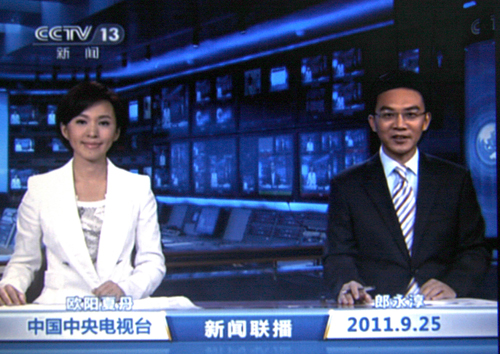
Xinwen Lianbo anchors Ouyang Xiadan (left) and Lang Yongchun.Photo: CFP
At 7 pm every evening, 74-year-old grandmother Zhang Derong sits comfortably on her sofa and tunes into China Central Television's (CCTV) flagship newscast Xinwen Lianbo, literally "news simulcast." The daily program is one of the world's most watched TV shows and has been an institution in Chinese living rooms since 1978. But on September 25, Zhang noticed something "unusual" about the half-hour news bulletin.
"It was the first time I saw an anchorman with glasses and a smiling anchorwoman," she remarked.
Xinwen Lianbo is one of China's most influential news programs. Its news content revolves around the political agenda and current affairs of the country. During its time slot, it is simultaneously broadcast on many provincial TV stations nationwide.
Given its vast reach and influence, anchors of the program are dubbed "faces of the nation" by many viewers. However the inclusion of two fresh faces – anchorwoman Ouyang Xiadan and anchorman Lang Yongchun – has generated plenty of feedback from viewers. Both presenters were born in the 1970s and their youthful appearance and colorful personalities mark a shift in the delivery of news on Xinwen Lianbo.
Facelift for newscast
The duo's debut sparked lively discussions on China's blogosphere, with Web users critiquing everything from Ouyang and Lang's slightly nervous facial expressions, enunciation, clothing and physical appearance.
Some gushed that Ouyang could be "the most beautiful anchorwoman in history," while other more astute Web users noted all anchors on Xinwen Lianbo in fact share similar facial characteristics.
"People with square-shaped faces exude modesty and dignity," said Dr Yin Lin, chief cosmetic surgeon at Yimeier Yinlin medical beauty clinic in Beijing.
Dr Yin contends that a person's appearance is largely influenced by their facial frame, adding that many Xinwen Lianbo anchors share common characteristics.
Facial frames of the anchors reflect the traditional Chinese aesthetic standard of santing wuyan. Santing refers to the specifically measured divisions of a person's face. The upper third spans the length between the hairline and eyebrows. The middle third runs from the eyebrows to the bridge of the nose, while the lower third consists of the area between the nose and the jaw line. Wuyan refers to the face's width from ear-to-ear. Ideally, this space should equate to the distance of five eyes running horizontally.
"The standard also mirrors the 'golden section' concept of aesthetics in the West," explained Dr Yin, referring to the theory whereby the head forms a golden rectangle with the eyes at its midpoint.
Ma Guifeng is a vice professor at the Communication University of China, which counts no fewer than 20 Xinwen Lianbo anchors among its alumni. She dismissed the theory that news anchors must possess sound facial proportions.
She also rejected reports from Beijing's Legal Mirror newspaper, which claimed that the university only accepts enrollments from students applying for broadcast majors if they have the desired facial appearance.
Dr Yin said that although square-shaped faces tend to be considered more dignified, young students who check into his clinic for plastic surgery prefer sharper jaw lines.
Rise of personalities
Since the mid-1980s when grandmother Zhang' family bought their first 32-centimeter television, she has become accustomed to the unchanged schedule of evening life that involves the family gathering together to watch Xinwen Lianbo.
She can recall every face of the program's anchors over the past 30 years. The program's original pairing, Li Juan and her male co-anchor Zhao Zhongxiang, always wore dark suits and never smiled. Their successors, the late Luo Jing and his female co-anchor Li Xiuping, occasionally offered faint smiles but sported the same, rudimentary hairstyles synonymous with the newscast's serious style.
Ouyang and Lang stood out in the competition for the news anchor positions made available when Xinwen Lianbo launched its makeover in August.
"I feel a stronger personal connection with the show than before," posted a Web user named Yiranjuzi on Weibo, China's popular microblogging website.
Xinwen Lianbo's changing criteria for choosing anchors reflects the rise of personalities in society and CCTV's drive to attract younger viewers to one of the country's most authoritative news programs.
However not every Western viewer shares the same enthusiasm for Chinese news anchors, with some pointing out their unprofessional flaws.
"They keep looking down at their scripts, which makes their delivery of news less fluid," commented Rashid Tabassum, 25, a medical student from the UK living in Beijing. "They should maintain more eye contact with the camera and smile less if it is a formal news program."
Pursuit of ratings
Others argue that it will take more than choosing fresh-looking news anchors on Xinwen Lianbo to revive the program, which has seen its ratings share dwindle from 40 percent before 1998 to less than 10 percent in 2009, according to statistics from CSM Media Research. "The program's more crucial goal is to transform its rigid broadcasting style of reading news word-for-word. Instead, anchors should tell news stories based on their understandings and report different angles to the stories," Feng Wei, a researcher in communication studies told the Shandong Business newspaper.