Cabbage classics
Photo:CFP

Ask older Beijingers for memory of Chinese cabbage, or Napa cabbage, or dabaicai, "large white vegetable," and they'll tell you nostalgic accounts about the veggie in winter, when hundreds of oval-shaped cabbages with broad green leaves and white petals were piled up in their courtyards or on the alleys of their hutong. The cheapest vegetable available during the long winter, it was eaten literally almost every day, braised or stir-fried.
Despite most Beijingers now taking to supermarkets for their shopping, Chinese cabbage still possesses a special place on many Beijingers' dinner table nowadays. It only costs 1 yuan ($ 0.15) a kilo, but in a refined restaurant a single dish can cost as much as 100 yuan, according to Yu Peng, the executive chef of Beijing's Qing Yun Lou Restaurant.
Bow before the King
A precious and rare vegetable in history, the Chinese cabbage has the popular reputation being of "the king of vegetables". Li Shizhen (1518-1593), a famous doctor and herbalist, studied the Chinese cabbage for its medicinal qualities, suggesting its quality can be compared to pine trees, as both can endure severe frost and heavy snow.
Originally confined to south China's Yangtze River Delta, it became popular in northern China. Thanks to its sweet, crunchy leaves and the rich nutrition, Chinese cabbage now is also increasingly being used in other cuisines.
Chinese cabbage has very high levels of vitamin C and is also a very good source of fiber, manganese, and foliate. It is also low in calories, and packed with many antioxidant plant compounds.
Chef Yu provided us with some easy to make recipes for the home. All the dishes use the cabbages grown in Hebei Province, called qing kou dabaicai, and are more crunchy and tender than regular cabbage.
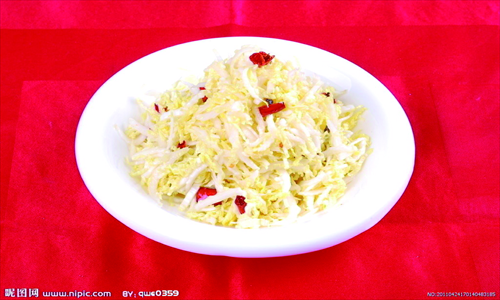
1. Chinese cabbage salad
The Chinese cabbage makes for a refreshing, perfect side-dish to go along with a few sips of baijiu. All you need for this simple dish is the core of a cabbage and some drops of sesame oil.
Directions:
1. Rinse and core the cabbage.
2. Cut the core into sheds and place on a plate. Pour sesame oil, add pinches of salt and serve.
2. Chestnut cabbage with chicken sauce
Once a royal dish during the Qing Dynasty (1644-1911), it remains one of the most popular cabbage dishes in Beijing restaurants. The crucial ingredient there is the soup, cooked with an old hen, pork ribs, duck and sometimes with beef. It can take up to 30 hours to prepare in restaurants. One dish needs three to five cabbage cores and several cups of peeled cooked whole chestnut, as well as the ingredients for the soup.
Directions:
1. Rinse and core the cabbage.
2. Simmer the old hen, duck and pork ribs for about three hours.
3. Cut the core into quarters, steam with the soup and rid of the soup when it is thoroughly cooked.
4. Stew chestnuts with the soup and pour them over the cabbage when they are cooked.
3. Steamed Chinese cabbage in supreme soup
A traditional Sichuanese dish, it looks simple but tastes great. Although it is called Chinese cabbage in kaishui, or boiled water, the dish is actually cooked with soup boiled with an old hen, an old duck, Xuanwei pork hooves (a famous brand in Yunnan), pork ribs and dried scallop. The soup, tasty but not oily, looks like clear water, given it its name. The most important procedure is to cook the soup, and once it is ready, pour it over the veggies and serve.
Directions:
1. Rinse and core the cabbage.
2. Simmer the old hen, old mother duck and pork ribs in cold water with gentle heat for at least four hours.
3. Beat the chicken breast with the back of the knife, add cold boiled water and mix it very well. Then add the mixture into the boiling soup and you will see the beaten chicken breast absorb the residue. Do it two or three times until the soup turns crystal.
4. Quarter the core and pour the soup over it.