HOME >> METRO BEIJING
Mahjong mania: The Chinese game that is a hit amongst foreigners
By Vera Penêda Source:Global Times Published: 2012-2-21 20:23:00
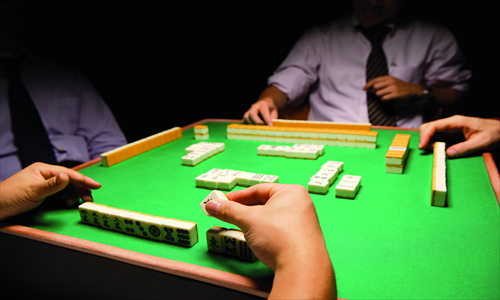
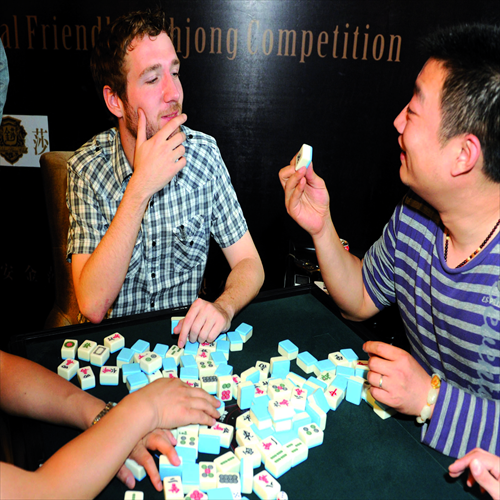
On a Sunday afternoon in a hutong off Beixinqiao you can hear the sound of tiles. Players are fetching and discarding mahjong pieces into the well (the center of the table) as they hum in Chinese "si bing" (four of pancakes), "er tiao" (two of bamboo) and "peng" (three of a kind). The four players at the table are waiguoren, but they all wish to take on Chinese adversaries at the mahjong parlor next door sometime soon.
This is the face of modern-day mahjong, which is becoming more popular worldwide. Ironically, while many Chinese youngsters might be moving away from traditional parlor games in favor of World of Warcraft and the likes, foreigners are actually taking up the Chinese dominoes.
A level playing field
With a wall of tiles in front of them, players collect, read and discard pieces as they follow instructions on a PowerPoint presentation and take notes to memorize the instructor's teachings. "My first contact with mahjong was actually abroad with foreign friends, who had learned the basics of the game from their Chinese friends," explained Manuel Morales, a 32-year-old political scientist from Costa Rica. Living in Beijing for two years, Morales took the workshop to make the best of a mahjong set he received as a gift. "I am looking forward to the next session when we'll visit the parlor across the street to play with locals. I hope to be able to teach the basics and play again with my foreign friends too," Morales said.
47-year-old Linda Shell is nimbler than some of the beginners. She first learned mahjong in Singapore with a group of foreigners who got together every week to play. "Mahjong is actually similar to the Western card game Gin Rummy in which we also improve our hand by forming two types of sets (meld) of three or four and eliminating cards (deadwood)," noted Shell, who is from the US. "When I moved to Beijing I realized there were nuances to the game and I'm taking the workshop to learn how to play it, Beijing style," she added.
Both Morales and Shell know survival Chinese and they assure the language barrier won't hold back foreigners. Instructors and players agree that different players take on the game at different paces.
"When you win, you shout woo!" said Joshua Yu, 29, an instructor. "You put down your tiles to show them to other players and collect your chips." Like many Chinese, Yu learned the game with his grandfather in his native Gansu Province. A mahjong instructor to foreigners for the past year, Yu says that people from all walks of life and ages, expats and travelers, show up at the workshops. "You can play it on the computer and you can find books in English about the game," he confirmed. "Mahjong is fun - it's a challenging game of luck," Yu added.
Fun, social, pragmatic
Xue Hua is Chinese but she joined the class as a way to practice her English skills and make new friends. "I work with foreigners who sometimes ask me to teach them mahjong. I came to learn the vocabulary of the game in English," said Xue. "This is better than an English class," she said.
Meanwhile, 44-year-old Nicholas Smith took up the game when he came to China in his early 20s. "I learned to play it from my colleagues when teaching in the countryside. Since everyone played, I thought it was a good way of socializing," recalled Smith, OBE and director of the International Festival Chorus (IFC) and the Peking Sinfonietta. "When I learned mahjong, we had to deaden the sound of the tiles by putting a blanket on the table in case a neighbor called the police to raid us!" he added. Smith himself had first observed the game back in the UK as a child when he saw his neighbors playing on the back of spending time in Malaysia.
Portuguese teacher Cristina água-Mel learned the game with her students and a group of ladies in their 50s from Macau, who were enthusiasts and astute players. "Whenever I strolled the streets of Macau I could hear the sound of the tiles coming from houses in my neighborhood and I saw people playing in the sidewalks; I got really curious about it," said água-Mel, whose known to have enraged a couple of Chinese players by beating them at their own game. "I don't play often at the parlor because I'm not fluent in Chinese and I fear I might be deceived," confessed the teacher, who bought her own mahjong table.
While água-Mel saw a lot more young people playing in Macau than she does here in Beijing, neither her nor Smith believe the game will disappear. "Board games are very popular in China and most people learn through an older family member and I believe that sooner or later, all Chinese people turn to mahjong, like they do with tai chi," noted água-Mel. "It's a form of gambling, which is in China's blood. It won't die out," added Smith with confidence.
Be the master of your mahjong universe
Quick facts
Mahjong has a disputed origin. One tale says that Confucius invented it. However, most facts seem to point to the game being developed in the late 1800s in the Ningpo area of China.
The word mahjong means "the game of the sparrows," due to the fact that the tiles, when mixed up, sound like several sparrows bickering.
The total number of tiles in a mahjong set is 108, which was inspired by a Robin Hood-style Chinese folk tale, dated back to the Song Dynasty (960-1279), called Water Margin about 108 peasants who fought the rich, corrupt tyrants and gave money to the poor.
The West got a glance of mahjong when it was launched in Shanghai and after that in Japan, America and lastly Europe.
There are no standard rules for mahjong. They vary from province to province.
A game of speed and strategy, mahjong ends with a "woo," the shout of the winner. If a player makes a mistake and it turns out that he didn't have the right hand to win, the game finishes with a "fake woo" and nobody wins.
57-year-old Chinese Xue Shengli created mahjong tiles with English letters that spell out his feelings for English mahjong.
A popular saying goes that if you were to fly over a Chinese city, you would be able to see people playing mahjong from the sky. There's an estimated 350 million mahjong players in Asia.
Beginner tips
1. Learn to group your tiles quickly - no one likes a slow player.
2. Don't let beginner's luck fool you into playing for serious cash.
3. There are as many ways of playing mahjong as there are Chinese dialects; learn to be able to win using one set of rules before you start learning variations.
Where to learn
Chinese people always learn mahjong from older family members or in their community. Several Chinese companies announce "lessons" online focused on teaching people how to win the game via qianshu, which is basically cheating and tricking to win money. You can always check out a mahjong parlor, but if you are not fluent in Chinese, chances are you'll come out with empty pockets.
Even if you do not have the opportunity to join or learn from Chinese friends or acquaintances, reliable places like Culture Yard and China Culture Center run regular mahjong workshops in English. Beginner and intermediate level classes are offered and prices range between 70 yuan ($11) to 200 yuan. Take a notebook and pen the first time you go. For more information visit: cultureyard.net and www.chinaculturecenter.org
Posted in: Metro Beijing