Get snuffed: the man who paints snuff bottles for a living
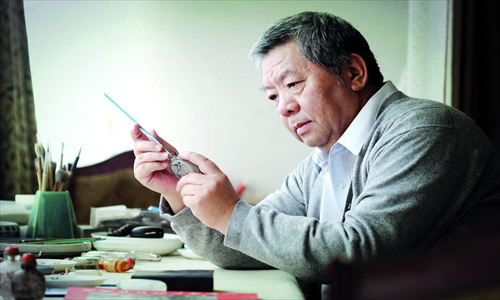
Chinese snuff bottles might not be in as high demand compared to their height during the 19th century, when people from all different walks of life in China would commonly own a bottle and offer friends and relatives a pinch of tobacco as a greeting. However, the market for snuff bottles has not died out, and as a result the technique of drawing delicate pictures on a palm-sized bottle continues.
Liu Shouben, 60, has been perfecting his bottle painting since the 1960s, after coming under the instruction of Ye Xiaofeng and Ye Fengqi, renowned masters in the field at that time. As a representative of snuff bottle painting, Zhang agreed to share with us what he understands about this unique occupation.
A coincidence
"Snuff bottle painting originated in Beijing in the late Ming Dynasty (1368-1644) when tobacco was first introduced from the West to China," Liu said. "Later this art spread into other places like Hebei, Shandong and Guangdong and formed unique styles in each place."
The use of snuff bottles, seen as a status symbol, increased and decreased during the Qing Dynasty (1644-1911). It then disappeared soon after the establishment of the Republic of China (1912-1949), but replica snuff bottles are still being made and sold at souvenir shops, flea markets, museum gift shops and abroad. It was this side of the industry that Liu initially got involved in.
He had no idea that he would stick with this profession throughout his career. For everyone in the 1960s, job placement was not in the hands of the individual but instead the state. According to Liu, because he had painting skills, he was designated to work at a Beijing arts and crafts factory at the age of 18.
"Just five to six people were responsible for painting snuff bottles at that time," he said. "All these bottles were not sold in the domestic market. Instead they were exported in return for foreign currency."
Decades later, Liu still does not find the work monotonous. "I was quite content with this stable job," he said. "And I felt that snuff bottle painting was exactly what I wanted to do in my life."
Patience is a virtue
When talking to Liu, the word that comes up the most is patience. "It might just be a small bottle, but when you have to paint calligraphy, natural landscapes and other features vividly, it takes time, concentration and patience," Liu explained.
In order to paint the tiny details, he needs to use a long piece of bamboo or a pen made from willow with a little curve at the tip. To ensure the tip remains sharp, it needs to be shaved from time to time. A maobi [Chinese writing brush] is also occasionally used to add small bits of color to the painting.
Although the painters try their best not to make errors, they are still unavoidable. "Drawing on a snuff bottle is more difficult than drawing on paper," Liu said. "Although, you can correct your painting; all you need to do is to put a little piece of cotton at the tip of the pen to clean the part you want to correct," Liu added.
"There isn't much technique for this job," he said. "If there is one then it should be patience."
Recently the bottles he uses have changed from being glass to crystal bottles. "Simply because these are non-recyclable, so it adds extra value to them," he added.
Small bottle, big ambitions
Since he stepped into this field, the numbers of snuff bottles he has painted have reached around 3,000. Some are truly beautiful, so much so that in 2003 he was awarded a gold medal of Beijing craftsmanship in recognition of his skills. "A snuff bottle might be small, but it embodies political, cultural, economic and traditional meanings," he said.
Selling is never a problem, at least not for Liu. He explained that painted snuff bottles vary in price from hundreds to thousands of yuan, with many viewing them as collector's items. The trade has therefore allowed him to feed not just himself, but his family.