Beyond the patterns
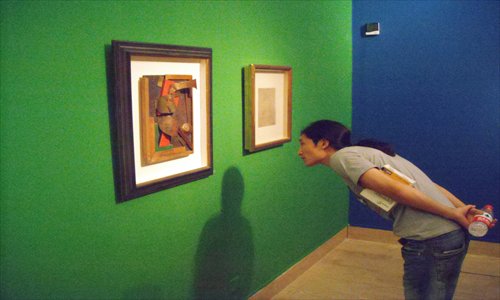
Bricks, stripes and patterns in primary colors might suggest simplicity, but the meanings behind artworks on display at the exhibition "From Malevich to Kandinsky - Constructivism in Europe" at the National Art Museum of China (NAMOC) are anything but one-dimensional. Some visitors admire the visual similarity between artworks and objects that focus on the essence of painting, such as composition and color. Yet others claim the artworks are too abstract, their meanings lost upon visitors unfamiliar with the early 20th century movement that originated in the Soviet Union.
Jointly launched by the German embassy and the NAMOC, the exhibition celebrates the influence of East European constructivism on modern art. It brings together a broad spectrum of 81 artworks, including paintings, sculptures, drawings and collages, most of which are being exhibited in China for the first time.
Constructivism artists including Kasimir Malevich, Vladimir Tatlin, Wassily Kandinsky, Alexander Rodchenko, Laszlo Moholy-Nagy and Otto Freundlich are among those whose works are on display.
Constructivism took root in the 1910s in the Soviet Union, driven by figures such as Malevich and Tatlin who were influenced by modern industry and machine structures. They honed their passion into an industrial, angular and abstract style of art.
According to Fan Di'an, director of the NAMOC, constructivism emerged as the "brand-new abstract art of its time."
"Its language was pure and simple, and the concept of 'structure' reflected the development of modern industrial civilization, as well as artists' cultural beliefs of combining art with industry," said Fan.
Kandinsky joined the constructivism movement in the 1920s as it spread to West Europe and influenced many major art trends, such as the Bauhaus and the De Stijl movements. Constructivism as a concept also spread to other fields including urban design, architecture, stage art, film and fashion. "It was an artistic sociological belief. To some extent, Europe owned the era of constructivism," said Fan.
As a style of abstract art, the appeal of constructivism isn't as universal as other forms of art. It historically struggled in particular to make inroads in China, and even today it is treated with a sense of unfamiliarity by many.
Li Chen, a 36-year-old accountant visiting the exhibition, described it as "far from my life."
"I find abstract art a little hard to grasp. I tried to figure out what the stripes and bricks symbolize, but struggled because usually they don't form any actual item at all," said Li.
"I stood and observed the titles of paintings, trying to figure out their meanings. It can be difficult. I'd appreciate a detailed visitors' guide that could offer more insight."
The meaning of artworks, however, wasn't lost on many visitors with artistic backgrounds.
Chen Mincong, a 27-year-old graphic designer, told Metro Beijing the exhibition had a sense of "familiarity" to him.
"Look at this," said Chen, gesturing at Carl Buchmeister's Diagonal Composition.
"This is classic constructivism; a conceptual painting made up with geometric abstraction. It contains no actual objects, yet manages to present the beauty of structure."
Fan said that although modern Western art has found a following in China in recent decades, many important forms of art remain unknown to most Chinese.
"Even though the constructivism movement has come and gone, its iconic artists and their works still open our artistic horizons and help us understand the relation between 'form' and 'content' in abstract art," explained Fan. "At the core of abstract art are the zeitgeists of its era. Its concepts and methods still inspire today's artists."
When: Until July 17
Where: National Art Museum of China, 1 Wusi Dajie, Dongcheng district
Admission: Free
Contact: 6400-6326