Breaking the mold
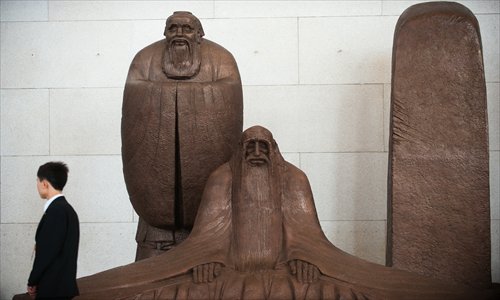
Some sculptures are cold, quiet and motionless, while others are passionate, powerful and seem to brim with life. But what all the sculptures displayed at the "Centennial of Chinese Sculpture Art" exhibition at the National Museum of China (NMC) share in common is that they reflect the country's changing artistic trends.
Jointly hosted by the NMC and the China Sculpture Institute (CSI), the exhibition commemorates the museum's 100th anniversary. More than 200 symbolic artworks created by iconic Chinese sculptors over the past century are being showcased. On display are the works of vanguards of modern Chinese sculpture art including Li Jinfa and Hua Tianyou; masters of the New China era since 1949 such as Qian Shaowu and Pan He; and the influential artists of today including Li Ming and Sui Jianguo.
Based on the historical development of modern Chinese sculpture art, the exhibition is divided into three sections: "Classical Realism," "National Independence" and "Exploring of Diversity."
The "Classical Realism" section consists of sculptures made during the Republic of China (1912- 1949) era, showing how Western-educated sculptors Li Jinfa and Hua Tianyou attempted to infuse the style of classical realism with Chinese art. Before this period, Chinese sculptors were mostly known for their freehand art style, stressing the creation of atmosphere rather than the direct representation of details.
A notable example is Li Jinfa's only remaining bronze sculpture, The Artist Huang Shaoqiang Avatar.
The "National Independence" section features artworks created between 1949 and 1980. The zeitgeist of the period is, as the name suggests, nationalism.
Perhaps the most identifiable sculpture of this age is the relief at the Monument to the People's Heroes in Tiananmen Square, as well as the revolutionary sculptures out the front of the Chairman Mao Memorial Hall that were completed in just five months by over 100 sculptors.
Finally, the "Exploring of Diversity" section features Chinese sculptors' accomplishments in embracing contemporary artistic styles since 1980. This relatively short period has witnessed growing influence from Western sculptors, while asserting Chinese art on the global stage.
Many visitors to the exhibition since it opened on July 7 have been impressed. Lin Fangfei, a 33-year-old middle school teacher and mother of a 5-year-old daughter, told Metro Beijing her horizons were broadened by what she saw. "I didn't know much about modern Chinese sculptures before seeing the exhibition, but now I've discovered some of the creative minds responsible for impressive works," said Lin.
However, other visitors were less impressed with the arrangement of the exhibition that spans several floors. "I have to say the museum can do better," complained Xu Meng, a 21-year-old college student majoring in design.
"Sculptures in the main section of the exhibition can only be observed from afar. Also, many sculptures are scattered in different zones. Why not put them together?"
CSI chairman Zeng Chenggang was eager to focus on the positives, however, insisting it's the "most systematic and complete" exhibition of Chinese sculpture art. "This exhibition not only illustrates the development of Chinese sculpture art systematically, but also presents the spirit of Chinese people across different ages," Zeng said.
When: Until December 31
Where: National Museum of China, east of Tiananmen Square, 16 East Chang'an Avenue, Dongcheng district
Admission: Free (closed Mondays)
Contact: 6511-6400