HOME >> METRO BEIJING
Very erotic, very violent
By Yin Yeping Source:Global Times Published: 2012-7-24 19:40:03
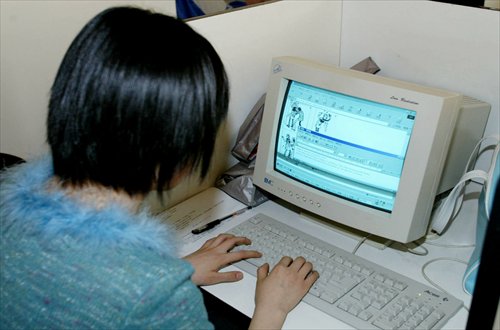
China's Internet authorities have shut down thousands of pornographic websites in recent years, yet turned a blind eye to sexually suggestive ads. Photo: CFP
China Central Television (CCTV) came under fire this month for censoring Michelangelo's nude sculpture David-Apollo. Those defending the broadcaster said the action was justified because the content was inappropriate, even though erotic material such as sexually suggestive advertisements are rife on domestic websites.
They appear on the country's most popular video-sharing websites, social networking websites and even online news portals. Images, some animated and others real, of scantily clad women are featured in advertisements that entice Web users to click on them, sometimes by luring them to play a game.
Shifting the responsibility
When it comes to deciding what can and can't be seen by China's 350 million Web users, the government's approach has been to shift some of the responsibility to Internet service providers. In November 2009, telecom giants China Mobile and China Unicom were required by law to regulate content displayed on websites accessed via their services.
The major targets that allegedly threatened social stability were pornographic websites and erotic videos, although oddly advertisements were allowed to fly under the radar and avoid the crackdown that saw 100,000 websites shut down.
Recently, the government has also called on Web users to blow the whistle on websites or online content deemed offensive by reporting them to a hotline (12321) or posting the websites' links to official Internet watchdogs www.12321.cn and www.cyberpolice.cn.
Despite these measures, it hasn't stemmed the tide of new erotic advertisements and websites from infesting the online world. In 2008, health advisory website 39.net caused a stir for showing images of Qing Dynasty (1644-1911) painting Chun Gong Tu, which depicts a sex scene between a man and woman, on the "sex health" section of its website.
Other websites use images of semi- or fully-naked women to attract hits from Web users. No matter how much controversy they draw, however, having such content appears to be legal, or at least tolerated, in cyberspace. Senior lawyer Sun Kui from the Anheng law firm in Beijing said that the main concern over images online isn't whether their content offends viewers, rather it's if their copyright is legal.
What has baffled many Web users is that on the one hand the government been determined to ensure some content, mainly written, is censored, while on the other hand it has been inconsistent in cracking down on online erotic material.
Lull after swooping crackdowns
In January 2009, China blacklisted 19 leading search engine portals, including Google and Baidu, amid concern that they "spread pornography or vulgar content, and threaten the morals of young people," the government said.
Six central agencies, led by the public security and industry and information technology ministries, spearheaded a month-long campaign to clean up the Internet of what it deemed immoral, vulgar and pornographic materials.
Cai Mingzhao, deputy director of the State Council Information Office, said at the time the government would continue to expose, punish or even shut down "infamous websites" in order to "purify the Internet."
In December 2009, the government offered a reward of up to 10,000 yuan ($1,565) to people who reported websites that feature pornography, although again no bounty was offered for Web users who tipped off sexually suggestive advertisements.
In January 2010, the Ministry of Public Security announced more than 5,000 people had been arrested and over 9,000 websites deleted for having pornographic content. Since then, however, the crackdown has seldom made headlines.
Like the CCTV saga involving Michelangelo's art, one of the most heated areas of debate is whether what is deemed "porn" can legitimately be called "art."
"Ethically speaking, a photo of a naked person should be covered with a mosaic even on a website showing art," Sun argued. "But since many people have different ideas about eroticism, there are different interpretations. Website operators know they are safe under the law if they call nude images 'art.'"
The Measures for the Administration of Internet Information Services issued by the State Council in September 2000 stipulate that any website that contains content threatening social order and stability can be shut down for spreading illegal information. Operators of offending websites can also face fines or jail sentences if found guilty.
Parental concerns in China
Apart from these regulations, some websites have their own specific guidelines for content management. The Beijing Illegal and Immoral Reporting Website (www.bjjubao.org) provides a criteria for what is considered inappropriate content. Erotic content, it says, is that which can tempt one's sexual desires or lead people to become depraved.
The State Internet Information Office and the State Council Information Office of China are the two watchdogs in this field. Wang Leyang, director of the health channel on video-sharing website sohu.com, told Metro Beijing that they need to follow their own specific internal guidelines along with the law.
"Since regulations are quite subjective, we pay close attention to providing positive, moral content and not merely pursuing greater hits from Web users," she said. "Not all news-related photos or videos are uploaded on our health channel, especially if they could have a severe or negative influence on society."
Wang said that parental settings on computers from software that limits the content children can access, such as Net Nanny, are more commonly used in the West than in China. "It's really up to website administrators to take responsibility by either providing warnings or restricting content that is unsuitable," she said.
Liu Yan, a 43-year-old mother, said she worries about not being able to control which websites her 15-year-old son visits.
"For a long time, my biggest concern was allowing my son to surf the Internet on his own without adult supervision," she said. "Even news websites have links to photos that are violent or erotic and can be disturbing for us as adults, let alone children. The Internet offers unlimited information, but it's fraught with concern for parents."
They appear on the country's most popular video-sharing websites, social networking websites and even online news portals. Images, some animated and others real, of scantily clad women are featured in advertisements that entice Web users to click on them, sometimes by luring them to play a game.
Shifting the responsibility
When it comes to deciding what can and can't be seen by China's 350 million Web users, the government's approach has been to shift some of the responsibility to Internet service providers. In November 2009, telecom giants China Mobile and China Unicom were required by law to regulate content displayed on websites accessed via their services.
The major targets that allegedly threatened social stability were pornographic websites and erotic videos, although oddly advertisements were allowed to fly under the radar and avoid the crackdown that saw 100,000 websites shut down.
Recently, the government has also called on Web users to blow the whistle on websites or online content deemed offensive by reporting them to a hotline (12321) or posting the websites' links to official Internet watchdogs www.12321.cn and www.cyberpolice.cn.
Despite these measures, it hasn't stemmed the tide of new erotic advertisements and websites from infesting the online world. In 2008, health advisory website 39.net caused a stir for showing images of Qing Dynasty (1644-1911) painting Chun Gong Tu, which depicts a sex scene between a man and woman, on the "sex health" section of its website.
Other websites use images of semi- or fully-naked women to attract hits from Web users. No matter how much controversy they draw, however, having such content appears to be legal, or at least tolerated, in cyberspace. Senior lawyer Sun Kui from the Anheng law firm in Beijing said that the main concern over images online isn't whether their content offends viewers, rather it's if their copyright is legal.
What has baffled many Web users is that on the one hand the government been determined to ensure some content, mainly written, is censored, while on the other hand it has been inconsistent in cracking down on online erotic material.
Lull after swooping crackdowns
In January 2009, China blacklisted 19 leading search engine portals, including Google and Baidu, amid concern that they "spread pornography or vulgar content, and threaten the morals of young people," the government said.
Six central agencies, led by the public security and industry and information technology ministries, spearheaded a month-long campaign to clean up the Internet of what it deemed immoral, vulgar and pornographic materials.
Cai Mingzhao, deputy director of the State Council Information Office, said at the time the government would continue to expose, punish or even shut down "infamous websites" in order to "purify the Internet."
In December 2009, the government offered a reward of up to 10,000 yuan ($1,565) to people who reported websites that feature pornography, although again no bounty was offered for Web users who tipped off sexually suggestive advertisements.
In January 2010, the Ministry of Public Security announced more than 5,000 people had been arrested and over 9,000 websites deleted for having pornographic content. Since then, however, the crackdown has seldom made headlines.
Like the CCTV saga involving Michelangelo's art, one of the most heated areas of debate is whether what is deemed "porn" can legitimately be called "art."
"Ethically speaking, a photo of a naked person should be covered with a mosaic even on a website showing art," Sun argued. "But since many people have different ideas about eroticism, there are different interpretations. Website operators know they are safe under the law if they call nude images 'art.'"
The Measures for the Administration of Internet Information Services issued by the State Council in September 2000 stipulate that any website that contains content threatening social order and stability can be shut down for spreading illegal information. Operators of offending websites can also face fines or jail sentences if found guilty.
Parental concerns in China
Apart from these regulations, some websites have their own specific guidelines for content management. The Beijing Illegal and Immoral Reporting Website (www.bjjubao.org) provides a criteria for what is considered inappropriate content. Erotic content, it says, is that which can tempt one's sexual desires or lead people to become depraved.
The State Internet Information Office and the State Council Information Office of China are the two watchdogs in this field. Wang Leyang, director of the health channel on video-sharing website sohu.com, told Metro Beijing that they need to follow their own specific internal guidelines along with the law.
"Since regulations are quite subjective, we pay close attention to providing positive, moral content and not merely pursuing greater hits from Web users," she said. "Not all news-related photos or videos are uploaded on our health channel, especially if they could have a severe or negative influence on society."
Wang said that parental settings on computers from software that limits the content children can access, such as Net Nanny, are more commonly used in the West than in China. "It's really up to website administrators to take responsibility by either providing warnings or restricting content that is unsuitable," she said.
Liu Yan, a 43-year-old mother, said she worries about not being able to control which websites her 15-year-old son visits.
"For a long time, my biggest concern was allowing my son to surf the Internet on his own without adult supervision," she said. "Even news websites have links to photos that are violent or erotic and can be disturbing for us as adults, let alone children. The Internet offers unlimited information, but it's fraught with concern for parents."
Posted in: Metro Beijing