The good emperors of China and their temple
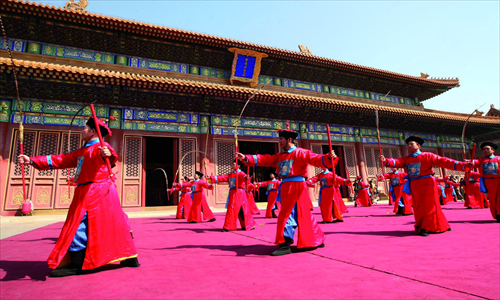
Addicted to visiting old buildings in Beijing, but tired of going to the Forbidden City and the Summer Palace?
Fortunately, aside from those well-known tourist spots, Beijing has many hidden gems among its countless skyscrapers.
The Temple of Ancient Monarchs is one perfect example.
Located on the very lively Fuchengmennei Dajie, the temple was built in 1530 during the Ming Dynasty (1368-1644).
Over the centuries it served as a place for imperial ceremonies. Today it has more than 20 historical relics and buildings made during the Ming and Qing (1644-1911) dynasties.
The temple, as its name revealed, serves no god but instead the great emperors of Chinese history, from the legendry monarchs of Fuxi and Shennong in ancient China to Zhu Youjian, the last emperor of the Ming Dynasty.
Altogether 188 different monarchs' memorial tablets have been placed in the temple.
There are almost 500 emperors from Chinese history, so how can the temple only serve 188 monarchs? How come Qin Shi Huang (BC259-BC210), the first emperor in Chinese history, was not selected?
According to Jiang Nan, who works at the Temple of Ancient Monarchs, criteria was first created in order to judge which emperors should be worshiped during the Ming Dynasty, but changed a bit during the Qing.
"When the temple was built in the Ming Dynasty, it only served founding emperors of each dynasty, but when the Qing government ruled China it changed the rule," said Jiang.
According to Jiang, they lowered the standard of entrance.
"As long as you were not a murderer or murdered and not a tyrant or responsible for leading your kingdom to its demise, you could be selected," Jiang noted.
In that case it is easy to understand why Qin Shi Huang was not selected as he is widely considered a tyrant in history.
The imperial temple has many very beautiful buildings. The main building, Jingde Chongsheng Hall (literarily meaning the hall for worshiping good governance and admiring the saints), is especially noteworthy.
Its ceiling is completely covered with delicate frescoes made from real gold, and even though it is 21 meters above the ground, you can tell the details of painted dragons on it.
The 60 pillars inside the hall also remain intact, having been made from precious Phoebe nanmu, which is a certain type of tree that does not react to humidity and heat.
As a place dedicated to serving past emperors, both Ming and Qing emperors considered the temple very important.
One example of this can be seen in the color of the roof: It is made from golden glazed tiles, which can only be used in imperial buildings.
Then, in front of the temple there are two monuments which warn officials and civilians that they have to dismount when passing the temple.
The additional buildings of the temple are also worth seeing. On the corners of the Jingde Chongsheng Hall there are four monuments for the emperors Yongzheng (1678-1735) and Qianlong (1711-1799) from the Qing Dynasty, with their articles carved on the monument.
All the monuments have giant stone turtles at the base and are decorated with dragons.
Where: 131 Fuchengmennei Dajie, Xicheng district
When: 9 am - 4 pm, closed on Mondays and Tuesdays
Admission: 20 yuan