Bumpy road facing Sino-S.Korean ties
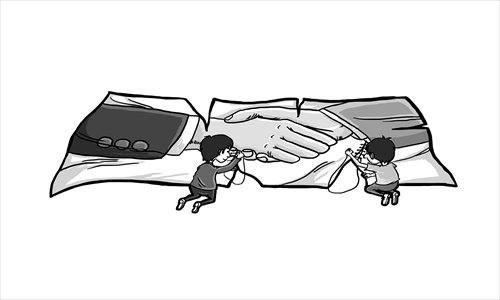
Friday marks the 20th anniversary of the establishment of formal diplomatic ties between China and South Korea. Their relationship has improved remarkably over the past two decades, starting from the level of "friendly cooperation" in 1994, going through several stages before eventually reaching the level of "strategic partnership" in 2008, cooperating on the economy and security affairs.
This quick rise of the Sino-South Korean relationship has exceeded the ties they have with many other countries. For instance, in merely 20 years, China has become South Korea's biggest trading partner, its largest export market and provider of import. South Korea has become China's third largest trading partner.
According to official data released by South Korea earlier this year, the two countries' trade volume hit $213.9 billion in 2011, taking up 19.77 percent of South Korea's total trade volume that year.
Exchanges between people have also soared significantly. South Korean statistics recorded 780,000 Chinese working in South Korea by January 1 this year, which accounts for over half of the country's 1.4 million foreign residents. The number of South Koreans working in China has reached a historical record of 1 million.
Besides, South Korea has a heavier diplomatic presence in China than in either Japan or the US.
However, due to Northeast Asia's particular geopolitical environment, differences between China and South Korea persist in sensitive areas. Issues such as North Korea, historical recognition, trade and maritime disputes have prevented the bilateral relationship from blossoming.
On the North Korea issue, the sinking of the warship Cheonan and the shelling of Yeonpyeong Island saw China and South Korea's relationship nose-dive and their political trust become severely damaged.
Arguments and controversies on historical and cultural subjects have also extended from academic circles to the grass-roots level, making people on both sides bash the other culture.
This was shown by a recent Gallup survey. Among 1,500 adult Koreans surveyed, 19.1 percent stated their dislike of China. This survey eventually put China as the second most disliked country to South Koreans, only behind Japan. The survey also noticed that this negative impression of China has been rising.
Similarly, a recent poll by the Chinese newspaper International Herald Leader found around 40 percent of Chinese respondents had reservations about South Korea. These emotions will no doubt bring a huge impact to the two countries' relationship if they are allowed to spread freely.
China's trade deficit with South Korea will also influence their economic cooperation. Trade imbalance between the two has long been present, but has become exacerbated as economic cooperation has deepened. In 2011, South Korea enjoyed a trade surplus of as high as $45.7 billion over China.
Disorientated bilateral investments, a lack of protection of intellectual property, and trade protectionism will also restrain the two countries' further cooperation.
Apparently, disputes over the sovereignty of Suyan Islet and other such disputes in the East China Sea could realistically bring down the two countries' relationship.
Under the influence of wider international politics, the climate between China and South Korea will constantly be affected by external elements like US interference.
But overall, the two are becoming increasingly close. This is particularly evident in terms of economic cooperation, as the two are closely dependent on each other.
However, Northeast Asian geopolitics centering around the North Korea issue and the relationship between the two Koreas will have a pivotal impact on future relations between China and South Korea.
The two countries, due to various differences in their national situations and development paths, inevitably have disparities or conflicts in their communication. But these problems are not unsolvable. If we look at the first 10 years in their two-decade relations as a honeymoon period, then the latter 10 years was a period in which their ties gradually matured.
At present, the priority for both countries is to work out plans that can be generally accepted by both sides to overcome these obstacles. The two will also need to readjust their mutual understanding, while building on and consolidating existing avenues of cooperation.
In the mean time, China and South Korea should aim at improving public opinion toward each other. Leaders should strengthen their political understanding and enhance strategic mutual trust. Only in these ways can China and South Korea's strategic partnership truly become fruitful for both sides.
The author is a researcher of Northeast Asian affairs with Jilin Academy of Social Sciences. opinion@globaltimes.com.cn