Playing dress-up
On a bus crossing the city under dim street lights in the evening, two young men who had just boarded were stunned at the sight of a woman sitting in the back. She was wearing an ancient Chinese-style costume and hairdo, as if she belonged to another era.
"Can you see that woman?" one man, who was possibly wondering whether she was a ghost, asked his companion. "Yes, I can," the other man replied. The two men turned their heads and cautiously asked the woman, "Can you see us as well?"
When Zhong Ying, a 21-year-old fan of traditional costumes, shared this anecdote, she couldn't help giggling. "The woman is a member of our hanfu [literally, the clothes of Han people] group, and that day, she was on her way home from a group presentation on traditional costumes and customs for the public in an outdoor park."
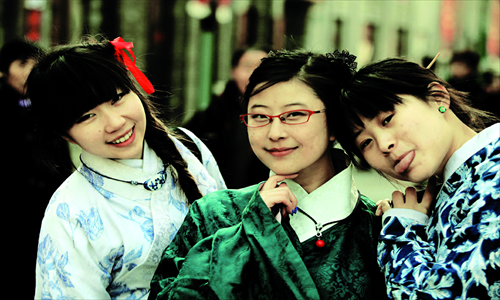
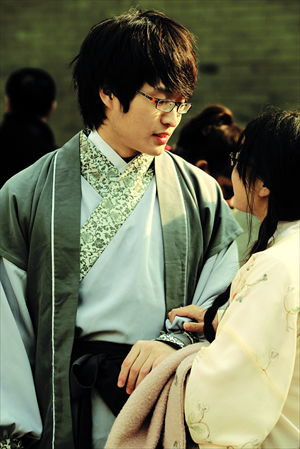
Young people's enthusiasm for hanfu and Han culture has prompted the rise of a hanfu movement in recent years. Enthusiasts in Beijing regularly hold about 10 activities a year on different occasions such as the Mid-Autumn Festival and the Qingming Festival.
"We believe that the appreciation of the ancient costumes plays a crucial role in the revival of the Chinese civilization," Zhong said.
History in today's trend
The hanfu movement was initiated in 2003 when a man named Wang Letian attracted attention when he wore a homemade traditional costume and walked down the streets of Zhengzhou, Henan Province.
Nowadays, you can find dozens of communities revolving around traditional clothing on the Internet. "In 2006, when I first joined the costume group, there were only about 10 people, but now we have 150 to 200 people actively participating every time," said Wu Jiaxian, 24, one of the hosts of a Beijing-based hanfu group on Baidu Tieba, Baidu's forum format.
Having been inspired by the classic novel A Dream in Red Mansions, Zhong has been interested in traditional culture since she was a little girl.
"I am deeply drawn to the charm and elegance shown by our ancestors," she said. Since 2010, when she bought her first traditional costume for 200 yuan ($31.52), she has participated in a number of public performances.
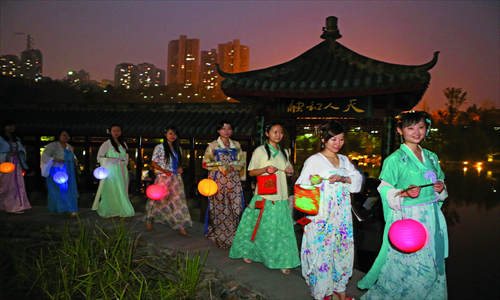
On August 23, also the Qixi festival according to the lunar calendar, Zhong, a preschool teacher who is also a pinyin tutor, took part in the Beijing hanfu group's latest activity at the Olympic Park in Haidian district.
This holiday is known as the Chinese Valentine's Day, and is based on a legend that the daughter of a goddess fell in love with and married a mere mortal. When they were found out they were turned into stars far away from each other as a punishment. Once a year, the stars come together, on the Qixi festival.
During the event at the Olympic Park, which saw more than 150 people wearing ancient costumes, Zhang and her friends performed a traditional celebration of the lovers' holiday, which included a focus on the importance of needlework for girls and praying for blessings from the Cygnus constellation, where the mythological lovers meet once a year.
"As more young people associate fun with Christmas or Halloween, our own festivals fade," Zhong explained, adding that the group wants to restore the public's appreciation of these forgotten Chinese rituals.
For Wu, the hanfu movement can also evoke patriotism in Chinese. "It is not simply a replication of ancient items, but a behavior that can inspire us to once again recognize our splendid past," she said.
Debates over definition
The term hanfu was invented to distinguish this style of clothing from qipao, the typical clothes of the Man ethnic minority, or Manchus, during the Qing Dynasty (1644-1911), which have been widely accepted as traditional Chinese dress. However, the definition of hanfu has stirred up some long-existing disputes.
"People have different opinions on which costume styles should represent the Han people and Han culture," said Chen Cheng, a magazine editor who has done extensive research on ancient costumes in East Asia.
Some argue that the clothes of the Ming Dynasty (1368-1644) should be dubbed hanfu, as this was the last era in which the traditional clothes of Han people appeared. This type of clothing was banned by the Manchu emperors of the Qing Dynasty.
But others, like Chen, disagree.
"Since the Han people were the ruling class during several periods including the Han [206 BC-220 AD], Tang [618-907] and Song [960-1279] dynasties, the clothing of each period could be considered hanfu," he said.
However, in Chen's opinion, the clothes that are now still worn by the elderly in the rural areas of South China are a better choice for hanfu. "The evolution of this type of clothes has never halted, so it is reflected in the real clothes that everyday people in China wear in their daily lives."
Missing a larger point
Young people may feel like they belong to something bigger when they wear ancient costumes and stand in front of old temples to show their respect to the past. However, according to Gao Wei, secretary-general of the Beijing Folk Art Association, this might not be the best way for modern people to absorb the essence of ancient Chinese culture. Gao asserts that there is far more to the meaning behind the beautiful clothing.
"In ancient China, clothes were the reflection of the rigid distinctions between social classes," said Gao. "The idea of demarcating social classes, which actually goes against modern ideas of social equality and democracy, should not be promoted."
"Clothing is not the essence of ancient Chinese culture," Gao said. "Merely mimicking ancient costumes but failing to understand their deeper meaning can be problematic."