The road less taken
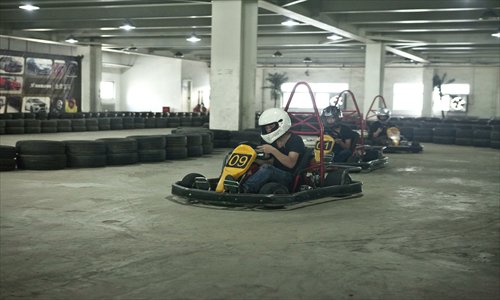
It's no secret that the dream of car ownership in Beijing has become increasingly elusive in recent years. Aside from competing with thousands of other budding motorists in monthly license plate lotteries, other factors such as limited city parking and climbing fuel costs have made getting behind the wheel more difficult than ever. But for those who want to gain a better understanding of how to drive or improve their motoring skills, then a visit to one of Beijing's go-kart tracks is a viable option.
Improving road safety
Qiu Yao, 28, is the marketing director for the indoor U-Speed go-kart track in Chaoyang district. A former member of the Off-Road Vehicles Committee under the Automobile and Motorcycle Sports Association of China, he understands the risks involved with operating motorized vehicles.
Qiu said racing go-karts is educational and can help people improve their driving skills. "There's no electronic equipment or electronic aids. Drivers have to coordinate their arms and legs while using their brain to keep everything flexible and in order. This subsequently influences driving skills. Go-kart drivers need to focus on what's in front of them and be comfortable with steering," he said.
A report by the World Health Organization released last year found that traffic accidents were the leading cause of death for people in China under the age of 45, with many of these accidents involving new drivers. The report also said that China has on average 70,000 police-confirmed traffic deaths annually, double the amount in the US.
Qiu noted the age range for go-kart racers at U-Speed was between 25 and 45, with the average age around 30. Qiu said more females, teenagers, and even foreigners are now starting to give the sport a go. "Collisions are the main risk for newcomers here, especially when handling curves," he noted, adding drivers must wear helmets and fasten seat belts.
All drivers need to experience their initiation behind the wheel somewhere, and cruising a few laps at the 450-meter track in a 160 or 200-cc go-kart can offer a safe option in a controlled environment, Qiu said. "Driving a go-kart is a preliminary driving phase. You don't need advanced skills," he said.
But others love go-karts simply because they have the need for speed. Gu Yu, 25, said the vehicles' top speed of around 45 kilometers per hour was one of the main attractions for him. "You feel like you're flying when you're driving a go-kart," the Beijing native explained.
Balancing speed and safety
The first go-kart track in China opened in the 1970s in Guangzhou, Guangdong Province. The first go-kart track in Beijing opened in 1995, and the sport has since spread rapidly across the country. While racetracks are known for their strict safety standards, accidents still happen, sometimes with tragic consequences.
The most infamous accident in Beijing occurred in 1997, when a female model died from injuries sustained after her hair became entangled in a go-kart engine. In 2001, a female college student in Macao suffered a serious brain injury when her scarf became tangled under a go-kart wheel. More recently in 2010, a 15-year-old female British student in Hong Kong was strangled to death in another scarf mishap, after it also became caught in a go-kart wheel.
The lure of go-karts is different in China compared to foreign countries such as the US, where the sport originated in 1956. During summer holidays, indoor racetracks are normally filled with students on vacation. But once school resumes, it is usually adults who flock to the small raceways.
Passion takes pole position
In a city where so many people take advantage of free activities such as dancing in public parks and squares, the cost of go-karting can be a major barrier. At the U-Speed track, 110 yuan ($17) buys you just six minutes behind the wheel. The track provides helmets and other safety gear to customers for free, but people can bring their own if they choose.
Zhang Xijie, 24, said driving a go-kart exceeds your typical car driving experience because you can literally put the pedal to the metal and not worry about being busted by police.
Her love for racing was sparked after watching the 2001 Hollywood film The Fast and the Furious based on the underground world of illegal street racing.
"The film seems to convey the idea that the faster you are, the happier you are. When you're in a bad mood you can indulge in driving, which is a good way to cheer yourself up," she said.
For a beginner go-kart driver, it helps to have a feel for what it's like behind the wheel. Experience as a go-kart driver can help reinforce the importance of paying attention to the road while at the same time honing skills such as peripheral vision and hand-eye coordination.
There's also a great emphasis on steering when it comes to driving one of these small karts. Being able to control a car steering wheel could mean the difference between life and death on the road.
Other sudden circumstances that can arise while driving a car include losing control while turning or braking suddenly to avoid obstacles. These are all scenarios a driver can learn how to better deal with from go-karting. Although instances like these can be unavoidable, they occur in a more confined environment at go-kart racetracks, giving novice drivers the experience they need to handle such scenarios with confidence.
Zhang enjoys racing go-karts partly due to the competitive spirit it instills. "I don't want to be the loser when racing others, and it's good to be able to say 'I am the best,'" she said. "Life is just like a racetrack - you never know where you can crash. You can never be too careful."
Chen Ya'nan contributed to this story