Inside ‘Little Russia’
Beijing's expat population is a melting pot of nationalities from all corners of the globe, yet many will admit to having little intimate knowledge of the city's Russian district known as Yabao Lu. Nestled east of Ritan Park in Chaoyang district, the sprawling residential and commercial hub is easily identifiable by its Kremlin-like architecture and Cyrillic signage.
In addition to Russians being one of China's 56 ethnic groups, an estimated 70,000 Russians live on the Chinese mainland, according to the country's 2010 census. Yabao Lu is home to one of the densest populations of immigrants in Beijing, rivaling Wangjing's "Koreatown."
It has been just over a year since shopping malls began appearing within Yabao Lu's former courtyard setting. Before the early 1990s, Yabao Lu had little to do with trade and was simply named Yaba (literally "mute man") Hutong - far less prestigious than its current name, which translates as "Elegant Treasure Road."
Traders today are collectively referred to as hao pengyou ("good friends"), a more endearing term than their former moniker of da daoye ("big traders"). Referred to both as "Russiatown" and the "Russian Market" depending on who you ask, Yabao Lu represents both a community and a commercial hub. Markets sell Fabergé eggs, Russian dolls, faux furs and Moscow's latest fashion accessories, while typical goods catering to Russian expats include dairy products such as sour cream and foods like buckwheat, fresh bread and beetroot.
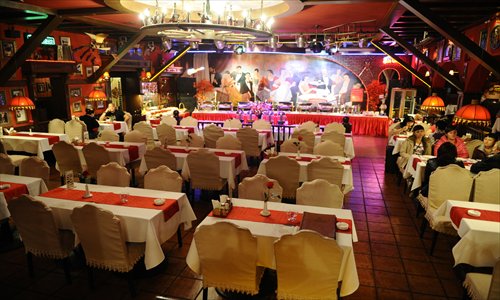
The Elephant restaurant gives Russians a taste of home both in terms of its fare, such as borsch or pork-filled cabbage, and its decor, which comprises wooden beams and red fabric.
Russian and Chinese dialects fill the air day and night in Yabao Lu, though in the mouths of both groups foreign tongues manage mostly broken speech. Rickshaw drivers, for example, are commonly seen on street corners entreating passersby with Russian greetings. This dual-form communication can sometimes make Putonghua a novelty for stall holders familiar with basic Russian.
Found in translation
Much like the reference of traders as "good friends," the cornerstone of business between Russian and Chinese stall owners and shoppers is companionship.
Arsen Yegiazsaryan, 30, has lived in Beijing for one year and is among the few independent business owners in the district's Tianyu Dasha mall. The wristwatch seller of Armenian descent told Metro Beijing he seldom feels like an outsider.
"Chinese locals treat me as one of their own. One of my best friends is a business owner named Yu Bilei. He helped me a great deal when I had to register my business because it was extremely difficult for me. I spoke no Chinese then, nor any English," he said.
Though he now can converse in Putonghua, Yegiazsaryan said he, like many other Russian-speaking expats in Beijing, would like to become more familiar with foreigners of other nationalities. "I would like to make friends with more Western Europeans, but I do not speak fluent English. This is a problem for many of us here," he said.
Xiao Suihui, a Chinese owner of an electronics store in Yabao Lu, describes his Russian as "only very basic." However, both Yegiazsaryan and Xiao have, like most traders, learnt what they know of each others' languages out of necessity for business.
For Russian-speaking expats, their flagship publication is Yabao, a free, monthly magazine founded by businessman Mikhail Obletnikov as a Russian-language alternative to other expat magazines. Yabao, like its many English-language equivalents, can be found in most Russian restaurants and grocery stores.
Cultural differences in commerce
Fashion constitutes the biggest trade industry in Yabao Lu, with outlets on the district's northern Shichang Jie currently enjoying booming business for mink furs as Beijing's temperatures drop.
Artem Teymurazyan, a 26-year-old Russian trader from the Black Sea coastal town of Sochi, said he regularly shops and dines at Yabao Lu. Asked what might define the community in Yabao Lu, he said it was "really all about business," adding there are also cultural idiosyncrasies to be found in the unique neighborhood.
"Westerners are generally targeted more aggressively as consumers in Beijing, but in Yabao Lu people will allow you to browse without pressure to buy," he said.
One exception to the Russian district's seemingly isolated status is the well-known nightclub Chocolate, an underground venue that typifies the modern Russian club scene.
Chocolate's owner, Svetlana Lustina, told Metro Beijing many foreigners and Chinese alike are drawn to Russia's party culture. "It's not about how you look, but how you party. Russians are known to be friendly," she said.
The latter stereotype isn't always universally accepted, however, among some people in Beijing's expat community. Asked whether Russians and others from Central Asian countries tend to keep to themselves abroad, Lustina conceded they were a close-knit community but denied they sought segregation.
"I think Russians do strictly the opposite, as they can meet Russians anytime and anywhere. Becoming friends with Russians is really easy because they are sincere and they will come and meet you if they like you," she said.
Searching for solidarity
Citing the basis on which Chinese and Russian residents find common ground, Chocolate's manager, Elizabeth Martinonycheva, said the Chinese "definitely have a different mentality" compared to their northern neighbors. "But they understand culturally what it means to fight for a stake in business and in life generally. I think this is something that both Chinese and Russians can relate to among one another," she said.
Muscovite Ksenia Korneeva, 23, said Russia's diaspora often find themselves stranded culturally in what can be an awkward middle ground. "I think Russian people don't find it very easy to identify with the East or West. Besides language barriers, many Russians are still not curious about the world beyond their borders," she said.
"I, like others of my generation, was told early on that I had to learn English and look abroad to get ahead. Russia is opening up, one generation at a time. I feel I can relate to almost anyone, but I like to stay familiar with Russian people in Beijing because there is an understanding about what we and our families have been through that you don't feel with Westerners or Chinese."