Old site, new life
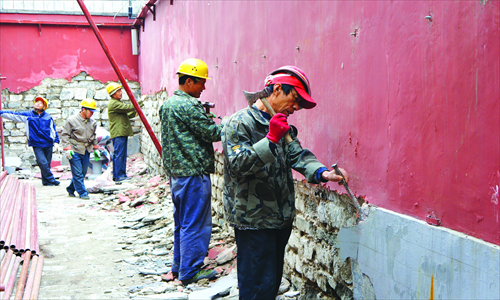
At Zhihua Temple near Chaoyangmen, a site that has been standing since 1444, the sounds of hammers pounding and shovels scooping up sand fill the courtyard. As one of the best-preserved wooden structures from the Ming Dynasty (1368 - 1644), the temple has survived the centuries thanks to a little bit of help. Since 1958, the Beijing municipal government has spent a lot of money renovating it. Then, on October 8, the temple closed once again for more renovation.
Zhihua Temple is not the only site to be given a touch up. There are many ancient sites across the capital that are crumbling. In some instances people step in to make sure they remain standing, renovating them using the same materials and techniques that they were built with. Metro Beijing wanted to know just how easy this is.
Repairing the old
Xue Jian, the Zhihua Temple curator, really wants to prolong the life of ancient architecture and protect relics, both for tourists and for general safety. The central job is to repair weathered parts of old structures.
At present, the temple has turned into a construction site. In the courtyard, several workers shovel piles of sand and sift them through a propped up screen. Deeper into the yard, scaffolding has been erected around Wanfo Ge, an attic where Buddhist sculptures are exhibited.
The main spots that are under renovation are the second floor railings of Wanfo Ge, the yard tiles and the walls around the temple, explained Yang Zhiguo, head of the business department at the Beijing Culture and Museum Communication Bureau.
Exposed to the outside world, the wooden railings on the second floor of Wanfo Ge have weathered over time. Some pieces of wood have become rotten as well and one pillar has become slanted, Xue explained.
The tile floor in many locations of the temple has also worn down, Yang said. A new path is being paved from the gate to the attic and a few tiles will be changed inside as well.
Golden rule
Zhihua Temple should look new and yet still old by May 2013. This is the key to renovating ancient buildings. Namely you should "fix the old like the old," said Qu Luzheng, the vice curator at the Temple of Heaven.
Cultural relic departments need to be careful when renovating ancient buildings because if they change too much, the buildings will lose their authenticity.
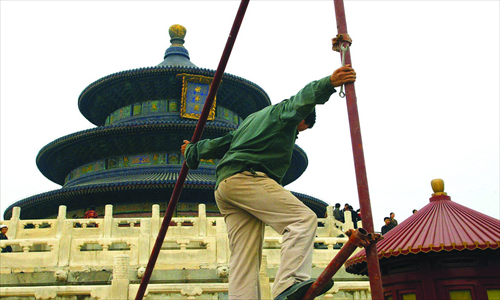
The Temple of Heaven located in Dongcheng district has seen a fair share of renovations over the years. Qu told Metro Beijing all the main attractions inside the temple have been renovated in the past 10 years, such as the echo wall and the temple walls.
When renovating the Temple of Heaven, a team of specialists examined historical photos as well as original walls that remained intact, Qu said. In the 1970s, when the walls were renovated, some of the tiles on the rooftops were made of cement because of the lack of funding. It did not look so authentic.
This time, in order to ensure it looked close to the original Qing Dynasty (1644 -1911) style, the specialists made tiles based on images and descriptions from ancient books. They also used fir and red pine underneath the tiles, in the style of yonder, Qu said.
Similar work has taken place at Zhihua Temple. Xue said that pine wood, the original material of the building, has been used for renovating the railings and pillars. For the path leading to the attic, the same ancient paving technique is applied.
"Jinzhuan mandi is the technique we are using for paving the path. It's the same technique used in the Forbidden City," Xue said.
Simply speaking, the technique is to make bricks that are exactly the same size using ancient techniques. After the bricks are laid out, they are soaked in raw tong (a type of tree) oil, giving the floor the look of being lined with shiny golden bricks.
Issues with renovation
The idea of using ancient techniques to renovate relics is seen as desirable, Xu Yitao, a professor at the Peking University archaeology department, told Metro Beijing. But there are some flaws as well.
"For example, the technique of making 'gold bricks', that's always been done, there's no mystery to it, but the question is whether it can be achieved in practice in today's context," he said.
Xu said when renovating, the construction team is affected by money and deadlines. Renovating relics often needs a lot of time and effort and should be treated like a research project. They need to look into ancient books, study original techniques and decide the best one to apply.
Xu highlighted another issue that generates much debate, namely the distinction between renovation and reconstruction.
The rebuilding of the city axis aroused controversy and many spoke up against rebuilding gates and ancient architecture that had been completely demolished over time.
"This shouldn't be debated too much. Rebuilding architecture means preserving lost culture. It's different from preserving relics with renovation," he noted, showing which side of the debate he stood on.
The more important issue professionals and officials should consider is whether rebuilding will hurt existing relics, Xu said. For example, when rebuilding a gate, if foundations are found underground, it's best to not rebuild and protect the site.