HOME >> METRO BEIJING
Stripped of dignity
By Liu Meng Source:Global Times Published: 2012-10-22 20:10:06
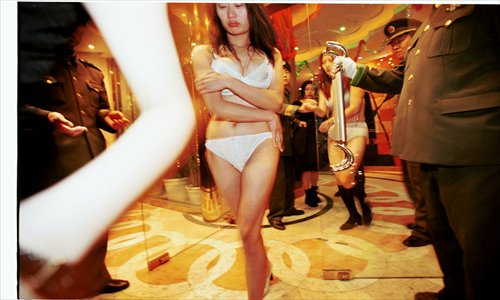
Police interrogation of nude suspected prostitutes is common nationwide, however the latest such scandal in Beijing last week was stoked by a false photo. Photo: CFP
Editor's Note:
The story Nude questions prompt naked fury appeared on Metro Beijing's front page on October 17. The accompanying photograph of the story was sourced from the homepage of news portal v.163.com, which depicted a plainclothes police officer interrogating a nude suspected female prostitute. The image of the woman standing next to a bed, her head bowed with her long dark hair covering her breasts and hands covering her genitals, triggered online fury last Tuesday. The photo was linked to a video on the website that was aired by a public security news program on the science and education channel of Beijing Television. The video showed an anti-prostitution raid by police on a health club in Yayuncun, Chaoyang district. Though the face and nude body parts of the arrested woman were pixilated, many Web users were outraged at the humiliation inflicted on the suspected prostitute. However, the photo was later proven to be unrelated to the raid by Beijing police.
The story:
A flurry of online comments posted under the video questioned why the police officer did not allow the woman to dress before his interrogation of her.
A Web user from Nanchang, capital of Jiangxi Province, even alleged that such an action was tantamount to soliciting a free prostitution service.
Xia Xueluan, a sociologist from Peking University, echoed that it was improper for police to question both the naked woman and her suspected client, a naked man who appears in the video squatting and handcuffed, without allowing them to dress.
Lü Xiaoquan, a lawyer from the Beijing Zhongze Women's Legal Consultancy and Service Center, said that the suspected prostitute and client had the right to sue the police for not being allowed to dress before questioning.
The back story:
I understood the views among Web users that police had crossed a line of decency. But I also wondered whether police had a motive to question suspects without giving them time to dress, such as gathering testimonies before either had a chance to concoct stories.
The media officer of the Public Order Corps refused my request for an interview and Zi Xiangdong, spokesman for the Beijing Municipal Public Security Bureau, could neither provide further details nor comment on the way suspects were questioned.
Metro Beijing's search for answers became even more hopeless after Wang Dawei, a professor from the Chinese People's Public Security University, also declined to comment because he insisted he wasn't the "right person" to speak on behalf of police.
Police did not respond to Metro Beijing until October 18, day after the story had gone to print.
They claimed that the plainclothes police officer in the photo uploaded on v.163.com was not from their squad, but was a Vietnamese policeman.
By October 21, v.163.com had taken the video off its website.
Using Google's search by image feature, whereby a photo is uploaded and its original source is traced, I found the image used by v.163.com had indeed been taken from a 2010 news report about a Vietnamese policeman's questioning of a naked suspected prostitute.
The apparent motive of v.163.com in using the image on its website was to generate greater interest in the story, which it obviously did.
It presented the image as a still from the video, which it was not.
However, the video did show Beijing police questioning two suspected prostitutes, both of whom were naked.
Since September 2010, Beijing police have launched a monthly crackdown on prostitution on the 11th day of each month, the Xinhua News Agency reported.
Before raids are carried out, police often tip off the media so they can attend raids and report arrests made.
Footage of raids aired on television is always censored to protect the identities of suspects.
However, it is still obvious from the pixilated vision that suspects are often questioned while nude.
Reportage of police tactics in questioning and detaining suspected prostitutes have routinely drawn public ire from people outraged at the lack of sensitivity and dignity given to those arrested.
The practice of Chinese police questioning naked women at raided brothels is hardly uncommon.
Infamous cases that caused similar public uproar include a raid in Zhengzhou, Central China's Henan Province, on October 28, 2009, when a police officer was photographed holding a nude suspected prostitute by her hair, and police raids on beauty parlors in Haining, East China's Zhejiang Province, on June 8, 2010, that yielded photographs of suspected prostitutes and their clients handcuffed and heads bowed.
Though Zhengzhou police later claimed that the photo was not publicized by them but by a reporter accompanying police on the raid, it did little to dial down the public's anger.
"Inhuman … law enforcement officers need to be civil when enforcing the law too," stated a Web user regarding the photo on Chinese online forum NetEase.
Another source of anger from the public over police raids on brothels is the sense of gloating they perceive follows such swoops in addition to sympathy for women deemed at the bottom of society.
"This society was not ruined by prostitutes, but by those people who can claim expenses [government officials, businessmen]. If they did not exist, then prostitutes would not have a market," a Web user commented on a story about the Zhengzhou raid.
"If you want to get rid of the root of the problem, then society must first arrest these people. What use is arresting a few prostitutes?"
Wang Lei, a law professor from Peking University, told China Central Television in a report it aired on the Zhengzhou raid that human rights should be respected and protected, regardless of people's race, gender or suspected criminality.
"Women's rights are especially protected in China. Nobody can insult them with their power," he said.
While the public outrage at Beijing police over questioning nude suspects overshadowed v.163.com's lack of media ethics in using a fake cover photograph for its story, calls have again been unanimous for police around the country to improve their handling of suspects detained in anti-prostitution raids by allowing them to dress before questioning.
Posted in: Metro Beijing