Mime of the times
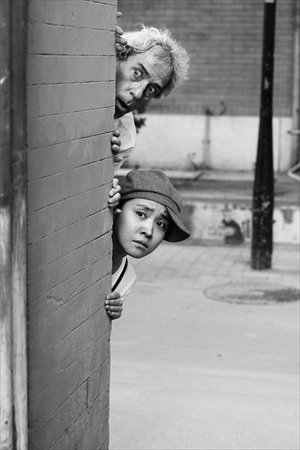
First-time viewers of French mimer Philippe Bizot's performances are often instantly captivated by his showmanship. Using simple makeup to whiten his face and brighten his scarlet lips, the mimer can depict a carefree schoolboy behaving restlessly in a classroom, a sorrowful lover awaiting his partner or a dying elderly man. Besides drawing laughter from the audience, what Bizot enjoys more is helping the audience bring their imaginations to life.
"Miming is not acting, it is living. It is an emotional yet universal language," said Bizot, who is in Beijing to stage four shows with two students from the end of this month.
Speechless spectacle
Having traveled the world over the past 40 years, the 60-year-old dramatist has performed in theaters, on streets and in mountainous villages. His audiences range from professional theater performers to blind, deaf and autistic kids.
"It used to be my dream to become a mimer, but now after all these years it has become my responsibility to make people like mime," said Bizot, who decided to be a mimer at the age of 8. Fresh from his South America tour, Bizot hopes his month-long performance stint in Beijing with his two students - Wang Xiaohuan, 25, from China and Jang Ye-la, 31, from South Korea - will attract more people to the art form.
Miming, a performance art that dates back to Ancient Greece and Rome, requires performers to silently act out stories through body language. Though many people mistake miming as a comic-based performance art, skilled mimers can act out stories spanning many genres.
In modern China, the most well-known mime act is Eating Chicken, which was performed by Wang Jingyu in 1983 at the Spring Festival Gala aired on China Central Television. The show, which used only body language to depict a scene of a man devouring chicken, made Wang a household name overnight.
However, few other Chinese dramatists have embraced the Western performance art. The careers of notable domestic mimers You Benchang, Wei Zongwan and Wang Deshun are all the more remarkable considering there are no miming courses offered at Chinese drama schools.
Master and apprentices
Wang Xiaohuan, or "Happy Happy" as Bizot calls her because of her joyous personality, is the French master's first Chinese student to work with him in productions. Wang performed mostly in dramas and short films after she graduated from the Central Academy of Drama in 2009.
It was her attendance at Bizot's performance 30 Years of Silence two years ago that mesmerized her.
"His performance made me feel calm almost immediately. It was so mysterious, and a single moment of eye contact made me feel like he was talking directly to my heart," she told Metro Beijing. "The stories remind me of my own experience. It seems they lead me into a dream from the onstage silence."
After the show, she participated in Bizot's workshop to fine tune basic skills such as concentration and expression with body language.
A year later when Bizot returned to Beijing, Wang and Jang, who is studying her master's degree at the Central Academy of Drama, started staging their first show Invisible Bridge with Bizot at the Penghao Theater in Dongcheng district. The production, which consisted of 13 episodes inspired by Bizot's time in Beijing, touches on love, friendship and life.
"My parents were so thrilled by the show. They used to see me act in dramas, but would not say much as they did not understand all of them. But with Invisible Bridge, my father even organized a discussion group about miming with his friends," said Wang, who is from Northwest China's Xinjiang Uyghur Autonomous Region.
From Beijing to the world
The trio's performance on stage appears, upon first glance, to be simple. Yet beneath the silent charade lies the fruits of intense training. Wang and Jang, who both remain mime novices, were encouraged by Bizot to read, write, paint or dance daily to get in touch with their creative sides.
"Such activities help you observe the trivial things in life and remain curious about everything around you," noted Wang. "One really needs imagination to be a good mimer."
Jang, a dancer and actress, arises at 4 am during summer to photograph the sunrise. She also indulges in reading, watching films and reading books about psychology. "Sometimes I just stare at a photo and try to figure out the meaning of it, which can be a source of inspiration," she told Metro Beijing.
Miming is a fledgling performance art in South Korea, according to Jang, but actors usually wear masks and often overact with regards to body language.
"Miming must come from your heart. More often than not we are asked to look inside to see what we have. When you have stories or something to reflect on, you try to share it with the audience," Jang noted. "Bizot has been telling me that to be a good mimer I need to be quiet, elegant and mysterious. I need to be able to catch the beauty of everyday life from observing everyone and everything around me."
Wang agreed, saying that actors in plays or films often yearn for more people to see them. But in miming "you just want to look into yourself," she said.
After their month-long performances under the tutelage of Bizot wraps up, the trio plan to embark on a world tour next summer that will take them to South America, Indonesia and Pakistan.
"Miming has changed me in many ways. It teaches me to observe the finer details of life," said Wang, a smile creeping across her face. "I used to walk down a street with my head down, but now I look up see the beauty in nature."
As mime remains a relatively obscure performance art in China, there are few opportunities for Wang and Jang, who is preparing to return to her studies, to perform. In Bizot's absence, Wang admitted she will have to return to working as an actress to make ends meet.
"I still need to make a living, but I hope that I can continue to mime," she said.