A skyscraper boom: The view from below
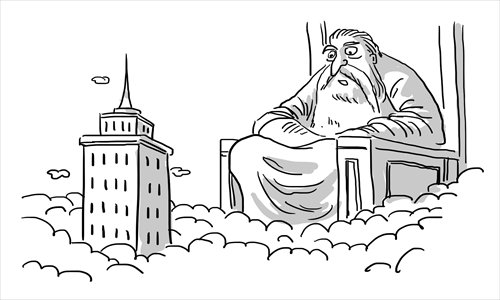
A special boom is quietly taking place in China, as a host of skyscrapers mushroom on the mainland.
With its daunting technical challenges, the skyscraper is one of the best indicators of a country's industrial development. There can be no compromises of safety, and it symbolizes the phase of development a country is in.
The Empire State Building in New York demonstrated the rising power of the US in the 1930s. In addition, the Golden Bridge over San Francisco Bay, and many other landmark structures told the rest of the world that the US was a world power to be reckoned with.
Such success stories are now being repeated in many countries, particularly in emerging market economies. For obvious reasons, the urge for emerging economies to assert themselves through majestic landmarks is more pronounced than that of developed countries early in the 20th century.
Putting up a skyscraper is thus not just a sign of vanity. Instead, it marks a nation's urge to reassert itself.
In China, doing something monumental is compared to the writing of a magnum opus. Thus, skyscrapers are considered the most brilliant phrases in the dense and enigmatic text of an urban layout. Without them, the text is dull, drab and prosaic.
For any city, skyscrapers are part of the attraction for capital inflows and foreign direct investment, if not in reality, then at least in perception. A city can hardly be considered modern without skyscrapers, a subway network, or many other fixtures such as mega-shopping centers, posh hotels and residential apartments. To a great extent, skyscrapers are a symbol of modernity.
The mushrooming of skyscrapers is also a result of the Chinese system. Local governments are, as a rule, deeply and directly involved in the economic development of their jurisdiction, not just in the mapping of urban expansion and development, but also in sponsoring and direct financing of skyscrapers. Urban development also means a great deal for the performance evaluation of officials.
In major cities, such as Shanghai, Guangzhou and Tianjin, land scarcity is a major constraint, particularly in the city center. Land prices are more expensive, but the cost of a skyscraper is lower per square meter. With modern technology, a building of 150 meters or above, or roughly 50 stories, should not be considered anything special in terms of design and construction.
However, the cost of operation and maintenance could be high, and will be normally passed on to the tenants. The major problem is that increasingly, skyscrapers are treated less as a means to reduce land cost than as ends in themselves. In this regard, real estate bubbles could be a cause for concern.
Nevertheless, I do not think it appropriate to write off skyscrapers for fear of bubbles. Given the vast regional differences in China, demand for office space differs from city to city. Even within the same city, the demand for property in the center is very different from in the peripheries. And this is true of skyscrapers.
Do skyscrapers precede market crashes or the bursting of real estate bubbles as a rule? Such crises do happen. There have been cases of the completion of a skyscraper being immediately followed by a market crash, or a real estate bubble bursting. While this is not inevitable, it is not far wrong to say that there is some correlation. Nobody will build a skyscraper in a no-man's land, and investors will be willing to put their money into it only when a particular city has been booming for a while. This is a very rational risk consideration. That is why developers are likely to bring up the rear due to the normal risk considerations. Contrary to expectations, however, the developer of a skyscraper could do it right at the end of the business cycle.
The attractiveness of a city does not rest with skyscrapers. There are a number of very livable cities that do not boast these architectural titans. It is the overall investment climate that attracts investors. This includes environmental protection, the quality of the air and water, law and order, social harmony, and many other ingredients that make a modern city. Therefore, local officials should take care not to lose their bearings when they are busy putting up a multitude of signposts to showcase their achievements.
Also, the taste of those in charge of urban development is key. There are some cities that have very strange buildings, which are costly to build and aesthetically repellent. If the overall urban design is not satisfactory, and if the skyline is less than pleasant, a skyscraper can hardly be a redeeming feature. Some local officials are eager to demonstrate their avant-garde sense of urban landscape, but the result may not be encouraging or appreciated by the general public.
The author is chairman of the Supervisory Board, China Investment Corporation. opinion@globaltimes.com.cn