Couple vs. Wild
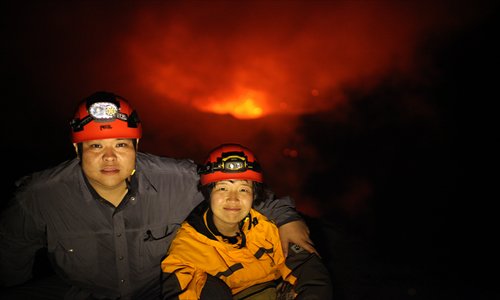
Adventurer Zhang Xinyu, 35, stared ominously into the boiling depths of Mount Marum on Vanuatu's Ambrym Island in the South Pacific. Lava bubbled deep inside the volcano's crater like a giant, frothing hot pot. The sky was dark and the ground trembled beneath his feet.
He carefully strapped on his safety harness and abseiling equipment before slowly beginning the five-hour descent into Mother Nature's inferno. About 270 meters from the bottom, he stopped atop a flat surface and took out the Chinese national flag from his bag. His fiancée, Liang Hong, snapped a photo to commemorate their milestone as the first Chinese to set foot inside the 1,900-year-old volcano.
Zhang recounts his November adventure from the comfortable surrounds of his office in Shuangjing, Chaoyang district, as coolly as if recalling a documentary he had watched on the Discovery Channel. Tall yet stocky with a dark complexion, Zhang doesn't immediately come across as an adventurer, nor does Liang, 34, a softly spoken slender woman with auburn-tinted hair.
Zhang and Liang recently capped off a memorable 2012 that saw them visit Oymyakon, Russia, the coldest place inhabited by people on Earth; Chernobyl, Ukraine, site of the world's worst nuclear disaster; lawless Mogadishu in Somalia; and some of the world's most dangerous active volcanoes in the Pacific Ring of Fire. Their goal is simple: to boldly go where no Chinese have gone before and document their experiences on camera.
No frontier off-limits
Zhang's natural sense of curiosity always led him to take the road less traveled. When he was in middle school in Langfang, Hebei Province, he bought his first car, though it didn't come from a dealership showroom.
"I saved 3,000 yuan ($481.50) and bought parts from a recycling plant to build the car," he explained.
More adventurous than academic, Zhang failed his final exams and had to repeat a grade in middle school. However, it allowed him to meet Liang, and the couple soon started dating.
After college, Zhang and Liang came to Beijing to make a living. In 2002, they started a business selling tofu-making machines. Within a year, they had amassed their first million yuan.
"He was a very devoted businessman and was always hard-working," Liang said of her fiancé. "There was one month in 2008 when he booked 26 flights and 12 train and two boat trips."
Zhang's turning point came following the 2008 Wenchuan earthquake in Sichuan Province that claimed nearly 70,000 lives. In the wake of the disaster, he led a team of volunteers at the quake zone and helped in rescue efforts for 10 days.
"He was at the frontline and saw many deaths, especially of children," Liang recalled. "After he came back we had a talk. He said life was fragile and could end at anytime, so we decided making money isn't a meaningful way to live."
Zhang and Liang then began planning trips around the world. They overlooked popular tourist hot spots, such as Europe and the US, in favor of destinations off the beaten track.
From 2008, they began learning how to sail, fly an airplane and scuba dive. Last year they set out on their international odyssey, starting by camping in Oymyakon in February, visiting Somalia in May, touring Chernobyl in August and coming face to face with Vanuatu's smoldering volcanoes in November.
Brushes with death
Before every trip, the couple researches their destination and what skills are necessary for survival. For example, before heading to Chernobyl they learned how to minimize the risk of being exposed to nuclear radiation.
Before descending inside Mount Marum, they attended a talk with experts from the Volcanic Research Center in Beijing and learned about eruption cycles. After their trip, the couple brought back "Pele's hair" - volcanic glass threads formed when molten particles are spun by the wind into hair-like strands - and donated their sample to the research center.
Despite taking all possible safety precautions before putting themselves in harm's way, every adventure the couple embarks has inevitable dangers.
"There are many things that scare us upon reflection, but when you are in the heat of the moment you don't have to the time to be afraid. You just want to get through it," Liang said.
During their recent volcanic expedition, Zhang realized after he ascended back to the crater's surface that his backup safety cable had been cut. If he had lost his footing while descending he could have easily fallen into the over 700-C lava.
When they were in Somalia, one night the Mogadishu hotel they stayed in screened a Champions League soccer game on TV in the lobby. Zhang wasn't interested and went back to the couple's room. Later that night they heard gunshots, but dismissed the ruckus as locals celebrating the result of the soccer match.
It wasn't until the next morning when they saw holes in the hotel lobby's door - the result of a shootout between rival gangs - that Zhang realized just how close he had come to being caught in the crossfire.
'Cultural ambassadors' on a quest
Earlier in the same trip, the couple had bought a SIM card for their cellphone. A couple of days later, Liang received a text message demanding $100,000 or else face being kidnapped.
Nervous, the couple immediately asked the hotel to increase security and changed their travel itinerary. In the end, they successfully took a plane out of Somalia.
Wherever Zhang and Liang venture, they capture their experience on film to ensure a lasting legacy of their journeys to some of the world's most unforgiving corners.
In Oymyakon, the couple camped outdoors in -52 C. Wearing layers upon layers of clothing, they woke each other every hour to do simple math to ensure they could still think logically. When they came out of the tent the next morning, they were both covered in a layer of frost.
But Liang said she's most proud of the fact they filmed the experience for 10 hours straight.
In Somalia, they found surprising links to China.
"Our goal was to show people there's more to Somalia besides piracy, which is all anybody talks about," Zhang said. "We ended up discovering many things that were associated with China."
Since the Chinese embassy closed down during the Somali Civil War in 1991, there have been few Chinese nationals in the country. Nevertheless, the couple met a Somali who spoke Chinese, found a tape of revolutionary "red songs" at a media center and met a doctor who studied at the University of Wuhan in Hubei Province at a hospital built by Chinese workers.
Zhang is already planning the couple's next trip to the South Pole, via five continents.
"We'll set off from Beijing at the end of April and take one-and-a-half years to get there, passing through 20 countries," he explained.
While such globe-trotting doesn't come cheap, Zhang insists the experiences he shares with his wife-to-be are priceless and are part of a much bigger mission.
"We hope to be cultural ambassadors, offering a piece of China to these places and bringing back other cultures to China," he said.