Gulou demo
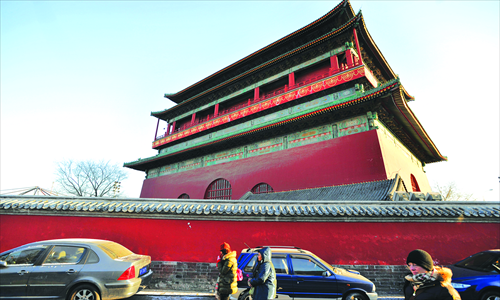
The Zhonggulou neighborhood, better known as Gulou, is slated to be demolished to restore the original size and outlook of the Drum and Bell Tower Square in Dongcheng district.
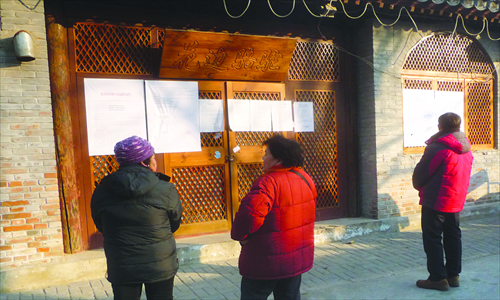
A sign in the window of the House Levy Field Office in the Gulouwan Hutong reads, "In the Zhonggulou neighborhood, we have been old neighbors. In the Shaoyaoju compound, we will be friendly neighbors."
Shaoyaoju in Chaoyang district is the new residence area where the 136 households from 66 courtyards are to be resettled, according to the Dongcheng district government.
Outside the office, on one of its walls, posted demolition and compensation plans have been torn down, an evident protest to the new plans.
The district government announced in a press conference earlier this month that the 66 courtyards in Gulou Dongdajie and Xidajie, Zhonglouwan Hutong and Doufuchi Hutong are to be torn down because they are illegal structures built in the 1970s and have almost no historical value compared to more authentic courtyards in other parts of the city. The demolished area will be used to restore the square and widen roads. The move is also intended to improve the living conditions for residents of the cramped courtyards.
Since the announcement of these plans, Gulou has been in the spotlight, with activists accusing the government of destroying the city's cultural heritage.
While the Dongcheng District Government said more than a fourth of the families have accepted a compensation package of 44,361 yuan ($7,115) per square meter to move out, a majority of them are still waiting it out in order to strike a better deal with the government.
The real purpose behind the demolition and renovations remains a mystery to residents.
On the chopping block
The Drum and Bell Tower neighborhood dates back 700 years when the towers were first constructed to help locals keep time. They ceased to function in 1924, and then became a historical and cultural site thanks to the Drum Tower's unique wooden structure. Nowadays it is one of the few lively neighborhoods in Beijing that showcases the authentic, old Beijing lifestyle in hutong, and therefore a popular tourist site for both domestic and foreign tourists.
Views are mixed on whether the courtyards should be demolished to make way for a larger square. Long-time resident Chen, in her 60s, who lives in on one of the houses in the No. 64 courtyard of Zhonglouwan Hutong, was loading her family's furniture onto a truck on Friday afternoon. She's part of the one-fourth who has accepted the compensation deal.
"The houses should really be demolished because they are too shabby to live in. They are not proper courtyards as there is no yard at all," said Chen, who shared a house of 30 square meters with the four generations of her family. "My mother-in-law is quite happy to move since she has never lived in an apartment before."
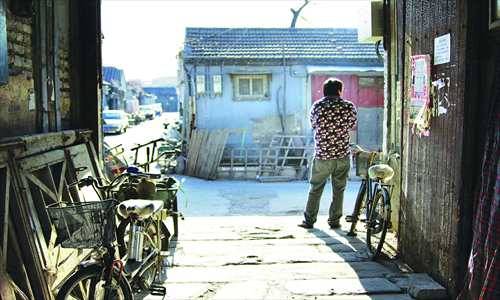
Wu Wei, an amateur photographer and real estate developer from Beijing, disapproves of the plan. Wu has made several visits to the area since he heard of the latest renovation plan and took Friday afternoon off to take some photos while the natural light was good.
"The Gulou neighborhood is an architectural complex and what it shows is the vivid, everyday life of native Beijing people. A historical place should be about the people living there," said Wu.
"Even though people here are living in cramped houses, they are still striving to make a better life, and that is the human side of old Beijing," Wu said, pointing to several foam-padded boxes placed outside of one courtyard and filled with earth to grow plants and vegetables. "See, that is what old Beijingers are like. They are trying to make a happy life for themselves and those are the scenes that me and my follow amateur photographers would like to capture."
"I would call it 'Qianmenization,' and the renovated Gulou will take the same fake outlook of the renovated Qianmen area," said a local café owner originally from France who asked to stay anonymous. Having run his Gulou-based business for more than two years, he is reluctant to move and is still looking for a new location. Rent in the neighboring area of Nanluoguxiang is much higher than his current place.
Wu said, "Whenever a tourist comes to Beijing, what they most want to see is the hutong. Without hutong there isn't much to see in Beijing."
Having worked in a demolition company in Beijing for about 10 years, Wu said he also disagreed with the logic of the demolition plan.
"If they think the houses are too cramped to live in, they can ask and compensate a certain number of households to move out and make space for the others," Wu said. "From my work experience, there is no need to demolish them all."
A questionable purpose
News about the renovation of Gulou has been going around for some time. Rumor had it in 2010 that the area would be converted with a 5-billion-yuan budget into a "Beijing Time Cultural City," comprising of restaurants, parking spaces and a museum about timekeeping technology. The plan was scrapped because of a "last-minute shift in upper-level city management that realigned the necessary guanxi," according to an article in the April 2012 issue of Time Out Beijing.
New plans to simply restore the square have aroused suspicion among both cultural heritage experts and locals, and rumors are circulating that the demolished area will eventually be converted into modern, expensive courtyards.
Although locals have been ordered by the Dongcheng district government to move out by February 23, there is no fixed timetable for the renovation or any design plans made public.
The Dongcheng Commission of Urban Planning said it has all the required legal rights to seize the houses, and that design plans would only be mapped out after the courtyards had been cleared out, according to a Beijing News report.
He Shuzhong, founder of the Beijing Cultural Heritage Protection Center, accused the local government of having ulterior motives. He told Metro Beijing last week that the move is "tourism development done under the banner of preserving historic relics" and that history and culture will be destroyed in the process.
"The government overlooked that the houses are also one important component of the whole hutong complex and it would do no good to preserve the city's cultural streets if they are torn down," He said.
A female in her 60s surnamed Zhang lives in a hutong near Zhonglouwan and has strong childhood memories of the area. She said the square was about the same, 4,000-square-meter size it is today when she was growing up and the only difference is that it was a more lively place for locals back then.
"When I was a child, the square was scattered with storytelling folk artists and stands selling different snacks," Zhang said. "The square was not that big, but it had the atmosphere of living in a hutong. If they are going to build a new, modern square, I'm sure it won't have the same atmosphere as before."
Li, a male resident in his 50s living in No. 58 Gulouwan Hutong, also voiced concerns.
"The road is supposed to be extended by five meters, but my courtyard is 20 meters in length. Why would they want to destroy the whole house?" said Li.
Besides, he pointed out, the local government spent a large amount of money renovating some of the courtyards on Gulouwan Hutong back in 2009.
"If they knew they were going to tear them down, why did they waste the money and effort then?" Li said.
An owner of a café near Gulou who asked to remain anonymous told Metro Beijing that the area would be used by a Chinese real estate company to build brand new courtyards. He worked with the company on another project and he received his information from real estate experts he knows inside the company.
Ma, who runs a souvenir shop nearby, said she heard the same news. The newly-built courtyards several blocks away are sold at 380,000 yuan per square meter. Displaced residents would get about 40,000 yuan per square meter, said Ma, so it's no wonder why a lot of people don't want to move.
Compensation qualms
Households in the area can get 44,361 yuan per square meter as reimbursement and are entitled to buy two- or three-bedroom apartments in Shaoyaoju at about 7,000 yuan per square meter. Those who move out earlier can receive extra money as an incentive.
However, according to housing agents nearby, the price for selling property in the Gulou area is much higher than the compensation packages - about 70,000 yuan per square meter. Meanwhile, as some of the households in the cramped courtyards occupy only 10 square meters, it is hard for them to afford a new apartment of 60 square meters or bigger in Shayaoju with the offered money.
"Most residents would be happy to move out if they were reimbursed properly," said Li Rong, 75, a retired government official who was taking a walk through the hutong set to be razed. He currently lives in Xiejia Hutong, near the Gulou area, and went through two demolition and renovation plans for his previous Deshengmenwai Dajie home in the early 2000s.
Li suggested that the government should also make the compensation plan public and let the public know how much each household will be reimbursed.
As Li continued his walk through the doomed hutong, a young man approached him, gave his mobile number and slyly hinted that Li should give him a call if he wanted a chance at sweetening his compensation deal.