Lenin lives on
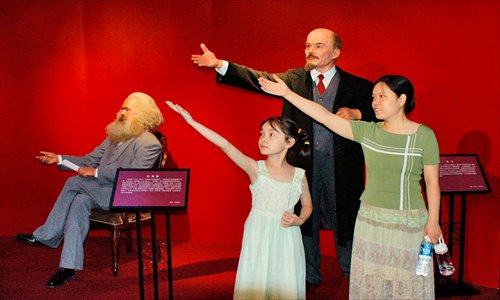
Today marks the 89th death anniversary of Russian politician, revolutionary and political theorist Vladimir Ilyich Lenin (1870-1924). Lenin is arguably one of history's most influential leaders. His communist theories and principles helped shape Maoism which, based on China's socio-economic conditions, continue to influence society today. His political ideals - steeped in the socialist, Marxist principles and bereft of any social class barriers - placed an emphasis on the common good of the people, not the individual.
Lenin's political legacy might live on, but people in China have mixed views about the man himself.
Learning Lenin in schools
"Moral education is very important for students to learn how to be good citizens," says Hao Shuang, a 23-year-old teacher at the China National Petroleum Corp. Kindergarten in Dongcheng district.
Hao says the kindergarten's curriculum doesn't include teaching about Lenin or New China's founding chairman, Mao Zedong.
"However, during class breaks or when the kids are waiting for lunch, I'll sometimes share one or two stories with them," she explains.
If you think stories about a stony-faced former Soviet Union premier aren't exactly appealing to 4-year-olds, you'd be right. To solve this, Hao recalls anecdotes about Lenin as a young boy to help her pint-sized pupils relate to the man.
Much like stories involving China's own good Samaritan revolutionary Lei Feng, most of the parables are rich in morals.
One of these includes the tale of how Lenin as a boy accidently broke his aunt's vase. Upon questioning, he denied he was responsible. His mother realized he was indeed the culprit on account of his rascal-like antics. Hoping he would come clean, she told him a story of virtue and waited patiently.
Not long later, Lenin burst into tears and confessed to his mother he had broken the vase. His mother then comforted him and told him to write a letter apologizing to his aunt. According to legend, Lenin never lied again and matured into a pure, honest man.
"I feel like they [the children] seldom understand what a great leader he was," says Hao, a hint of disappointment in her voice. "I have the duty of teaching them what is good and what is bad."
Hao acknowledges her pupils don't enjoy stories about Lenin as much as, say, protagonists whose adventures involve more than sobbing and apologizing. "Stories about superheroes or fairy tale characters are more welcome," she admits.
Another kindergarten teacher, Zhao Yueyao, recalls Lenin stories being taught to her when she was a child in a moral education class called "cultivation of ideology and morals."
"I think nowadays it's called 'life and morality' class," says Zhao, 23, who teaches at a Tongzhou district kindergarten. "I doubt if pupils realize the connection between Mao and Lenin, but that is more [the responsibility of] history teachers. I don't think I knew Lenin's influence on Mao until middle school."
Benjamin Tian, 24, originally from Shanxi Province, studies English and political science at Beijing's Foreign Affairs University. Tian says that coming from a family of teachers meant it was almost impossible for him not to learn about Mao's Leninist leanings.
Having grown up during the Cultural Revolution (1966-76), Tian's parents and others from their generation were heavily influenced by Maoist policies.
"My father agreed with most Leninist doctrines. My parents were greatly affected by them," he says. Asked if they thought Mao and modern China would exist without Lenin, Tian chuckled.
"Absolutely," he says. "Some Chinese think that without Lenin there would be no Mao."
Sinner or saint?
However, Beijing's academia is divided in its appreciation for Lenin. Zhou Xiaozheng, 66, a retired sociology professor at Renmin University of China, describes him as a "national sinner for Russia" and "criminal for China."
"He urged Mongolia, an integrated part of China since the Yuan Dynasty (1279-1368), to become an independent country. He also appointed [disgraced Chinese revolutionary] Chen Duxiu as General Secretary of the Communist Party of China [in 1921]," Zhou said. "Worst of all, he advocated dictatorship. This obviously doesn't fit with our society today, especially when we want a society ruled by law."
Zhou believes future generations should continue to learn about Leninism in Chinese history, though not in a glowing light.
"Lenin and his theory should definitely be taught in schools, but not to incite worship. Rather, to know his politics thoroughly using a judgmental eye," he notes. "I think it is stupid and wrong for Chinese to see Lenin as a hero. The fact is he is anything but one."
T-shirts and paraphernalia
Some younger Chinese in Beijing find it difficult to reconcile their own indifference towards the men who helped shape the country they currently live in.
"Of course I can recognize his [Lenin's] face," says Wang Li, proprietor of online clothing shop Peerless. Despite selling a broad range of kitsch T-shirts emblazoned with communist political leaders - including Lenin - Wang confesses to knowing "very little" about the man himself.
Wang, aged in his mid-30s, says that in terms of business he doesn't sell as many Lenin T-shirts as he would like to.
Unsurprisingly, his bestselling T-shirts don Mao's beaming portrait. "I guess it's because some people like to indulge in the past," he says.
Wang theorizes that perhaps the reason why the bald, goateed Lenin isn't as popular is because most young Chinese are unaware of him.
"After all, the former Soviet Union is so far removed from us now, as are the evils that it provoked," Wang says.
"I don't really remember any young Lenin stories [from school], but if I did it wouldn't matter because all those sorts of stories are complete nonsense."
Jiang Jie and Qian Chengya contributed to this story