Posh appeal
Imagine a team of Chinese cheerleaders bouncing up and down, pom-poms in hand, shouting "P is for Port! O is for Outward! S is for Starboard and H is for Home! Put them altogether and what do you have?" The girls likely don't know the meaning of what they are spelling out. Let's explain it to them.
What you have is an adjective depicting elegance. The word "posh" is chiefly used to describe the behavioral attributes of the British upper classes. The first recorded use of the word appeared in Punch magazine in 1918.
Back then, it meant "smart and fashionable." A popular theory holds that posh is derived from the aforementioned acronym P.O.S.H. that was stamped on the first-class tickets of passengers traveling in style on ships bound for exotic locations around the mid-19th century.
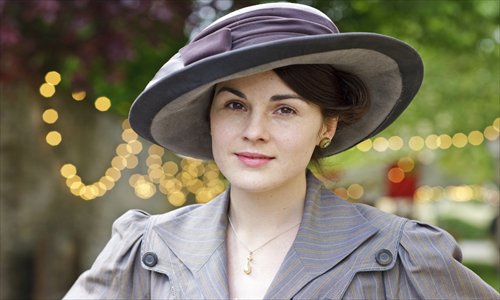
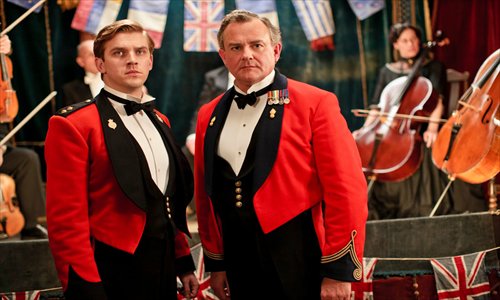
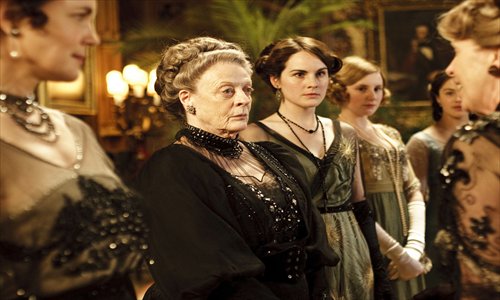
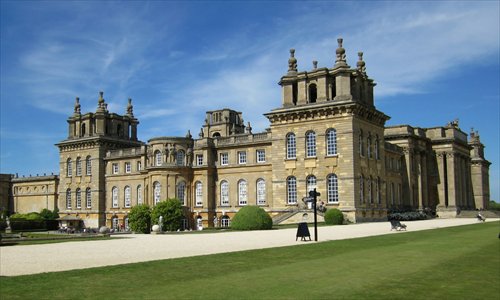
Fans of hit-Brit TV show Downton Abbey might remember that in the very first episode of the series - set in April 1912 - main protagonist Robert, Earl of Grantham, discovers to his horror that the unsinkable Titanic now lies at the bottom of the ocean floor.
Robert's heir presumptive and cousin James Crawley - no doubt with a P.O.S.H. ticket stub tucked away in the upper pocket of a tweed jacket - is now also at the bottom of the sea. Thanks to the pitiless iceberg, the issue of securing the heritage of the Downton estate has now been cast depth-wards, too. The scene is set; cue opening credits and a TV series that has since gone on to garner much critical acclaim, making Downton Abbey one of the most widely-watched TV shows in the world, China included.
Chinese cheerleaders, civilians or fans of all things British need not download, stream or fake DVD their time away any more. New Year's Eve 2012 saw Downton Abbey make its debut broadcast on CCTV 8 along with a host of other international shows. These shows will air at 10:30 pm. Monday to Saturday, averaging three episodes per day.
There's a lot to catch up on for local newcomers to the ways of English gentry life at Downton. Much has happened in the three seasons and two Christmas specials. More recently, the show was picked up for a fourth season by the ITV network in England.
Posh manners and polite courtesies are all a reflection of the supposedly civilized society the characters of Downton inhabit, which is exactly what Chinese fans want and expect. In this respect, Downton Abbey is the quintessential British export for Chinese to experience a historical sense of Britishness.
"Definitely, manners and courtesy are the two most important things for British people," says Beijing college student Yu Xiao, 21. "I just love stereotypical Englishmen. They are both cute and serious."
Like Yu, many young Chinese came to notice Downton Abbey after growing up on a steady diet of brash and sensational American TV dramas.
"It's got a special English flavor to it. I just love the British accent, which is beautiful and elegant," Yu says.
Yu was also drawn to the show because of the aristocratic lifestyle of the characters and the exquisite costumes.
Accountant Elsa Tong, 24, originally from Wuhan, Hebei Province, has strong feelings toward costume dramas both from home and abroad. However, Tong draws a distinction between the qualities of period dramas from England and ones from China.
"Downton shows a panoramic view about a family during World War I with a complex and rigorous plot," Tong muses. On the other hand, Tong says, Chinese scriptwriters have proven themselves time and again to be capable of only producing "cheap and boring domestic soap operas."
"There is still a long, long way for us to go to catch up," she says about the superiority of English dramas.
Although admitting that CCTV's decision to broadcast the period drama is bold, Tong is apprehensive about the likelihood of a botched dubbing job.
"CCTV never has good dubs. I'm really afraid the awful dubbing will ruin everything," Tong says.
The dubbed version has some Chinese fans on Sina Weibo annoyed and even irate at the prospect.
Attracting a much wider audience is something long-time Downton fan and Chinese teacher Lin Huiying, 36, thinks will harm the show's appeal. She is refusing to watch the dub.
"I prefer the original. My friends and I download it online and the subtitles are pretty accurate," she says.
Lin, from Quanzhou, Fujian Province, was so taken with the show that she started a blog about it - based on her diaries - which was later compiled and published in Wenhui newspaper in Shanghai two weeks ago.
Lin's article touched on all things Downton, but one theme that ran throughout: good British manners.
"Chinese people have never seen anything like it really," says a gentle voiced Lin over the phone. "The stories, characters, accent, manners. Even the costumes and acting are amazing."
"Manners are way more important than laws," Lin concludes. "It defines a person's character and moral standards. Bad manners can destroy a society through poor moral standards."
Posh or not, foreign or Chinese, none of this has any bearing on the potential to enjoy a well executed English period drama.
Luo Meng contributed to this story