Meteor fragments discovered
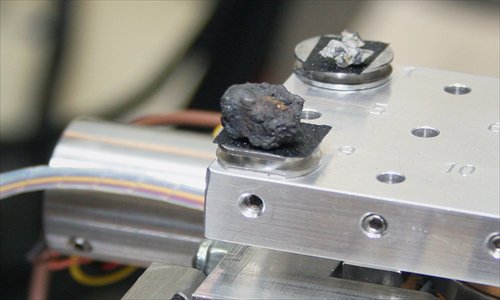
Scientists said Monday they had discovered fragments of the meteor that spectacularly plunged over Russia's Ural Mountains creating a shockwave that injured 1,200 people and damaged thousands of homes.
The giant piece of space rock streaked over the city of Chelyabinsk in central Russia on Friday with the force of 30 of the nuclear bombs dropped on the Japanese city of Hiroshima during World War II.
Recovery workers scouring a small lake where at least some of the fragments were believed to have fallen were unable to discover anything in their initial search.
But members of the Russian Academy of Sciences that conducted chemical tests on some unusual rocks on Sunday said the pieces had come from outer space.
"We confirm that the particles of a substance found by our expedition near Lake Chebarkul really do have the composition of a meteorite," RIA Novsosti quoted Russian Academy of Sciences member Viktor Grokhovsky as saying late Sunday.
Grokhovsky's Urals Federal University separately posted a statement on its website on Monday that featured a photograph of a person holding a tiny piece of porous black rock between his index finger and thumb.
"This meteorite belongs to the class of regular chondrites," the university statement said.
Grokhovsky said the rock in question was composed in part of metallic iron as well as chrysolite and sulfite. Its iron content was estimated at 10 percent. "Most likely, the find will be called Meteorite Chebarkul," the Russian university said.
The elusive meteorites fragments that have hit Earth have generated interest. Russian space debris hunters have posted ads on websites offering as much as 300,000 rubles ($10,000) for an authentic piece of the latest space rock to hit the planet.
Chelyabinsk authorities responded by cordoning off the area around the lake and not allowing any media or independent researchers hunting for meteorites near the hole that developed in its thick sheet of ice.
Grokhovsky said the tiny rock's find and 50 others like it came in the snow not far away from the lake. He also expressed confidence that a much larger meteorite was buried in its waters despite claims from the authorities that it was empty.
The lake "is still cordoned off, but it is quite clear that a meteorite is buried there," the scientist said.
"Since we found the fragments, traces of the upper layers of the meteorite, that means that its main mass is resting in the lake," he told the Interfax news agency on Monday.
AFP