Beijinger strikes his match fancy on 260,000-item collection of matchboxes
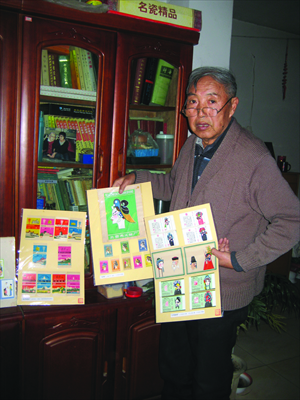
Walking into Zhao Sheng's apartment in Tongzhou district, you'd think it was a private museum. He collects matchboxes, and his flat is filled with them, on shelves, in frames, in drawers, in shoeboxes.
"I have about 260,000 pieces now," Zhao, 80, told Metro Beijing. He is known to have the largest collection of matchboxes in China. He has been collecting for 62 years, and collected items from about 200 Chinese match factories and from more than 30 other countries.
Zhao became a worker at the former Beijing Match Factory in 1951. Fascinated by the beautiful patterns and wide varieties, Zhao started collecting matchboxes and match labels as a hobby.
At first, there were only simple match labels attached to the boxes, later the labels and boxes became more artistic, with all sorts of printings on them.
Zhao explained that in 1958, Beijing Match Factory launched China's first box sets: three sets of birds, landscapes, and flowers, 12 boxes of each set. "And of course I have them," he said.
His job allowed Zhao to easily amass a collection of all the designs that had come out of Beijing Match Factory since it was built in 1906. He used to visit the matchbox markets, too, to find pieces. Later he built up relationships with collectors across the country to exchange information and collections.
Upon his retirement since 1993, Zhao started categorizing his collection according to the themes of the designs, the years and the origin city. There are more than 30 categories, including people, landscapes, architectures, birds, flowers, sports, paintings, music and calligraphy.
Zhao has one set of Dream of the Red Chamber, more than 600 pieces, with all its characters in different costumes, which he's particularly proud of. And as today happens to be "Learn Lei Feng Day," Zhao also has a set that tells the life story of comrade Lei Feng, a moral model.
He pasted the unfolded boxes and labels on special paperboard, with notes on the origins. Zhao researches the pieces by reading all kinds of files and history books. It's a major undertaking and Zhao has only accomplished one-tenth of it so far.
Carefully, Zhao showed Metro Beijing a small portion of his collection. Behind every piece, there was a story.
Among his collection, one of the most precious pieces, called "Dragon Dance," is China's first matchbox, made in 1879 in Foshan, Guangdong Province.
Many of his boxes are one of a kind. Zhao has one set specially made in 1993 when Beijing applied for hosting for Olympics. But as Beijing failed in its bid, those matchboxes were destroyed and didn't make it to the market. Zhao found the piece in cracks between stocks in the factory's warehouse after days of searching.
Zhao has many anecdotes to tell about his collection. In 1961, Zhao received an unexpected letter mailed from the Soviet Union. Inside the envelope were 11 pieces with patterns of Yuri Gagarin, the first human being to journey into outer space.
"It was signed by a Saliha (probably 'Salihi')," said Zhao, showing the note that came along with the boxes. "I didn't even know this foreigner. He probably had read about me from the newspapers."
During the Cultural Revolution (1966-1976), like many intellectuals, Zhao was criticized and denounced, his house was searched and things were confiscated by the Red Guards. Zhao managed to preserve most of his collection then by hiding the matchboxes on the roof and in the corners under other items.
Zhao's collection has been featured in about 90 exhibitions, and in the future he hopes to do more and to expand with the help of the government and museums.
"I hope I can do exhibitions overseas too," Zhao said.
"Great knowledge can be gained through these small boxes. Matchboxes illustrate how the society was then, and record how it changes," said Zhao. For example, many boxes made in the 1970s are printed with quotations from Mao Zedong, and slogans of the Cultural Revolution. There are also celebrities and politicians of the time, such as famous actress Hu Die in the 1930s, Marilyn Monroe, President Obama and others.
Zhao has written many articles for newspapers, and has given speeches at seminars and in schools. He's very glad that people are gradually realizing the importance and the pleasure of collecting matchboxes.
Many young Beijingers have become interested in it. For example, Qian Yantong, 24, a website designer in Beijing, started collecting in 2011.
"I am just a beginner, but I like them very much," said Qian.
"A person should always have something to pursue - now that's life," Zhao concluded.