Mao money, Mao problems for devoted collector
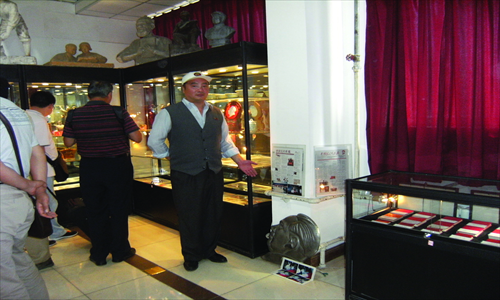
For more than 20 years, Liu Lei did one thing and one thing only: collect Mao Zedong memorabilia.
He has spent much of his earnings and stayed single for all his 50 years because there "isn't enough time and energy" for both.
Red wooden shelves stand against the narrow walls in Liu's home, full of Mao statues and badges in red, white and black. Most of the statues are busts, some with a military cap on, some not. Many small statuettes depict Mao standing and waving, a pose he took at the founding ceremony on October 1, 1949, at Tiananmen Square.
"My parents were both in the military and they collected Mao badges, which impressed me," Liu said. "As I grew up, many of the badges were lost and my mom always thought it was a pity. By coincidence, I found a gentleman who sold these things, so I started collecting."
Liu started with Mao badges, then moved on to anything related to Mao: statues, Mao's book of quotes, relics of the Cultural Revolution (1966-76) era. His collection now has about 20,000 items.
Liu found the souvenirs by browsing the red markets and antique markets often. It isn't easy to find items that are made in that era, he testified.
"I often go to a variety of collector's markets, both in Beijing and on trips to other cities," he said.
His most prized possession is a set of Mao badges signed by Kong Qinmei, Mao's granddaughter.
These badges were hung on the trains in Northeast China's Jilin Province around 1969, Liu said. Made with aluminum, these badges feature just Mao's head, each weighing 14.5 kilograms. Liu found these on a train exhibition in Jilin. He now has seven such badges.
It might have been the influence of Liu's parents that ignited his interest, Liu said, but he has sentiments about that particular era that kept the hobby going.
"I was born in 1963. I have strong feelings for Mao that are particular to that era," he said. "I cherish the memories of Mao and worship him. I admire his charisma and the things he did, including founding a nation."
Even though many people collect these items to make money on the antique or auction market, Liu said he simply wanted to remember a piece of history.
Liu welcomes contact from people who are interested in the era and is happy to spread his passion about his collection and Mao. Besides being a collector, Liu also organizes red activities, such as exhibits of his collection or the singing of red songs.
Liu currently lives in a two-bedroom in Qinghe township by himself. Throughout the years, he has persevered through much difficulty. He isn't rich; he's changed jobs many times: factory worker, small business owner, laid off for a while. Right now, he's working at a private dance school.
Liu admits keeping up his collection has been hard and has taken up much of his time, money and energy. The antique badges don't come cheaply.
Usually, badges cost about 200 or 300 yuan ($32 to 48), but that's just for the ordinary ones, not the special pieces a collector seeks.
Some of the rarer badges Liu has come across in his badge hunts can cost up to 10,000 yuan, he said. These are usually very old and hard-to-find pieces, so once a collector sets an eye on such badges, the value is up to the seller, and the collector doesn't have much choice in the matter, Liu said.
However, Liu has no regrets.
"I have never been married and don't have kids. These are prices I have to pay because of this collection," he said. "The other couple of collectors I know, they are mostly in the same state. I think it's worth it."