Breathe. Breathe in the air.
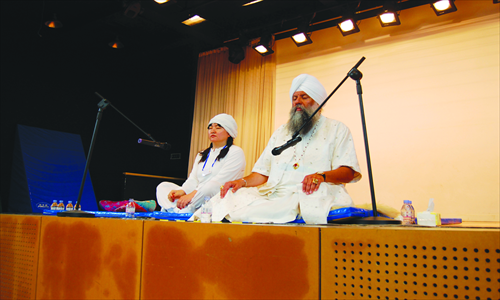

S.S. Gurubachan Singh Khalsa addresses the crowd from the stage of a large school gymnasium with a simple question. The roughly 60 students in front of him sit evenly spaced out in the meditative lotus position (crossed legged) either on yoga mats or sheepskin rugs. "How many of you are looking for happiness?" he enquires. About 70 percent of the turban-clad clan - all dressed in white, loose-fitting attire - raise their collective hand.
Gurubachan was the assistant and student of the late renowned Kundalini yoga master and spiritual leader, Yogi Bhajan. He is here in China playing chief yogi as part of a larger touring entourage billed as the Yoga and Meditation, Health and Healing Kundalini Yoga World Tour, which came to Beijing this past Saturday, March 16, for a one-day exclusive seminar (the first of eight cities in the Chinese mainland) on how to calm the mind to happiness by breathing.
As the deep orange glow of the weekend sun failed somewhat miserably to penetrate the thick smog that had engulfed it, attendees of the seminar - held at the Daystar Academy past the Fifth Ring Road on Shunbai Lu, Chaoyang district - were learning ancient breathing techniques, despite or perhaps in spite of spiked pollution levels.
Makeshift signs on the doors to the gymnasium had strongly advised teachers and parents (presumably, earlier on in the school week) to restrict all outdoor activity for children. In between these messages of warning was a promotional poster for Saturday's event. On it was a quote from Yogi Bhajan: "Why is meditating so essential? By meditating we take our garbage out."
"Subconsciously, you stop breathing even more when you breathe this pollution," says Gurubachan to an attentive group of disciples during Saturday's morning session. "We have to consciously break that habit. Because with this kind of a breath comes your health, prosperity and peace of mind."
Finding your Kundalini
There are many different types of yoga but all yoga forms are believed to elevate or arouse kundalini energy and have their origins in a foundational yoga scripture dating back to the 2nd century.
Classical yoga like Hatha Yoga puts an emphasis on different types of posture (or asana), the archetypal poses one associates with yoga. According to some forms of yogic philosophy, kundalini means the spiritual energy or life force located at the base of the spine. Other more direct definitions for the word allude to a latent female serpentine type of energy located at the base of the spine. The practice of Kundalini is therefore a system of meditation directed at uncoiling such wound up energy.
"First the body has to be purified," says Hemanth Venkatarum, 25, originally from Mysore, southwest of Bangalore in Southern India, who attended Saturday's seminar.
"We have to purify our bodies for our life and our mind," he reiterates. "How long we have air inside our body is [the length of] our life."
Venkatarum - a yogi himself - attended Saturday's Kundalini seminar out of curiosity. Venkatarum is the director of Prana Vikasa Yoga Shala (2010), a Beijing-based company specializing not only in authentic classical forms of yoga like Hatha and Raja but his very own invented yoga, the eponymously named Hemanth yoga.
Venkatarum describes the morning session by Gurubachan as "very good" but is quick to suggest that the practice of breathing in so deeply for the meditations is actually detrimental to one's health.
"The pollution here is so bad," says the young yoga instructor who admits his breathing is shorter than ever, having lived in the capital for six years now. "Any breathing yoga like Kundalini is dangerous in a place like this."
Venkatarum indicates that he has known people in his care who have suffered respiratory problems by breathing in too deeply for meditation. "I have to be careful with how I teach my students," he says.
Venkatarum observed that during the afternoon session, people were feeling cold and kept getting up to drink water.
"No one had any energy and some people were actually sleeping [as opposed to meditating]," he says. Asked if he thought it had anything to do with the heavy pollution outside, Venkatarum confirmed that he thought that it definitely was.
Coming in from the cold
Of all the attendees meditating to the dulcet baritones of Gurubachan's translated mantras, most were searching for something they couldn't quite find in their own lives. Some had suffered loss or had gone through a recent personal crisis; the common impression was that doing Kundalini would help one deal with problems of a personal nature whatever they may be.
Karolina Gillert, 42, originally from Poland, says she came to Saturday's seminar because she was going through some rough times. Her daughter has recently been hospitalized, suffering from an eating disorder. Doing Kundalini yoga seemed like a decent way to decompress from the acute personal pressures she was feeling.
"I've done some classical yoga before but this is my first time doing Kundalini," says Gillert during the hour-long lunch break after the morning session. "Usually I am energetic but I have to slow down. I've been worried sick and have been thinking a lot."
Gillert says that she was overwhelmed to the point of tears at one point during the third meditative breathing exercise during the morning session.
In person, Gurubachan (of Lebanese descent but from Ohio in the US) is tall and big, his long beard graying and imposing. However, the warm and soft-spoken nature of a practiced guru pervades him.
During the lunch break, people gathered around him like moths to a flame, disciples to a guru. Most, if not all, had a specific problem or ailment they needed advice on. One woman asked for advice on an ailment currently suffered by her husband. Gurubachan advised the boiling and eating of a certain vegetable to help.
"I don't like to see people suffer. I can't handle suffering," says Gurubachan. The reason for not including any stretches for the seminar, he says, is because anyone can teach a yoga class. "The underlying factor, and it's not just in China, is that people are under a lot of stress and people are hurting and they are looking for ways to experiment, to touch, to see what works for them."
Unfortunately, experimenting for one's sanity doesn't come cheap. One ticket to Saturday's seven-hour seminar cost 950 yuan ($158).