Last night a private DJ saved my life
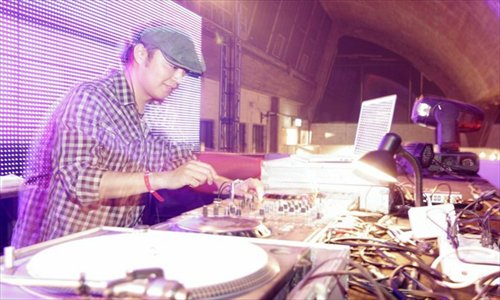
Did you ever wonder what exactly your friend meant when he or she mentioned that one of their friends was a professional DJ? By definition, the word professional implies someone who earns a living from doing something. A DJ, or disc jockey, on the other hand, is ostensibly someone who plays recorded music to an audience, but the better ones can make or break a night purely on the basis of song choice and execution.
As Beijingers jump feet first into a spring post snow with a sense of urgency and the city comes alive with parties, one should be aware that a new local breed of enterprising DJ is stalking the town. He or she could be spinning shapes at an event you might be attending in the very near future. But the question is, how would you be able to tell?
In Beijing, there are DJs of the professional persuasion and there are DJs of a more refined private persuasion. Professional DJs get paid regularly at certain venues around the city.
Private DJs, on the other hand, are a somewhat scarcer breed. They find employment solely on the basis of having the necessary skills to set a mood for an event, catering to their clients' specific requirements. They might have day jobs to supplement well paid but intermittent work, and often selflessly recommend each other's services to clients.
The private DJ community here is an intertwined network of friendly full and part-time DJs eager to serve their clients with the best possible execution of an arsenal of tunes for any given mood at any given time.
So what differentiates them from downloaded DJ software or even a playlist on an iPod?
Going private
"I developed an interest in DJing around 1994, and then in 1998 I officially became one [a private DJ]," says Li Xiu, 36, originally from Ji'nan in Shandong Province. Li's promotional blurb describes his unique specialties as "funky house beats infused with classic rock samples - great for parties with an emphasis on dancing."
Li, who works under the name X. Lee, explains that working as a pro in the bars and clubs of the capital was overall an unpleasant experience. Li says that he soon became disillusioned with the "bar owners in China who only look at money," and even goes so far as to say that the sole focus on generating cash was for owners to stuff their venues with as many women as possible.
"Their [bar owners] sense of art is reflected in their taste for girls," Li surmises. "All they want is youthful, beautiful girls. As long as the waitresses are good-looking enough to attract more clients, who cares about how the DJ is doing there?"
To preserve the natural passion he had for his hobby cum craft, Li turned private in 2007. "I just couldn't work for those fat cats [anymore]."
Similarly, 28-year-old Wei Zhigang, who started working as a DJ in 2002, decided to go private in 2009 after reaching the limits of his patience with the "chaos and mess" in the bars and clubs around town.
Wei has no regrets about leaving the bar and club scene. "DJs in bars are less qualified," he says. "If you want to excel in your work, you'd better become a private DJ."
Wei says that his main DJing commitments now come in the form of product launches, private parties and some festivals.
Pros and cons
Ironically, Wei claims that being a private DJ means that he is more professional than the professionals.
However, it is still a little unclear as to what private DJs offer over their naturally professional competitors.
"For me 'private' is not the opposite of professional, amateur is," says Beijing DJ Tobias Patrick, 32, originally from Cologne, Germany. "As a DJ in China it is easy for amateurs to get well-paid gigs in clubs or at brand openings. But as an amateur, you can be more selective and choose those gigs that fit the sound you like."
Patrick goes on to say that professional DJs who are dependent on their fees have to compromise way more in China, like spinning chart hits in local clubs such as Suzie Wong's and Mix.
"But that doesn't mean that they have less skills or musical knowledge," he says. "It's not about if you decide to make DJing your profession, or even if you decide not to. It is about how much work and love you put in your music."
Wei attempts to explain the concept of a private DJ to Metro Beijing once again but is left painting in broad undefined strokes. "When I worked as a regular DJ at bars, I just muddled along," he says. "In other words, normal DJs only work for the money, not the music." Wei claims that by going private he can now command between 1,000 and 2,000 yuan for a four-hour set. "I do tons of homework before a show so I have the right set in the right order to give them [the audience] a wonderful time," he adds.
Perhaps it is with the clients themselves where an answer for the market need for private DJs lies.
Zhu Jia, 27, a bar owner in the Workers' Stadium, Chaoyang district, theorizes that the biggest difference between a pro and a private DJ is that the latter has better skills. "You can tell the difference just by listening to their performance. A private DJ can lift the mood and highlight the whole night. They are the soul of the party." Zhu says that he has hired a few private DJs in the past and will continue to do so.
Private DJs, it seems, are more professional, passionate and prepared. Perhaps friends will be speaking of their private DJ friend, but then you might know what to expect.
Qian Chengya contributed to this story