Flop gear
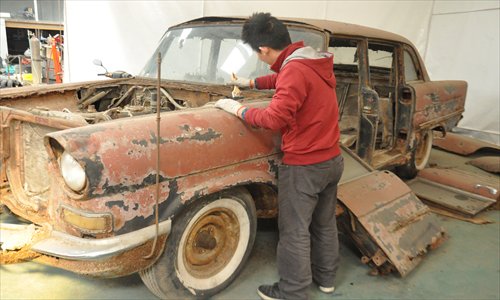
Early last year, Xu Tao received a phone call from a friend saying he had found an old Hongqi CA72 in a village near Fushun, Liaoning Province.
"It was basically a pile of steel. He saw it and asked me whether I wanted this 'piece of junk,'" Xu recalls of the 1958 model, made by China's first luxury carmaker. After negotiating for three months, Xu bought it for 3,000 yuan ($484) - a price the seller was more than happy to pocket.
The CA72, part of the first generation of Hongqi cars, is most recognizable as the early vehicle-of-choice for China's Party elite. It rolled off the production line in time for the 10th anniversary of the founding of the People's Republic of China in 1959, with Chairman Mao Zedong standing in the back of a CA72 convertible coupe to salute cheering crowds during a parade at Tiananmen Square.
As the country's first domestically-engineered car, it instantly became a symbol of national pride. It's also an exclusive prize among auto enthusiasts, with Xu saying just 202 were produced from 1959 to 1965.
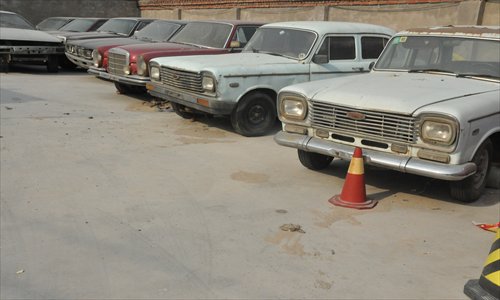
The CA72 is one of many vehicles among Xu's collection of restored classic cars in a warehouse in Daxing district.
But his cars could be destined for a dead-end under a revised law passed by the Ministry of Commerce, which could see such vehicles seized and sold for scrap metal unless they pass three consecutive half-yearly safety inspections.
Restore and adore
Xu's CA72, a shadow of its once-shiny black former self, is parked in his warehouse. Its door handles are rusty, bench seats torn out and scratched chrome bumpers appear ready to fall off.
Xu, 30, rebuilds most of his classic cars from scratch, fixing many parts by hand. Aside from the actual restoration process, hunting down rare parts for them is also part of the fun.
"I bought a bunch of spare parts from repair shops last year that were produced by the First Automobile Works, which made the Hongqi CA72," he proudly explains.
Bai Ning, editor of Chinese magazine Car Owners, bought his 1978 Citroën CX25 through classified website 58.com.
"I saw this car on the used goods section of the website. It was being sold in Qinhuangdao, Hebei Province," he says of the vehicle considered by some collectors as the "last real Citroën" before Peugeot bought the company. "This model is almost impossible to find in China."
Bai paid about 30,000 yuan for the car, but insists its value can't be calculated financially.
"You can't really put a price tag on classic cars," agrees Hou Xiaoming, secretary-general of the Classic Vehicle Union of China (CVUC), a national non-profit organization supported by auto enthusiasts, collectors and enterprises. "If you like a car, you'd pay anything. By the same token, if someone wants to buy your favorite car, you wouldn't sell it for the world."
CVUC organizes events, such as rallies and tours, that aim to raise public awareness about classic cars. In October, the group will host a tour of classic cars from Beijing to Shanghai.
But aside from such activities, classic cars seldom get the chance to hit Chinese roads because of a law since 1997 that requires cars over 15 years old to be scrapped.
One of the reasons collectors can only take pride in their vehicles behind closed doors is that China doesn't have antique vehicle registration, which in many countries allows vintage cars to remain legally roadworthy.
Reaching a crossroads
An amendment to the 1997 law, which takes effect May 1, replaces the 15-year rule with a new one stipulating classic cars must pass three safety checks in a row every six months or else face the scrapheap.
While welcoming the axing of the 15-year rule, Hou says the amendment hardly fosters classic car ownership because few such vehicles can meet modern emissions standards.
Bai notes there aren't such laws in Europe or the US, saying Chinese legislators have failed to keep up with the growing number of the country's auto enthusiasts.
"Transport laws always affect classic cars, even though no policy has specifically addressed classic car ownership since 1949," Hou says.
On the other hand, some argue the issue of safety is a key concern. With no air bags, power steering or sometimes even seat belts, classic cars simply can't meet safety standards set by modern vehicles.
"Classic cars shouldn't be using our roads because their condition can't be ensured. What if they are involved in an accident? It's too dangerous," says Hu Feng, a software engineer and cyclist in Beijing. "It's fine for enthusiasts to collect cars, but it's selfish for them to consider driving them."
Hou understands worries about safety, but claims no responsible classic car enthusiast would drive a rusty or rundown vehicle on the road.
"Without a national policy, classic car culture will never develop smoothly. Currently, most classic car owners keep their vehicles in garages and only sneak drives on remote roads once in a while," he says. "We understand the new amendment is good from a broad viewpoint, but it signals the end of the road for classic car ownership in China."
When contacted by Metro Beijing, a hotline operator at the Beijing Vehicle Administration Bureau said the department will wait until the policy takes effect before commenting on how it will be enforced.
Highway to hell
Many of the cars Xu owns haven't passed safety inspections, meaning they will continue to remain mothballed after May 1.
"I have to clean them and start them up daily. I hire people to keep up maintenance," says the full-time car collector and trader. "I only earn about 100,000 yuan per year. The development and fate of my business hinges on the law."
Hou and other auto enthusiasts have submitted a proposal to the National People's Congress and pressed vehicle administration departments for laws to be relaxed on classic cars.
Among their proposals is for classic cars to drive on high-profile routes, such as Beijing's Chang'an Avenue, on certain dates annually to raise their profile nationally.
But for the time being, Hou feels powerless.
"Classic cars in China are knocking on death's door," Hou said. "The only way to deal with the current situation is to park my car in my garage and not buy another one. But what's the point of just leaving a car in the garage?"