The tragedy of Antigone
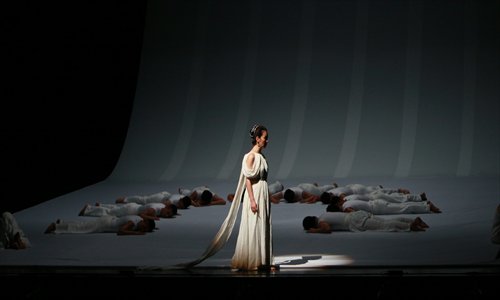
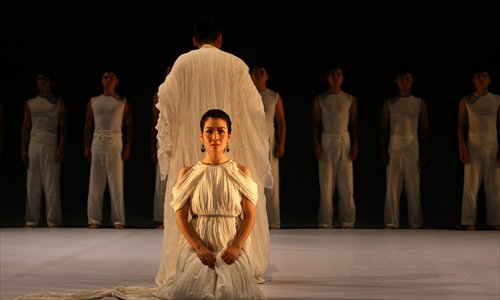
Antigone, written by Sophocles around 441BC, currently enjoys its second year of production at the National Centre for the Performing Arts (NCPA), with its two-night run taking place Tuesday and Wednesday. The play's director, Li Liuyi, says he has not attempted to adapt Antigone for a Chinese audience, instead keeping all the Greek tragedy's original themes such as incest, hubris and patriarchal oppression intact, just translated into Chinese.
Antigone begins in the wake of the death of Antigone's brother, Polynices, who after attempting to restore justice to Thebes is denounced as a traitor by its ruler, Creon. Antigone's determination to give her brother a respectful burial leads to a tumultuous battle of wills between Antigone, Creon and the gods.
Li, who has also directed Oedipus the King for audiences in Beijing, says he believes despite the play's success in Beijing in 2012, not all audiences are likely to understand Antigone in its traditional Greek form.
"Of course some members of the audience will find the play a little odd. What you have to ask yourself, however, is whether Chinese audiences can understand even traditional Chinese works of literature. Think for example about Dream of the Red Chamber by Cao Xueqin," Li says.
Dream of the Red Chamber, written in the mid-18th century Qing Dynasty (1644-1911), is one of China's most complex classical novels, consisting of more than a dozen notable characters within more than 100 chapters. Like Antigone, its lasting significance stems from acute observations of society from the time in which it is set.
Audiences of Antigone who struggle to comprehend the role of several omniscient gods in the play get a little help contextualizing important twists in the plot with a cheat-sheet pamphlet handed out at the performance. One such twist occurs toward the climatic end of Antigone, when the blind prophet Tiresias confronts Creon over his recklessness as ruler.
Li says that in order to challenge the audience without losing them, he has focused this year on accentuating the emotions of each character. Antigone and her sister Ismene, for example, develop a strong presence in the play as their worsening sibling relationship shows through the physicality of the actors.
Some readers of Antigone also claim to have found the Greek tragedy difficult to understand. Among them is Xie Sida, a 22-year-old graduate from the Central Academy of Drama in Beijing, where she majored in Drama History and Criticism. Xie describes being struck by the role of the Greek chorus in Antigone, whose traditional role in Greek plays is to collectively announce melodramatic change in the plot, often through unified movements and long speaking parts between tableaus.
"The performers in Antigone all seem to draw a lot on body language and shouting together in order to get their point across. These traditional ways of performing can easily bewilder a modern audience. The script can be sort of hard to catch at times also," she says.
Li's decision to dress the cast of Antigone in plain white togas representing those of ancient Greece may be considered an authentic touch among audiences new to Greek drama. Xie, however, believes an approach like this that tries to "build up a historical atmosphere" risks further alienating those who find a new form of theater difficult to grapple with.
"The key reason Chinese audiences can't enjoy Greek theater so easily is that there remains a huge cultural gap between Greek and Chinese literary history," says Li. "Emphasizing this to ordinary theatergoers won't do. If Antigone is meant to appeal to a wider audience, adjustments will have to be made to incorporate more familiar Chinese aspects without losing the play's plot or its message," she says.