Breaking the ice
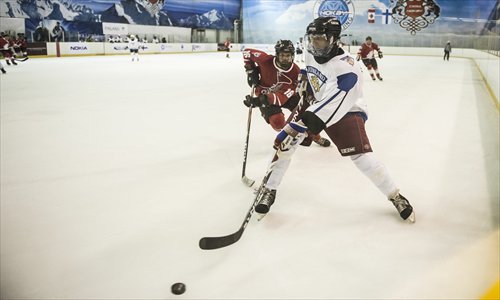
With nothing in front of him but an anxious Finnish goaltender, Curtis Dracz tears down the right flank of the rink on a blistering breakaway. The sound of his skates carving ice drowned by deafening cheers from teammates, the Canadian coolly braces himself to unleash a powerful slap shot, hoping to extend his team's 1-nil lead over their longtime foes.
The puck whistles through the air for what seems an eternity, only to be slapped away by goalie Peter Helenius.
Ricocheting off the left side of the goal, Finnish fans let out a premature cheer. Their relief is short-lived, however, as enforcer of the Canadian side James Shepheard swoops on the puck and fires from eight meters out. Goal! Helenius is left dumbfounded as cheers erupt and Shepheard's teammates flock to embrace their goal-scorer.
The game is just 12 minutes old, but Finns both on and off the ice have far from given up hope of avenging last year's defeat. Chants of, "Go, go, Finland, let's go! Go, go, Finland, let's go!" echo around the arena.
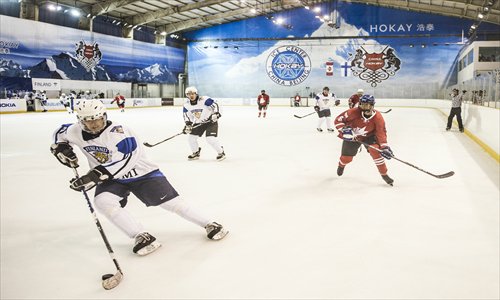
The atmosphere is electric, the smell of ice fresh and the tension at times palpable. But this isn't the Winter Olympics or even an international friendly between the two countries, nor is it in Helsinki or Toronto. It is the annual "Hockey Night in Beijing," which was held Saturday at the capital's answer to Maple Leaf Gardens: Hokay Ice Rink in Gaobeidian, Chaoyang district.
Aside from their love for the world's fastest sport, Finns and Canadians attending this year's event also enjoyed other shared passions including beer, barbecued meats and music. Established last year and boasting rosters exclusively of expats, the annual grudge match has become the biggest fixture on Beijing's ice hockey calendar. Canada, who last year defeated their Nordic foes 5-3, again triumphed on Saturday, closing out 4-1 winners.
Tickets for the game sold out months ago, with more than 700 fans filling the arena.
More than a game
Jukka Lukkarinen, one of the most vocal Finnish fans in attendance and a 12-year Beijing resident, said the bitter taste of defeat hadn't dampened spirits.
"Even though we lost the game, it was a good one. It's well organized. Both teams played very well, and the crowd was very into it," he said. "It's a pity this is just an annual event. I'd love to watch more games like this, and hopefully see more Chinese players involved."
When he's not terrifying opponents on the rink, Dracz is the director of Can Life Sports and Entertainment, an organization that promotes Canadian culture. The 26-year-old sought to join a local hockey team when he first came to Beijing four years ago, and today is one of the most active players in the six-team Beijing International Ice Hockey League (BIIHL) as captain of the Grinders.
"Hockey is not only a game to me. Its social side really helped me settle down in Beijing. No matter who you are or what you do, we are all fans of hockey who play together and share beers. It's a lifestyle for us, and has helped us form a community," said Dracz.
For newcomers to Beijing, the city can be an overwhelming place filled with countless culture shocks. Joining others who have a passion for hockey - a sport still in its infancy in China - offers a "nostalgic escape," Dracz said.
"There are many challenges attached to living in Beijing [as an expat], including learning Chinese, dealing with pollution and suffering horrible traffic. People [in Canada] always ask me, 'Don't you have a hard time in China?' But aside from missing family and friends, those challenges are nothing. Hockey brings me lots of friends. We are a big family," said Dracz.
As the anchor of China Central Television's Sport Scene program, Jonas Gilbart is better known among viewers for calling highlights of hockey games rather than playing it. The 30-year-old, who came to Beijing four years ago, said hockey is a major reason he has stayed in the city.
"I arrived here originally planning to stay one year. I probably would have left here if it wasn't for hockey," he said. "Hockey is more than just a game. It's a great community that has helped me to find friends and 'brothers.' No matter whether in Beijing or Canada, when you're in the lockerroom it's exactly the same feeling. Whenever you are abroad, you search for a sense of home. I have it here," said Gilbart.
Gilbart plays in the BIIHL for the Revs team. Games in the league, played Sunday nights from 6 to 9:30 pm, almost always end with players from both sides going out for beers.
"No matter what's going on throughout the week, you can come on Sunday night, see your friends and forget about everything else," said Gilbart.

Enforcing a softer reputation
In addition to the Grinders and Revs, the BIIHL includes the Originals, Ice Hogs, Emperors and Hot Wings. Like professional teams, Beijing's hockey elite compete for an end-of-season championship, and seasons - along with injuries - can be grueling, spanning 81 games.
Most players in the league are semi-professional. They are teachers, businessmen, diplomats, media professionals and students whose ages range from 17 to 50.
Despite the comradery off the ice, once the puck drops games are serious and roughhouse tactics common. While those uninitiated with the sport might assume Beijing has the same punch-ups that break out in National Hockey League matches, Dracz insists good sportsmanship underpins their games.
"Tension, pushing, crashing and sometimes punches are common in hockey - that's part of this competitive game. Sometimes you get really angry, but when the whistle blows you shake hands and congratulate each other on a good game," he said.
Asked ahead of Saturday's grudge match with Finland if patriotic pride could spill over into violence, Dracz laughed. "No, absolutely not," he stressed.
Although at times the crowd bayed for blood during the tension-filled game, diplomatic goodwill ensured all pride - and teeth - remained intact.
"We don't want to get penalties. You let your whole team down if you go to the penalty box for punching someone," Dracz explained after the game. "This can lead to your opponents scoring, which is why we played disciplined hockey."
Goods sports off the ice
Another reason Saturday's match lacked flying fists was that all players regard themselves as ambassadors for their sport, which they hope to promote among Chinese youth. "We didn't cross the line because we don't want to send a bad message to [Chinese] youth that hockey is a game full of fights," said Dracz.
According to the International Ice Hockey Federation, there are only a few hundred registered hockey players in China. The sport remains most popular among Chinese in the country's colder northeast provinces, although it has been growing in Beijing over the past decade.
But even if violence isn't part of hockey in Beijing, it can still be a dangerous sport.
Tom McCabe from Team Canada recalled one horrific injury that happened during a match in Beijing.
"Our teammate got hit by a puck straight in the mouth and was seriously hurt. Another guy, who is a doctor, rushed over to him immediately and helped reduce the pain," he said. "That's the good side of Beijing hockey - even in terrible moments, we are ready to help each other."
Dracz, who is also a junior hockey coach, has been encouraged by the sport's rapid growth in China.
"I coached 10 Chinese kids for eight months last year. Apart from hockey skills, I also tried to teach them more important hockey values, such as manners, respect, and saying sorry and thank you," he said.

Professional ambitions
Even though hockey holds a religion-like status in his native Canada, Dracz notes the sport still has a long way to go in China. "Every time I leave my apartment with hockey sticks, people ask me whether I'm going to play golf," he laughed.
It's these kinds of misunderstandings Dracz and his friends hope to clear up through a new ambitious project: founding a professional league.
"[Hockey in China] is not like basketball, where you have Yao Ming and the CBA (Chinese Basketball Association). It's not like football, where you have Beijing Guoan. Kids watch those guys play and follow them. I want Chinese to join this game to know what hockey is," Dracz said.
Shanghai-based China Dragon, the country's sole professional team, competes in the Asia League Ice Hockey competition, which includes teams from Japan and South Korea. Dracz's vision for the new league is a domestic competition, with two Beijing teams and one from Harbin, Heilongjiang Province.
"We plan to have one game every week, and attract 300 to 400 parents and kids to support their team and form a real league. The players need fans and fans need the players. They (fans) will watch them, cheer for them, and gradually create an atmosphere for hockey," said Dracz.