Spiritual Revolution
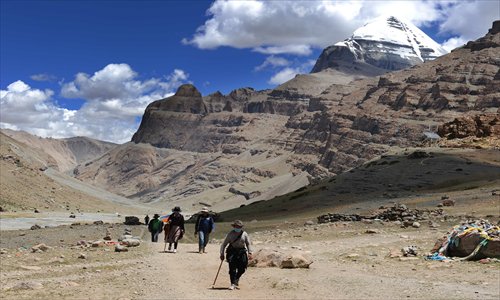
Buddhist kora pilgrims ascend Kangrinboqê Mountain in the Tibet Autonomous Region in August 2012. Photo: CFP
Yu Jiangong can't help but gush when telling others about his journey last month to the Tibet Autonomous Region. Unlike most tourists lured by the region's monasteries or snow-capped mountains, the 26-year-old bank customer service manager went to Tibet for kora, a meditative-inspired pilgrimage popular among Tibetan Buddhists.
Kora, literally "revolution" in Tibetan, is undertaken by Buddhists to absolve their sins and purify their souls. Pilgrims travel up to hundreds of kilometers on foot, walking clockwise around sacred summits - including Kangrinboqê, Anyemaqen, Gaduojuewu and Meri Snow mountains - with some even performing full-body prostrations every few steps.
In recent years, a growing number of urbanites have joined the pilgrimage. Like their Tibetan counterparts, they rough it by sleeping under the stars and risking their lives at times by braving the wilderness. They are also unified by another goal as Buddhists: pursuit of their own spiritual journey.
Yu admits he lives an "above average" life despite his young age. The married father-of-one owns a Volvo SUV and recently bought a Beijing townhouse. However, he often feels troubled despite his creature comforts.
"Many people of my age see me as a moderately successful, middle-class guy. But I feel 'lost' because of my job and family issues. I feel as if my own existence is gradually being overshadowed by clients, colleagues and many trivial things," he says. "I heard many people 'found' their true selves through kora, so I decided to give it a try."
Yan Yao, a former IT marketing manager, was lured to Tibet after enduring personal turmoil similar to Yu's. She returned to Beijing last month after an eight-day kora odyssey to Kangrinboqê Mountain, which lies in western Tibet and is revered by Buddhists as a sacred site.
Yan, 28, notes her kora was a personal challenge that tested her limits, but also allowed her to reassess values and take stock of life.
"For people used to urban lives, the unpolluted environment of Tibet is extremely beautiful yet also extremely tough. My kora journey started at about four kilometers above sea level. The high-altitude journey made every step difficult," she recalls, adding hazardous snow and frost meant she had to crawl along some parts to avoid slipping.
"The journey was too dangerous, too tiring. My only thought at the time was to conquer my hardships and finish the kora. Focusing on this helped me forget about all the other distracting things," says Yan.
"The only important thing was the journey. I had never had such an experience [in Beijing], and when I finished my kora I discovered my potential."
The pilgrimage has even given rise to a new form of "spiritual tourism," with tour guide Cui Yue helping metropolitan Buddhists conquer their kora.
"As long as you don't suffer from heart disease or high blood pressure, you can participate in a kora pilgrimage. More important than physical health is psychological strength. Kora demands strong endurance, so those who want to go on such a journey should practice long-distance running first," advises Cui, 33, adding that hygiene is often the journey's first casualty.
"Pilgrims might not shower for 10 days, and must get used to eating canned food. The most important thing, however, is not to give up."