The cheer leader
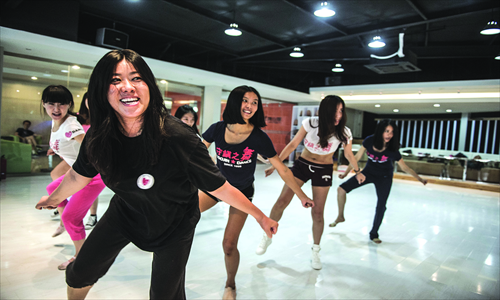
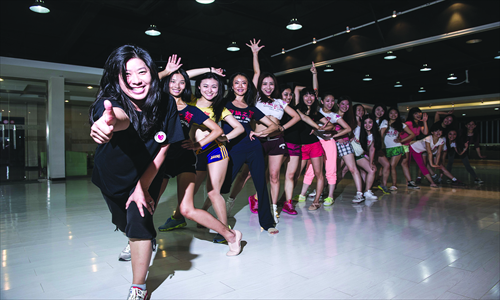
With a vivacious smile, Cho Soojin leads her team in a Saturday morning rehearsal. Photos: Li Hao/GT
The veteran cheerleading coach from South Korea Cho Soojin sat leisurely with her legs crossed at the Woo Dance Studio near Sihui while three young hopefuls improvised cheerleading dances in front of her and 18 members of the Soojin Dance Team she founded in 1999.
Next, the prospective cheerleaders were asked to follow one of the team members doing some more moves to prove that they had basic skills such as doing splits.
"That woman dances well, but she tends to have this careless attitude. She might just come for fun and won't be able to handle the hard training a cheerleader has to do," said Cho, while the other members watched the dancers closely after their own two-hour practice on a Saturday morning.
"Cheerleading is not all about skill, but also attitude. The newcomers also have to be liked by all the members - and they have the final say," said Cho, 40, of her team's democratic system for selecting new members.
Everyone in Cho's 49-member squad is part-time, and each joins and leaves the team on a voluntary basis. Therefore, recruiting from time to time is the way to keep the team going on its current schedule of weekly performances during the peak months from May to October.
After the tryouts, the outspoken and vivacious Cho spoke to the team for a few minutes about their plans for the coming weeks while joking loudly with team members, some of whom she has worked with for more than a decade.
"The cheerleaders with my squad range from 18 to 45 years old. People from the cheerleading circle and some media friends have tried to talk me into looking for more young, beautiful faces. But I would rather have someone who is serious about cheerleading - [not] just a pretty face," said Cho, whose job now focuses on running the squad and hosting instructional courses for youngsters.
"I was young and dressed sexy before, but I feel like I was selling [my] body and that is not the philosophy I want to run a cheerleading squad with," said Cho, who was dressed in a baggy black T-shirt and knee-length pants.
Cheerleading in China
First arriving in China to study Chinese in 1994, Cho, now fluent, has an impressive resume and has been in the limelight for most of her time in the country.
While she was still studying Chinese at Beijing Language and Culture University, Cho became the most sought-after foreign aerobics instructor at Beijing's private gyms and even had her own aerobics program broadcast on Beijing TV stations.
She first put together a cheerleading squad made up of her old aerobics students for the 2002 World Cup, performing for the Chinese soccer team - the first time the team had ever had cheerleaders.
Following the success of their performance, Cho was handpicked by the Chinese Basketball Association (CBA) to be its national director of cheerleading from 2002 to 2005, and chief advisor and choreographer for all sports venue performances during the Beijing Olympics in 2008, which put her in charge of 300 cheering squads from across the country.
After her tenure with the CBA, Cho focused on her own dance team, the Soojin Dance Team. Since then, she has worked to promote cheerleading among Chinese and kept busy competing with other squads to make sure her own team nabs top performance jobs.
While her squad's earlier performances were more akin to aerobics, Cho, the self-taught cheerleader who travels to the US to observe NBA cheerleading squads, has been working hard to get her teams to a professional level and to combine Chinese traditions with Western cheerleading movements such as high kicks.
Cho gained recognition as the first to incorporate Chinese fans into cheerleading routines. The dances she choreographed for the Beijing Olympics using swords as props were also industry firsts.
"I don't quite like Korean cheerleading squads as most of them put stress on the image alone. They want thin figures and pretty faces," said Cho.
"A cheerleading squad has to have its own style," she continued. "The cheerleading squad I like is one that is tightly united and the members have their own jobs. Dancing with the squad is a way for them to find joy and happiness."
Going pro
Not just dancers, cheerleaders have to be knowledgeable about the sports they perform for, Cho noted. She recalled the first few times she led a CBA squad. The members cheered for each shot the team made, and they prepared 20 routines for the games. By comparison, Cho said, professional teams only do three or four routines.
While Chinese cheerleaders are often more shy and less exuberant than the stereotypical American cheerleader, Cho has been encouraging them to be more confident while performing, even when they are standing alongside superstar NBA players.
The team preformed earlier this month for sportswear company PEAK with the NBA's Tony Parker present at one event. "I told them they are the stars and the sports turn out better with the presence of cheerleaders," Cho said.
Currently there are about four professional cheerleading squads in Beijing and 20 smaller ones - some affiliated with universities, others run within private dance studios - a burgeoning scene that Cho is happy to see. However, one of the problems with the cheerleading market is the vicious competition.
To keep the teams running, some groups perform for events such the opening of a new restaurant or shopping mall, and they lower their performance fee to edge out more professional teams.
"This has become a vicious cycle," said Cho.
Cho does not perform now as she jokingly said she is too old to be on stage, but her enthusiasm and passion for cheerleading continues with the classes she leads for Chinese youngsters.
She has been working with students from the Shijia Primary School and hopes the essence of cheerleading - being united - can be passed onto the younger Chinese generation.
"Cheerleading can transform a child and teach them to foster the spirit of unity and how to [hold themselves with] confidence, " said Cho.