HOME >> METRO BEIJING
Tuskforce leader
By Zhang Wen Source:Global Times Published: 2013-7-29 18:18:01
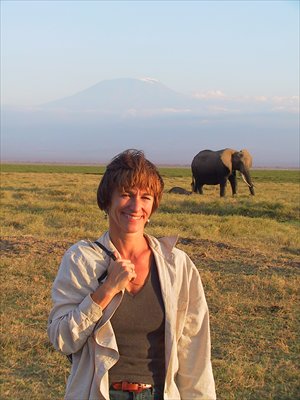
Poole's love affair with elephants began as a child growing up in Kenya. Photo: Courtesy of Petter Granli
Wearing a T-shirt with a logo featuring three elephants, Joyce Poole kicked off her maiden visit to Beijing by speaking at a seminar at the Chinese Academy of Social Sciences. Poole, a zoologist and co-director of conservation group ElephantVoices, has campaigned for more than 40 years against the slaughter and captivity of elephants.Her talk was proceeding smoothly until an audience member suggested to Poole that keeping elephants in zoos was an effective way to protect them and allow people, particularly children, to understand them better.
"Elephants are landscape species; there's no place in captivity where their needs are met. No matter whether at a zoo or circus, you're looking at them having problems. You're not 'saving' an elephant when you put it through so many years of suffering in captivity," she explained.
On July 19 shortly after Poole gave her talk, Hong Kong customs officials seized more than 1,000 elephant tusks destined for the Chinese mainland. It was a timely reminder of the devastation wreaked by demand from the world's largest ivory market.
When she talks about the suffering of elephants, Poole exudes emotion and energy.
"Every tusk costs a life. It is a misconception that tusks drop off; they need to be hacked off with an axe. Tusks are embedded deep inside the jaw of an elephant," Poole said.
Childhood in Kenya
Decades after she first began studying elephants as a 19-year-old, Poole still feels a thrill being close to the creatures.
Poole's family moved to Africa after her father accepted an appointment to lead the US Peace Corps program. He also served as director of the African Wildlife Foundation in Kenya, a posting that led Poole to enjoy much of her childhood on family safaris.
It was at Amboseli National Park in Kenya in 1963 when she first encountered an elephant in the wild.
"We were in a Land Rover and I asked my father what would happen if an enormous elephant nearby charged at our car. He told me that [the elephant] could squash the car to the size of a pea. So, of course, when the elephant came at the car, kicking up dust, I was terrified," Poole recalled of what luckily proved to be just a mock charge.
But away from her excitement and wonderment for elephants, there were also many moving moments. In 1980 when returning to her Amboseli camp from a morning of field research, Poole noticed a female elephant named Tonie standing on the open plains. She seemed alone, but upon closer inspection Poole found that she had company.
"At her feet was a dead calf. Tonie stayed with her baby, without food or water, chasing away jackals, hyenas and vultures," she said.
After two days, Poole decided to bring her water. As she drove toward Tonie, the grieving cow began to charge. But after seeing Poole pour water into a basin from a safe distance, Tonie was coaxed over.
"I was standing half out of the car pouring water as she drank, her tusks only centimeters from my head. Afterwards she reached into the car and touched me on my chest with her trunk as if to say thank you. It was an incredible moment," Poole said.
Scholar to advocate
Poaching of elephants persuaded Poole to take a stand against the global ivory trade.
"With all I have learned about the intelligence and complexity of elephants, I cannot ignore the suffering they experience," she said.
In 1998, she was called as an expert witness in an infamous elephant cruelty case that became known as the Tuli Elephant Debacle.
Using helicopters and vehicles, poachers separated 30 elephant calves from their families at the Tuli Block, Botswana. The elephants were trained in brutal conditions before being sold to circuses and zoos.
The perpetrators were eventually charged with cruelty and tried by a South African court. Poole's testimony shed light on elephants' social behavior. She also provided valuable evidence of the calves' suffering.
The trial became a landmark legal case, leading South Africa to ban the capture and export of elephants for captivity.
Poole has always been outspoken about advocating elephants' rights. Demonstrating the same resolve and courage that has seen her ward off countless mock elephant charges, she refuses to be intimidated by her critics.
"When I was a child, I used to tell the neighborhood boys off," she recalled. "When I saw them being unkind to an animal, I would say, "How would you feel if the animal was doing that to you?'"
For decades Poole has campaigned against the ivory trade, but she concedes she often feels powerless because of its sophisticated scale.
"You don't witness people actually killing elephants because [poachers] are careful not to be seen, but you see the results of their destructive work," she said, revealing that her visions of dead and wounded elephants have caused her to lose many nights' sleep.
When an elephant named Goodness she studied at Kenya's Maasai Mara National Reserve was fatally speared for her tusks in August 2012, Poole was inconsolable.
"She was such a sweet elephant and the matriarch of her family. Of her family of five, only her eldest daughter survived. Three younger calves had succumbed to predators or died of grief or starvation. Getting tusks off that one elephant destroyed the whole family," she said.
Future plans
In order to raise global awareness and combat the ivory trade, Poole founded ElephantVoices in 2002 with Norwegian husband Petter Granli.
Helping bolster the organization's presence and mission in China is actress Li Bingbing, an anti-ivory trade ambassador. Poole has even enlisted the help of American saxophonist Paul Winter.
"He used some of our elephant recordings in the song 'Elephant Dance' on his Grammy Award-winning album, Miho: Journey to the Mountain (2010)," Poole said, adding she hopes to organize "Elephant-A-Live" concerts in Beijing and New York to raise further awareness about the welfare of elephants.
Posted in: Metro Beijing