HOME >> OP-ED
Bold predictions about China’s future discern inertia of history
Source:Global Times Published: 2013-8-8 19:43:01
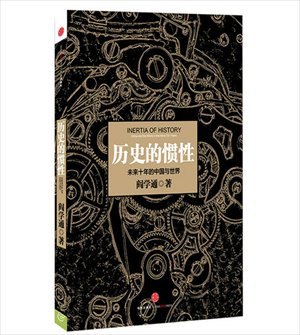
Yan Xuetong, Inertia of History: China and the World in the Next Ten Years, China Citic Press, July 2013
When everyone is discussing about how "peacefully" China is going to rise and how the Chinese dream is going to harmoniously interact with its US counterpart, Yan Xuetong, director of the Institute of International Studies in Tsinghua University, chooses not to be a mild-mannered wonk.Compared with other scholars of political science in Chinese academia, he dares to make more strong predictions in his new book, Inertia of History: China and the World in the Next Ten Years. Many of Yan's opinions subvert the traditional concepts of Chinese diplomacy, and his suggestions to the Chinese government are also boldly assertive.
This book follows the consistent style of Yan's works: straight talking, direct statements, and bold predictions. But this does not make this book irrationally radical or even extremist.
Fu Ying, former deputy foreign minister and spokeswoman and chair of Foreign Affairs Committee of the National People's Congress, provides a blurb for this book, saying it provides a "sober and objective outlook."
Yan puts a time limit on his prediction: 10 years. It's a reliable limit but a dangerous attempt. Yan takes the risk of failing a short-term prediction, but considering the accuracy, 10 years is a reasonable and feasible limit.
He combines the physical theory of inertia with the development of international relations. In the book, he points out that a nation's decline or rise, based on historical records, is always a long process.
Once a nation declines, the force of inertia will keep pushing it to decline, and it is unlikely to reverse the trend for decades or even centuries. As for a rising power, this inertia theory is also applicable.
But Yan believes in the importance of reform, which he thinks is an interior strength that is powerful enough to change the inertia of history if it persists. He also asserts that by maintaining the most high-paced reform in the world, China is accelerating its inertia of rising. In 2023, it will be on an equal footing with the US as a superpower.
Besides his optimistic prediction of China's future, Yan strikingly clarifies his outlook on the world order after 10 years.
Yan insists there will be a bipolar system in which China and the US will take the lead.
It reminds people of the Cold War between the former Soviet Union and the US. But the intensified globalization and weakened ideological conflicts, according to the book, have reduced the odds of the breakout of both cold war and "hot" war down to zero.
Peaceful competition, as he mentions in the book, will become a must.
Yan's suggestions for China's future diplomatic strategy also take a clear stance. A nonalignment policy and low-profile diplomacy are barriers that China should break through first of all.
China needs "true allies" to avoid being isolated. Such alliances will empower China to take more international responsibilities, set up a more equal and reciprocal international order, and provide more public goods.
Kevin Rudd, now the Australian prime minister, says the book is "thought-provoking." It is certainly unique, and will stir debate even as it prompts counter-arguments.
Posted in: Fresh off the Shelf, Viewpoint