Live by the Sword
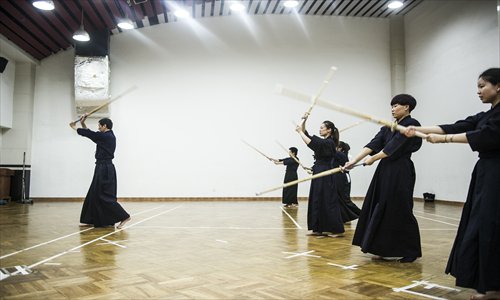
The popularity of Japanese fencing is on the rise in Beijing. Photo: Li Hao/GT
Fully equipped in kendo armor and dark blue outfit, Zhang Yi stands barefoot on the wooden floor of a gym inside the Beijing Workers' Gymnasium. His helmet is being struck repeatedly with a wooden stick by his partner, who gives a deep shout with every strike. Although he also wields a wooden sword, Zhang stays still.
"There are seven spots you can hit in Kendo and the hitting is very fast. Beginners start by practicing head strikes," explains Wang Hongning, an instructor at Jianyuanshangzhi Kendo Club.
After several strikes, Zhang switches positions with his partner and starts doing the hitting.
"It doesn't hurt because the head is well protected by the helmet," says Wang, pointing to the solid leather and cloth headpiece with an aluminum grille that shields the face.
Kendo, or Japanese fencing, was first introduced to China in 1996 by a Swiss practitioner. At that time, it was mainly expats from countries and regions around the world including Japan, South Korea and Taiwan who took part. It wasn't until around 2000 that Chinese people began joining kendo clubs as well; 2002 was the first time a promotional test was held in China, said Liu Xianzhao, 42, who manages Beijing Kendo Center.
Having learned about kendo from the Japanese anime Detective Conan, Zhang, 28, says that the martial art is a fun way to lose weight because it requires intense whole-body concentration.
"I lost 10 kilograms in the first three months. And I plan to pass the third-dan test in the next three years," Zhang said, as beads of sweat drip from his face.
In this mixed-gender practice, some women find the strikes from male partners very challenging. "I felt like I was going to faint if he kept hitting so hard," said Pan Jie, 40, who has practiced kendo since 2011.
But her perseverance has paid off outside the gym. "I feel I am able to stand up to men better because I have a better understanding of their strength and ability," Pan said.
Although there are now several thousand practitioners in Beijing, the sport is not as popular as it could be among Chinese, said Yu Ting, chairman of the Kendo Research Society.
"I think the reasons are that most people still hold anti-Japanese sentiment, and it's not an Olympic event, so there isn't much financial support from the government or media coverage," Yu said. On the other hand, he says, "I know many Westerners who are very passionate about it. Most of them were attracted by seeing it in The Last Samurai and Star Wars."
Although China has a long way to go, its kendo practitioners are catching up, says Rogier van Bijnen, 33, who has competed for the Dutch national team in three world championships.
"When I arrived in China in 2009, I could beat most of them," Bijnen said of his fellow practitioners at Yu's Kendo club. "But in the last four years, there has been a big development. The gap is closing."
Then there are those like Boris Linde, a fourth-dan Russian practitioner who sees kendo as more of a philosophy than a sport.
"It is a way of life and way of thinking. My kendo training makes me feel at ease. Funnily enough, that helps me deal with Chinese traffic."
Evelyn Cheng contributed to this story.