HOME >> METRO BEIJING
Remote obsessions
By Jonny Clement Brown Source:Global Times Published: 2013-8-28 19:53:01
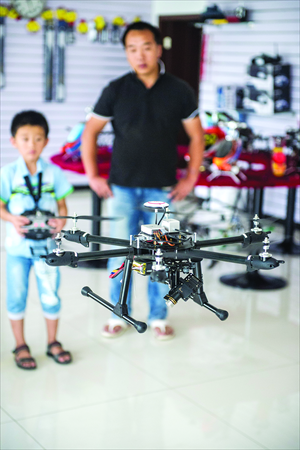
Liu Chujun shares his father's hobby. Photo: Li Hao/GT
Like a giant dragonfly pumped up on amphetamines, the radio control (RC) helicopter dips, swerves and drops precariously from the sky. The pilot Zhang Zhi, 35, is firmly on the ground - sober, silent and still. It's his thumbs that do most of the work, from muscle memory. They have no trouble maneuvering the miniature copter in the impressive way that it moves. To witness it is both exhilarating and terrifying.
Eventually the loud buzz of propellers finds a steady rhythm as the mechanical insect hovers close to the ground. It's upside down. "It took me years to be able to execute these sorts of flying maneuvers," Zhang half shouts above the din.
Zhang is manager of Golden T Airpower Model Aircraft Club, a new company specializing in the training and practice of flying RC helicopters, situated in Huangcun, a suburban satellite town 25 kilometers west of Beijing, in Daxing district.
For the club's member base, flying model aircraft, particularly helicopters, is a serious pastime and sport. In China RC hobbies are on the rise. In May, the 12th China Model Expo took place at the Beijing Exhibition Center in Xicheng district, attracting over 20,000 industry professionals and model enthusiasts. In September the Shenzhen Convention and Exhibition Center will host the 13th China Model Expo with over 300 domestic and foreign manufacturers displaying the latest in model aircraft, cars, boats and trains.
According to the website Hobby Expo China - a site dedicated to the ongoing model expos in the mainland - the RC industry is currently experiencing more than a 15 percent annual growth rate. Not bad for a hobby up against mobile phone apps and computer gaming.
Conventions are important, but it's the sheer grassroots enthusiasm for the activity through clubs like Golden T Airpower Model Aircraft Club that is pushing the industry forward.
From toy to turbine
"The difference between this and toys are the channels," Zhang says as his thumb manages to flip the copter right side up again flying into the middle distance. "Model helicopters have six channels for keeping directions and balance."
Zhang believes that toys are simply to be played with, discarded and then thrown away. However this is not the fate of his beloved RC helicopters. Zhang is quick to make the distinction.
"With these you can change whatever broken part needs fixing and repair it to fly again," he says. "Besides, that's part of the fun."
If you're a TEDGlobal fan, or even if you're not, you might have come across an online video - released in June - showing a demonstration of intelligent quadcopters (helicopters with four propellers) playing catch, balancing cups of water and cooperating with each other without any manual human input.
The "intelligence" required for these computer-controlled quadcoptors to cooperate with each other - based on complicated programmed algorithms - is one element of what made this display so interesting.
Another interesting aspect is that it is so much easier for a computer to successfully navigate a quadcopter than a human.
"Helicopters are the most difficult things. You have to have an understanding of electronics, physics, geometry and math. They're all needed," Zhang says.
"That's why I don't like [RC] cars. They are not challenging enough."
Every weekend, Zhang's club organizes RC copter trips to rural spots on the outskirts of Beijing. Zhang says that this is the essence of the hobby - to get outdoors and do something positive. He claims that looking up at the sky helps with bad posture and can even prevent Alzheimer's disease.
Flying high
Of course Golden T Airpower Model Aircraft Club is not just a weekend business endeavor. By day and during the week, the club functions as a repair and supply shop. The first thing that greets you as you walk in is a bank of newly boxed RC helicopters including toy quadcopters (unintelligent) and something called a hexaflyer - a helicopter with six propellers.
Zhang says that despite founding the club in 2010, he still hasn't yet implemented a strict membership system. Although he is thinking about charging for membership in the future, the club continues to provide free support and tutoring for those who seek it.
Now that it's the summer holidays, Beijing businessman and RC helicopter enthusiast Liu Zhonghua, 31, comes to the club when he has the time. He also brings along his son Chujun, 6. What is interesting is witnessing both generations bond over father's hobby.
"[Chujun] has been doing this for about six months now," says Liu who has been flying RC helicopters for about six years.
"It takes about one month to get the hang of it but after that, to get good, it takes much more time."
As father and son gear up for a flight - warming up on a sturdy-looking easy-to-fly hexaflyer - Liu reveals the methodology of how he trains his son professionally by instructing him on what to do.
"The slightest movement will be amplified on the plane immediately," Liu warns his son. "Let's move it forward slowly, then left, now right. Good!"
The noise of the hexaflyer is like the sound of a swarm of biblical locusts. It's an expensive looking piece of equipment too. But Liu says he can afford it - after all he is CTO of his own company.
Zhang timidly defends the seeming exclusivity of his hobby-cum-business by likening it to golf or fishing. However, he does admit that those who can afford it tend to ignore the basic training techniques, preferring to take a "fly, crash and buy a new one" route instead.
"One bad habit of Chinese people is that they don't care for instructions," Zhang observes. Carelessness with instructions can soon mount into a costly affair.
Provided a serious newcomer wants to get really good at flying RC helicopters, they might go through multiple aircraft as they make their way up the equipment chain. According to Zhang, after two or three months of learning, one should be forking out at least 5,000 yuan ($817) for a professional model plane. This is after investing in the beginner to intermediate stages.
"I don't think it is expensive," Zhang says. "Maybe 10,000 or 20,000 [yuan] per year. For any sport, that's not expensive."

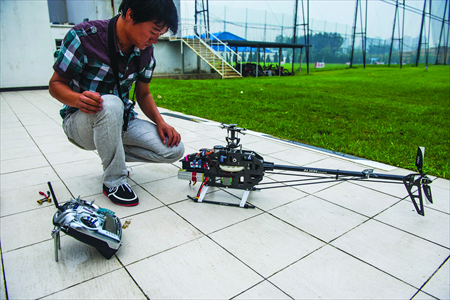
Hobbyists regard some RC choppers as toys but others as sophisticated machines. Photos: Li Hao/GT
Boys' toys
Both Zhang and Liu state with relish that crashing is an intrinsic part of flying RC helicopters. Perhaps this pleasure in the destruction of their toys finds appeal in grown men who refuse to give up on their boyish mischievousness. Not surprisingly in China, RC enthusiasts are almost exclusively male.
Beginners looking to splash the cash at a new and challenging hobby should fear no more, because China's number one RC copter champion has been there and done it all.
"I think I've lost count of how many helicopters I have crashed," says mechanical engineer Liu Hao, 28 (no relation to Liu Zhonghua or his son). "There are always mistakes made during training. Doesn't matter how good you are, you just cannot avoid them."
For three consecutive years, Liu Hao has placed in the top 10 of the 3D Masters - a prestigious international model helicopter competition where spectators, vendors and elite model pilots gather to witness the best in RC helicopter display.
Liu Hao says that he - like many of his competitors from around the globe - got into the sport to realize a childhood dream.
"Many people want to be a pilot but for whatever reason they can't," Liu Hao reflects. "So for us this is a way to realize our dreams. It's also a great outdoor activity and very relaxing."
He describes his training as "very dull and boring" because to be a champion requires hours of practice on moves that might only take a split second to pull of in a real competition. But he worries for the current state of RC helicopters in China. By his own admission he has been China's number one competitor for a few years, but now at the age of 28 feels that he is perhaps becoming a bit too old for the role of young trailblazer. "When I go to world class events, I can't help but notice that many foreign players are under 20. Some of them are even as young as 9 or 10. Why hasn't China produced a new generation to overtake me?" Liu Hao asks rhetorically.
Liu Hao blames video gaming culture for the dearth of Chinese kids emerging as RC world-beaters. But then again Liu Hao always had the guidance of his father and uncle who were members of RC clubs back in the day.
Over to you, little Chujun. Everyone is counting on you.
Sun Siyu contributed to this story
Posted in: Metro Beijing