China’s Transformation
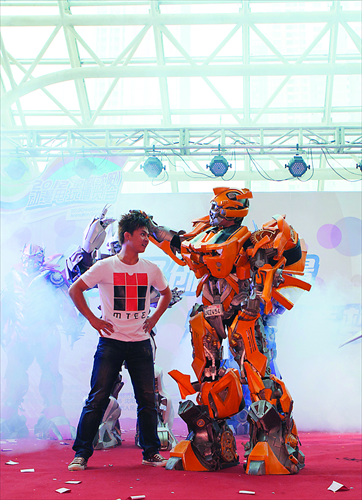
Chinese cosplay enthusiast Mei Luo dressed as the Transformer Bumblebee poses with a fan. Photo: Courtesy of Mei Luo
Transformers invaded China in 1988, when they starred in the first animated science fiction series to be broadcast on television here. Since then, the vehicle-cum-robots have captured the collective memories of generations of young people.
Today, fans amass giant collections of Transformer models, build their own Transformers with Chinese characteristics, and even make their own Transformer animation. Right now, Beijing is host to the country's biggest ever Transformers exhibition, at Gotrus, an exhibition space in Chaoyang district, featuring more than 3,000 Hasbro Transformer toys worth an estimated 6 million yuan ($980,000).
The exhibit covers an area of 4,000 square meters and is expected to draw over 100,000 fans before it wraps up on October 28.
A 3-meter tall model of the robot Optimus Prime stands in the big hall, welcoming fans. Along the walls of the long entrance corridor is the history of the Transformers, which were first created in the United States in 1984 for the toy market, and then spread to Japan and other countries, transforming into television series, comic books and films.
For Chinese people born in 1970s and 1980s, Transformers are part of their collective childhood memories. The toys people collected as young children are now worth a lot of money, especially those in the original boxes.
At the exhibition, visitors can see these old models. Most of them have never been played with, because taking them out of the package reduces their value.
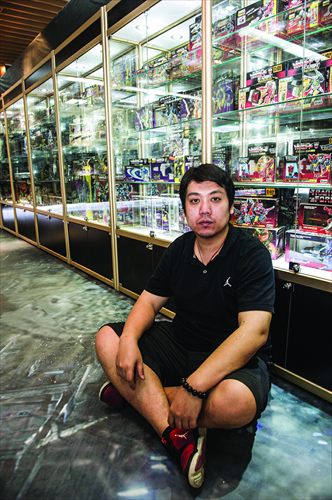
Collector Li Hongbo. Photo: Li Hao/GT
Building a robot army
Li Hongbo, 35, contributed around 800 Transformer models to the exhibition. Li said that this is about one fourth of his total collection.
"My first Transformer models were gifts from my mother when I was in the primary school. When I entered middle school, I saved my pocket money and lunch money to buy the models, which at that time cost around 50 yuan each," recalled Li.
After entering into college with more money to spend, Li started his journey down the road to becoming a serious Transformer collector.
"I collect all the characters who appeared in one episode, and never miss the characters I like or those that are not so attractive. Each Transformer toy series costs around 40,000 yuan," said Li, adding that he carefully reviewed each episode before collecting each Transformer toy series.
In Li's exhibition area, there are both Transformer collections that have been carefully stored in their packages, and those opened for play, most of which he purchased second hand.
Li told Metropolitan that he wants to open a Transformer toy museum one day.
Robots with Chinese characteristics
Designer Sun Shiqian, 29, has collected almost 2,000 original edition models. But he is not satisfied with buying, he wants to create. So he set out to make Transformers with Chinese characteristics.
"It's not good for a grown up to just collect toys. I studied art, so I decided to make my own creations," he told Metropolitan.
Sun developed his strong interest in Transformers when he started watching the American cartoon at the age of 7 on Chinese television. Later, during his studies at the China Central Academy of Fine Arts, he began to make his own original Transformer models.
At first, Sun tried to make his models look the same as the giant robots he saw on the screen. His most famous work is the 2.7-meter-tall model of the character Metroplex that he made three years ago. Its white body is made of square iron boxes. It can transform into a city, a battle station or a giant robot. It took Sun two months to complete Metroplex in the 20 square meter warehouse space he rented.
"Metroplex can transform and all its joints can move. Metroplex so far as I know is the largest Transformer model in the world that can transform," said Sun. He said he applied for a world record for his work but withdrew because of the complex application procedure.
Sun said he often hurt himself when he cut and welded the iron materials, although the injuries took no more than a Band-Aid to heal.
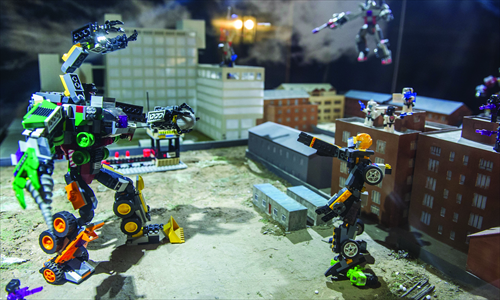
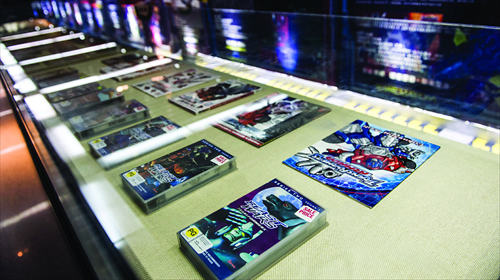
Collectables on display at the Transformers Expo. Photos: Li Hao/GT
New creations
Sun has made a total of three giant Transformer models, in addition to 20 small ones. He no longer just imitates what he has seen. Now he tries to add local flavor to his works, or create new Chinese characters.
"I try to get inspiration from the traditional Chinese arts like Peking opera, water ink painting and Chinese seal cutting," he said.
One recent work used traditional Chinese stone carving for the robot's outer surface. Another is a giant robot, which he called The Goddess, comprised of dozens of tiny robots bunched together in a way that evokes a Buddhist sculpture.
Sun spent around 5,000 yuan to purchase the materials for each big robot. He told Metropolitan that the hardest part for him is the design. "It takes me long time in planning. I need to think about the overall design, from the mechanism to safety," said Sun.
Radical remix
Zhao Dongxu was not satisfied watching Transformers on television. So he created his own Transformer animated stories.
"I am a Transformer fan. I used to write scripts of Transformers stories on the Internet. One day I saw people posting some foreigners' DIY Transformers animation work. At that point I thought to myself, I should do the same thing," Zhao told Metropolitan.
That year was 1999. Zhao began to learn all the computer software and video editing techniques for his animated creations. At first, Zhao re-edited the materials from all the Transformer animated television series to recompose them into very short videos that quickly circulated among Transformer fans.
After building his reputation, Zhao realized that he might make a living from animation and editing. Though he did not make money directly from his Transformer projects, they brought him other projects and job opportunities.
Among Zhao's hundreds of Transformer animations, the most representative one is Truth 2005, based on his adaptation of the Transformer movie made in the US in 1986.
"That movie wasn't imported to China. So in 2001 I managed to find the original version, write my own script, re-edit it and dub it with other Transformer fans," said Zhao. He wrote his own script, and used many popular online words and memes to show the Transformers in a humorous way.
According to Zhao, no one is working full time on making DIY Transformer animations in China, and fewer than 10 people do it as a hobby.
Living robots
Sun's models and Zhao's animations add their own flavor to the Transformer series. But cosplay fan Mei Luo, 24, thinks the closer he can get to the original version, the better.
Mei Luo is the first person to bring the Transformer universe into China's cosplay scene, in which people dress up in elaborate costumes to imitate their favorite cartoon characters.
"Most people don't understand me. They think I'm crazy to introduce living robotic characters onto the cosplay stage," laughed the 24-year-old.
Mei originally imitated the handsome and beautiful cartoon images from Japanese animation and comic books with his elaborate costumes.
But after he saw the Transformer live action films, he decided to cosplay the convertible robots. "Every Transformer costume weighs about 20 to 25 kilograms. They're airtight and we have to stand on shoes with high platforms. This is difficult," said Mei.
In order to wear the heavy costume, Mei and other team members have to do daily exercise like push-ups and running.
"But it's even harder to make the costume. I'm constantly learning how to improve the costume materials and how to use dye to make it more like the original," said Mei.
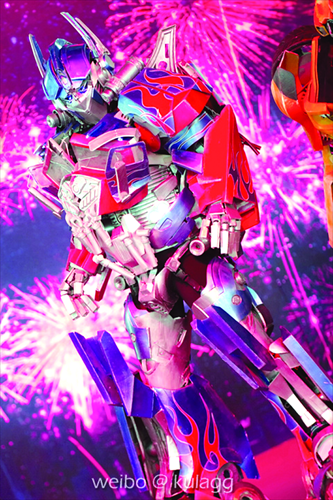
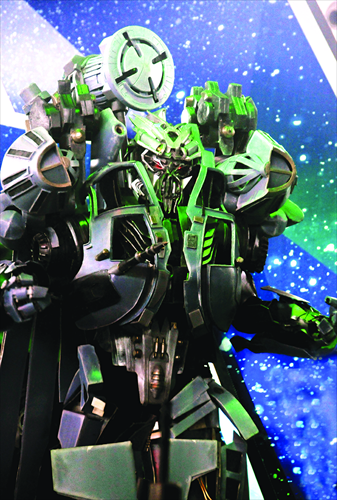
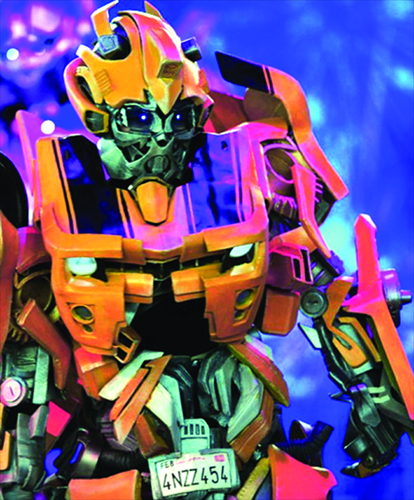
Mei Luo's cosplay group. Photos: Courtesy of Mei Luo
Generation gap
Johnny Zhao, 36, helped promote the three Transformers live action films in China, and translated the English version of the Transformers books. He said the popularity of the Transformers in China is partly because it was the first sci-fi action cartoon that Chinese people saw back in 1988.
"And the simultaneous introduction of the toys helped people seal their affection toward Transformers," said Zhao.
Transformers fans can be divided into two groups, those born in the 1970s and 1980s who grew up with the animated television series, and those born in 1990s or later who grew up with the live action films. In the upcoming action movie Transformers 4, Zhao said that he expects to see Chinese elements in it.
He does not anticipate any homegrown science fiction to rival the popularity of Transformers any time soon. In his opinion, China lacks the soil to cultivate good sci-fi films and animation. "We'd better learn from the Transformers," said Zhao.
"The development of the additional productions should go side by side with the TV shows."