Bird on a string
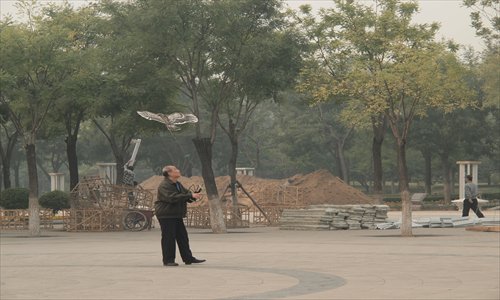
A kite enthusiast allows the line to unspool as his eagle-shaped sport kite catches the wind. Photo: Hu Qingyun/GT
An eagle with a wingspan of over a meter hovers high up in the sky. Suddenly, it dives down. Just as it's about to hit the ground, the bird soars up again. It's early morning in a park near the Temple of Heaven, and a group of middle-aged men are flying their eagle-shaped sport kites. Their arms mill and whirl. If you didn't know better, you might think they were doing some kind of martial art.
Ni Zhixin, 63, has flown this type of kite for over 15 years. Dancing used to be his hobby, but then he broke his legs in an accident. "Then one day, I saw some people flying eagle kites. I was amazed by the power and flexibility of the little kite," Ni said.
Although eagle-shaped kites date back to the late Eastern Zhou Dynasty (around 400 BC), these sport kites have become popular in recent years for their ability to do stunts such as circling and swooping. There are more than a thousand hobbyists in Beijing alone. Most are in their fifties or older, and many of them construct their own kites, Ni said.
"It can fly like a real bird. I've even heard stories that these kites can attract real eagles to fight with them in the sky," said a 50-year-old enthusiast, surnamed Li. Around him, the other kite-flyers concur.
Smiling, Ni tells the story. "When I flew my kite in Yanqing County during Spring Festival a few years ago, it attracted ten or so eagles, which wheeled around it. They thought the kite was a real eagle trespassing on their territory," he said. To prove it, Ni played a video of the incident for the Metropolitan reporter. Thinking back on that experience, Ni gets emotional. "I felt that the kite had its own life force and was a part of nature," he said.
Because the eagle kites are soft-wing structures with only one bridle line, practitioners need to find an effective flight angle and pull with proper force to take advantage of air flow and centrifugal force.
It's not as easy as it looks. "It requires technique," said Li, who has only been flying these kites for about a month. "Beginners like us have to chase the kite all the time to find the right angle. The winds shift constantly, the kite is big and it's hard to maintain control." Despite his best efforts, Li is only able to maintain the kite in the air for a short time.
Ni compares kite-flyers to pilots, saying that one can only call himself a true player if his kites have logged over 3,000 flight hours.
Generally speaking, kites can only be flown in good weather, when the winds are right. With the dynamic exertion of the kite-flyer, however, these eagle kites do not require wind. In fact, they can be flown indoors.
"It's suitable for everybody at any time of the day -even at night, if you add some lights to the kites. You can even fly it inside the office to relax your neck and eyes," said a kite enthusiast surnamed Wang.
The majority of these sport kites are shaped like eagles, a heroic-looking creature that dominates the sky. However, Ni has made several kites depicting cartoon characters to promote the hobby among young people.
Although eagle kite-flying can be a type of whole-body exercise, Ni prefers to think of it as a cultural experience. Because eagle kites originated in Beijing, Ni says, to fly them is to better understand what it means to be a Beijinger.