Clever initiative frees ‘graffiti artist’ in all of us
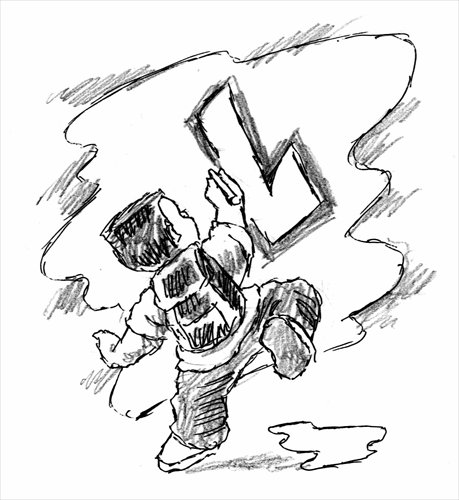
Illustration: Peter C. Espina/GT
With the draw of allowing people to pen whatever sayings or scribbles they wanted on an age-old cultural relic, a curious new experiment at Yellow Crane Tower in Wuhan, Central China's Hubei Province attracted thousands of "graffiti artists" over the National Day holidays that ended Monday.
In a bid to please visitors wanting to write "I was here" or sign their names at the site, organizers invited tourists to leave their mark behind on a giant new electronic screen, encouraging them to "mess up" the board rather than the walls of the sacred tower.
And unlike previous inking by tourists at other historic attractions, the wifi-enabled digital board further allows visitors to remember their "work of art" by sending their graffiti home with them via e-mail.
According to the authorities, putting the electronic screen into use managed to significantly reduce the urge of visitors to deface surfaces over the week-long break when tourism numbers soared. No new graffiti from the holidays was spotted in the scenic area despite rampant vandalism seen at the site during peak periods in the past, they said.
And on Sina Weibo, where the country's most active and widest range of voices gather online, many people have expressed appreciation for the initiative while others are even calling for the move to be followed at other popular scenic sites nationwide.
Indeed, a number of Chinese Net users seem to like the idea of giving tourists a dedicated place to let their creative instincts run free - especially after a Chinese schoolboy who scratched his name on to an ancient sculpture at a 3,500-year-old Egyptian temple in Luxor angered people around the world, adding further to the stereotype that Chinese tourists behave only in "uncivilized" ways.
But the pen-heavy exercises of Chinese tourists, according to some psychologists, come from a natural inclination that humans have to leave their mark on the places they visit. Like dogs urinating to mark their territory, people, too, are driven by this primitive instinct, they say.
Perhaps, the theory may at least in part help to explain why 15-year-old Ding Jinhao, the aforementioned Chinese schoolboy, was so eager to carve "I was here" on a centuries-old Egyptian relic.
By comparison to their Western counterparts, Chinese tourists are still relatively new to the whole concept of tourism. As such, many are still learning how to strike the right balance between acting impulsively and behaving appropriately when touring new places.
The authorities at Yellow Crane Tower have come up with a clever way to appeal to Chinese visitors' urges to scribble down the excitement they feel when experiencing the unknown for the first time. They have effectively found a compromise that does not discourage or damper the spirit of tourists by telling them "No."
We have also seen such positive results from similar approaches in other parts of the world. In Croatia, for example, authorities chose not to penalize gum-spitting tourists, instead allowing visitors to leave their mark or sticky wads of confection behind on wooden pillars erected at popular areas.
Although some people are skeptical about the lasting impact of the positive results seen from the electronic screen placed at Yellow Crane Tower - worried that tourists who tire of the digital board when the novelty wears off will jump back into their old ways of inconsiderately doodling on the walls - we should not be so quick to assume the worse in our people. Give them time to prove to the world that they do not need to destroy priceless relics or artifacts to enjoy the wonders of travel.
The author is a Global Times reporter. liuzhun@globaltimes.com.cn