HOME >> METRO BEIJING
Desk toppers
By Yin Lu Source:Global Times Published: 2013-10-31 18:53:01
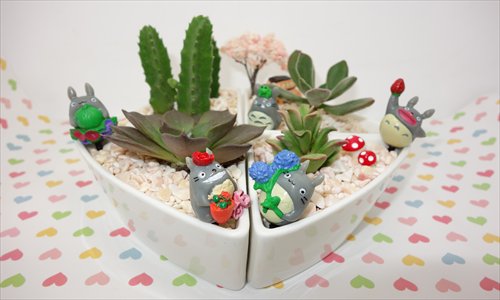
Totoro figurines frolic among succulent plants on a desktop planter. Photo: Courtesy of Wu Feifei
Not in the mood to work? Maybe you need to upgrade your work environment.Beijing office-workers are increasingly turning to tiny gardens, fish tanks and air-cleaning gadgets to personalize their office space and stay refreshed throughout the workday.
Whether they are romantics who crave beauty, crafty types who enjoy DIY projects, or visionaries who appreciate how technology improves our quality of life, they are finding setups that are a fit for their desks and their wallets.
Wu Feifei, 31, who works in the financial industry, gets plenty of compliments about the moss terrariums on her desk - and for good reason.
She makes them herself using glass containers, various mosses and cartoon figurines.
"When you see it on your desk, your negative emotions immediately disappear, and you're in a good mood for the whole day," she said. "The temperature of offices in winter is good for mosses. And you only need to water them every other day," said Wu.
Wu's fondness for these mossy microcosms prompted her to open a shop on Taobao, China's largest online retail website, where she sells supplies for DIY plantscapes. "Little houses and cartoon figurines of Minions [from Despicable Me] and Totoro are the most popular these days," said Wu of the characters that decorate the terrariums.
With her sideline business, Wu has jumped on a popular trend. A Taobao keyword search for "moss" and "mini-landscape" yields more than 3,000 results. On the social networking website douban.com, moss-lovers have formed groups to discuss DIY terrariums. One of the biggest, founded in March of 2010, now has 15,000 members across the country.
But moss terrariums are not the only kind of low-maintenance greenery popular among Beijing's white-collar professionals.
Plump succulents have also become a mainstay of office desks. "These small fat plants are sought after for their sweet meaty looks," said Wu. "Some resemble bunny ears, bear claws or deer antlers."
Ella Shen works in network operations, which means that she spends her days writing e-mails and making phone calls. What keeps her working with vitality is a USB-powered desktop aquarium, whose vegetation, sand, and tiny artificial hills she carefully arranged herself. The whole setup cost her a total of about 150 yuan ($24.60). "It's small but it brings me big joy. Watching the fish swimming is a good rest for the eyes and it brings fresh air too," said Shen. "When they saw how very convenient and inexpensive it was, a few of my colleagues got a tank too."
Other office workers prefer to improve the workplace environment with electronic novelties: humidifiers, negative ion generators, formaldehyde absorbers, and even miniaturized air purifiers designed to be used on desks.
But experts remind consumers that these desktop distractions may not be as effective as claimed. "The main function [of plants and fish tanks] is landscaping. They don't absorb radiation. They are not very useful in purifying the air," said Song Guangsheng, secretary general of China's Indoor Environment Test Center.
As for the desk gadgetry, Song told Metropolitan that a negative ion generator can only generate a small amount of the charged particles, far from enough to effectively purify the air. "Portable purifiers are not even as effective as masks. People should also be careful about devices that might produce ozone, which is bad for the health."
Posted in: Metro Beijing