Tower Play
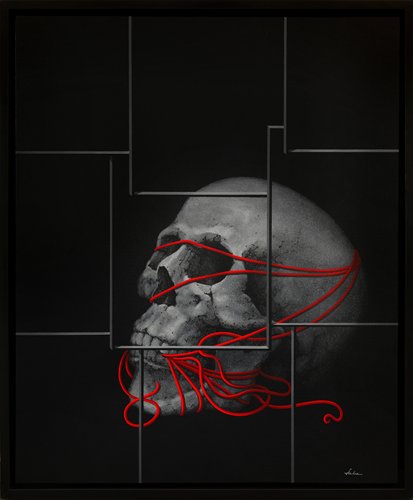
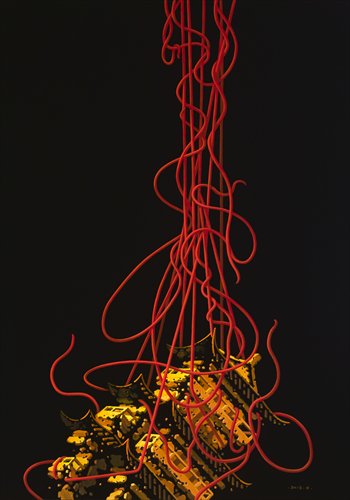
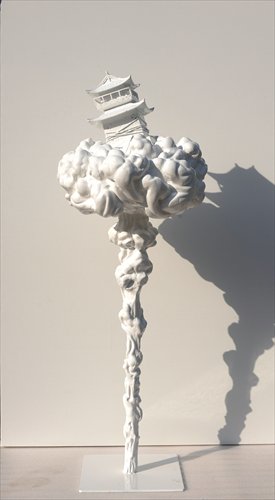
Top to bottom: Battle of Freedom, Red City, and Imaginary City Photos: Courtesy of Liu Jiahua
The image of an ancient Chinese tower appears repeatedly in the artwork of Liu Jiahua. Its walls are pockmarked and riddled with cracks, and it appears as if it has crumbled off its foundations. In some paintings, the structure is tangled up in gleaming red cords; in others, a group of towers tumble through a cloudy sky, dripping rubble and scaffolding.
What is the thinking behind these evocative images? The public can decide for themselves as Liu Jiahua, 34, kicks off his fifth solo exhibition this Saturday at Art for All Society Gallery in 798 Art Zone in Chaoyang district.
This latest exhibition showcases 18 paintings as well as two sculptures, all produced in the past two years. "My artwork can be seen in the context of four progressive stages," Liu said. "In the first series, 'Xincheng' (2006-2008), I was trying to establish my own utopia through the medium of painting; the theme was about the building up of China's own infrastructure."
In the second stage, "Qincheng" (2008-2010), Liu realized that utopia has come to mean incessant urban renovation. "I see construction sites everywhere - in Beijing, of course, and Guangzhou, Shenzhen and even Italy. Both demolition and construction take place endlessly everywhere, which made me focus on the process of urbanization," Liu explained. "I started to paint surrealistic works revealing the destruction and absurdity that takes place in metropolitan areas."
Liu is no stranger to fast-paced mega-cities. A native of Chongqing, Liu studied oil painting at the Sichuan Academy of Fine Arts and then became a contract artist at the Tank Loft - Chongqing Contemporary Art Center. Since 2010, Liu has lived and worked in Beijing.
Paying attention to current social conditions is what really matters to Liu. In the symbolic images of tumble-down houses, Liu probes at Chinese people's faith.
Both the ancient Chinese buildings and the images of red ropes - an unraveling of the Chinese knot - embody tradition, he told Metropolitan, but "the structures also implicitly refer to modern people's spiritual emptiness," he said.
The artworks of the third stage, "Weicheng" (2010-2012), are infused with self-awareness. "The significance of my artworks has increased as time goes by. We have grown up together. The construction depicted in the third stage not only represent the real buildings, but also my own maturation," Liu explained.
In the upcoming show, he has gone further. "Wucheng," the name of the exhibition, literally means "My Own Castle," which Liu says is meant to trigger deeper thinking in the viewers. "They can see the mirage-like or floating construction images in the paintings. If the viewers are perceptive enough, they will see that there are also practical elements such as digging machines and rural laborers."
Liu has presented the overexploitation of the urban areas in his works, especially the hardship of making a living and the absurdity of existence, using his self-described "Chinese-style Gothic aesthetic."
"I intentionally destroy the traditional composition of paintings and then reconstruct it again," he said, and the result challenges viewers to see the rebuilding that is constantly taking place around them. "The collapsing ancient architecture in the art serves as the emblem of declining Chinese culture, yet the real interpretations depend on the audience reflecting and thinking critically," Liu said.
The exhibition will continue at Art for All Society Gallery until December 23.