Climbing enters its ‘Ice Age’
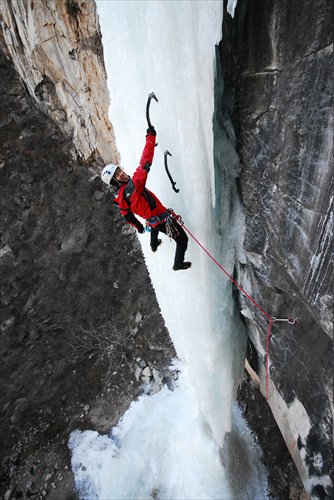
He Chuan climbed in Beijing in 2011.Photo: Courtesy of He Chuan
It has been a year since Zhao Xingzheng climbed Jianshanzi Mountain in Sichuan Province, but the 24-year-old still feels butterflies in his stomach when he thinks about it. Zhao set off with a climbing partner early one December morning at the foot of the 5,472-meter mountain. Their climb proceeded smoothly, and by 2 pm the pair was less than 400 meters from the summit. All that separated them from the top was a hazardous icy peak. An ice climber scales Taoyuanxiangu, Miyun county. Photo: CFP
This was the moment Zhao had trained two years for. As his companion climbed ahead, Zhao fastened his harness and swung his ice axe into the peak to begin his anxious ascent.
But midway into the final stage of the climb, disaster struck: a heavy rock broken loose by his partner above hit Zhao.
"The slab of rock, which measured about 30 by 40 centimeters, struck my shin. I assumed nothing was broken, so I continued," said Zhao.
But he was wrong. The duo eventually reached the summit before descending back to camp, where Zhao realized his bloodied shin had a stress fracture.
Breaking the ice
Ice climbing has become a popular winter activity among extreme sport enthusiasts in China over recent years.
Derived from rock climbing, ice climbing involves the climbing of icefalls, frozen waterfalls, cliffs and rock slabs covered with frozen water.
Techniques and equipment used in ice climbing differ from rock climbing. Climbers often use an ice axe for shorter, less challenging ascents. For steeper climbs, climbers usually wear crampons, or shoes with metal spikes, and harnesses fixed to ropes anchored by ice screws.
Running belays are used for climbs that involve more than one person. The lead climber inserts ice screws used to anchor ropes as they climb.
The follower then removes these screws as they climb up the leader's path. In total, equipment needed for ice climbing can cost up to 10,000 yuan ($1,647) per person.
In Beijing, the sport is most popular between December and February.
More than 1,000 people are estimated by Zhao to have tried ice climbing in the capital, with active climbers numbering more than 200.
Climbing sheer peaks in sub-zero temperatures make ice climbing a difficult and sometimes deadly sport.
But for Zhao and many other climbers, risks associated with the sport aren't enough to deter them from reaching new heights.
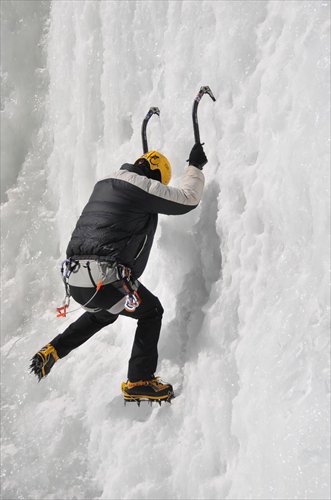
He Chuan, a teacher at the Beijing Institute of Technology, became hooked on ice climbing when he first tried it in 2002.
"I enjoy the feeling I get from carving out each step on the way up an icy peak. I love conquering my fears and taking on new challenges. From preparing for an ice climb to standing on the summit, I savor every step," said He, 34, who climbs weekly throughout winter.
He said one of the most difficult climbs he ever completed was at Shuangqiaogou near Siguniang Mountain in Sichuan Province in 2007.
Ice climbing uses a water ice (WI) grading system to rate the difficulty of peaks. WI refers to ice that is either seasonal or disappears during the warmer months.
Gradings range from WI-1, or not steep, to the most dangerous WI-7, which indicates an incline of roughly 180 degrees.
Shuangqiaogou has a WI-6 rating, which He said includes a vertical ascent of 30 meters to 60 meters without anywhere to rest.
It took He more than three hours to reach the 60-meter summit when he climbed it six years ago.
In Beijing, most ice climbing routes range in difficulty between WI-1 and WI-6.
The two most popular locations are the Taoyuanxiangu and Tianxian waterfalls, which freeze during winter, in Beijing's northeastern Miyun county.
"WI ratings are often changing because of the variable thickness of ice each year. Climbers who follow in the ruts of others always have an easier time because they already have a route carved out," said He.
He said that compared to rock climbing, ice climbing requires "stronger lower body strength and more stability."
"When you use the ice axe and crampons to dig into the ice, you should cling closely to the ruts already made if possible. But with rock climbing, you need to alter the pressure and strength of your hand depending on different holds," He said.
Zhao has taught ice climbing to people as old as 60 and as heavy as 100 kilograms.
"It usually only takes a day for most people to master basic ice climbing skills," said Zhao.
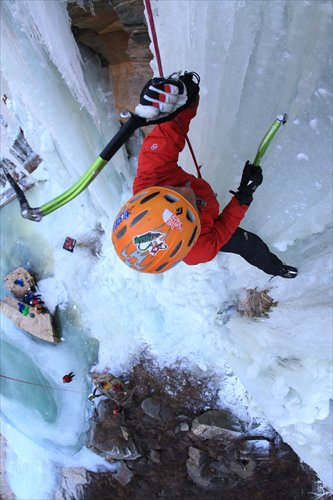
Ice climber Zhou Peng witnessed the death of one of his companions in 2012, but the tragedy only strengthened his resolve to continue with the sport. Photo: Courtesy of Zhao Xingzheng
Risky climb to the topEven though ice axes only need to penetrate the ice one centimeter to be strong enough for climbers to pull on, the heights involved and unpredictable state of ice can make it a perilous sport.
Zhou Peng, one of China's top ice climbers, lost his companion Yan Dongdong during a fateful climb on July 9, 2012, in the Tianshan Mountains in the Xinjiang Uyghur Autonomous Region.
Yan, 28, became well known in the mountaineering world after he and other climbers carried the 2008 Beijing Olympic torch to Qomolangma, also known as Mount Everest. Yan fell to his death in a crevasse on an unclimbed 5,900-meter peak.
Zhou, who tried for five hours to rescue Yan after he fell, declined to talk about the death of his friend other than to say he planned to continue climbing to honor Yan's legacy.
"I like ice climbing because it feels like you are conquering Mother Nature. When you climb up frozen waterfalls, the icicles are so beautiful." said Zhou.
"Every time I set out on a climb I only think about succeeding. I don't get weighed down by the dangers," said Zhou.
Asked if risking one's life is worth the adrenaline rush of ice climbing, Zhao replied that it is "worth sacrificing one's life to explore a beautiful route."
"I have seen news of deaths around the world from ice climbing when things go wrong. I know of all possible outcomes," said Zhao.
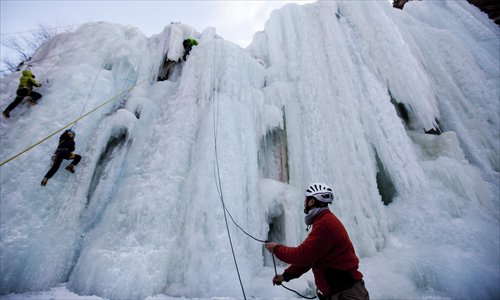
A group of ice climbers at Taoyuanxiangu. Photo: CFP
International appealAudrey Sniezek, an amateur rock climber, told Metropolitan that her most unforgettable ice climbing was in China.
The American decided to make her debut ice climbing during a visit to the Qionglai Mountains in northern Sichuan in September 2012.
Apart from getting used to the 3,400-meter altitude, Sniezek found the other main challenge was recognizing the serious consequences of making a single false step.
"I loved it. It's scary and it's understood that you don't fall, unlike in sport climbing where falls are common," Sniezek said of ice climbing.
"Safety is always a concern. It's important to learn how to place gear, inspect gear, set anchors, rappel, belay and understand the terrain and conditions of the ice," she added.
As for He, he is already busy preparing for next year's Ice Climbing World Cup organized by the International Mountaineering and Climbing Federation in Cheongsong, South Korea.
"We will focus on mixed climbing at the competition. It is basically a hybrid version of ice climbing that involves scaling man-made ice walls that are very steep and require greater effort to carve into the ice," He said.