HOME >> OP-ED
Kung fu fever goes beyond high kicks
By Rong Xiaoqing Source:Global Times Published: 2014-2-20 18:33:01
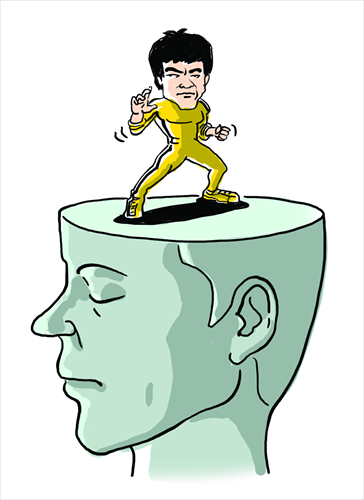
Illustration: Liu Rui/GT
It is a highly unpredictable world. But if history can be trusted, I'd bet on another wave of US kung fu fever in the Year of the Horse.
Chinese martial arts first intrigued the Americans about half a century ago, thanks to a young man named Bruce Lee.
His Chinese face hampered his career in the early years. In the 1960s TV series The Green Hornet, his character, Kato, wore a mask. And in the 1970s, he pitched the idea of making another martial art TV series, originally titled The Warrior to Warner Brothers. The show was made without Lee in it. It starred US actor David Carradine as warrior monk Kwai Chang Caine and was renamed Kung Fu.
Nevertheless, these shows plus Lee's later movies, intrigued Americans with his kung fu kicks, punches and amazingly athletic moves. His enormous energy burst from a skinny yet muscular body.
Ever since then, there has been a close relationship between the waves of screen popularity as new movies and programs come out and the number of students signing up for martial arts classes in New York's Chinatown.
Kung fu reached its peak in the US shortly after Lee died in 1973 during the shooting of Enter the Dragon. Interest began to wane. By the 1990s, many schools had been forced to close.
Then, following two movies, Ang Lee's Crouching Tiger, Hidden Dragon in 2000 and Zhang Yimou's House of Flying Daggers in 2004, a revival gained strength. A couple of new martial arts training schools emerged in the New York area, and the existing ones all got new students, including some local cops.
A survey by the Sporting Goods Manufacturing Association found there were 6.9 million Americans practicing kung fu in 2004, a five-fold increase from 2001.
The wave then died down a little without broadly popular movies, and rents skyrocketed. Kung fu schools started to struggle again with lower revenues and higher costs.
This year, though, the stars seem to be lining up again. In January, The Grandmaster, Wong Kar-wai's latest endeavor based on the life of martial arts legend Ip Man, was nominated for two Oscars, cinematography and costume design. Then, American Chinese playwright David Henry Hwang's new drama Kung Fu, based on the life of Bruce Lee, is opening in an off Broadway theater on Monday.
If the latest performing art works can again rejuvenate martial arts in the US, it is not going to be just a repetitive cycle.
The previous kung fu movies created a generation of followers who are intrigued by the mysterious power of the practitioners.
They come to the masters hoping to learn some fighting skills that can help them, like Lee showed in the TV series, to conquer rifle-wielding bandits, or even like Zhang Ziyi showed in the 2000s movies, to be able to soar in the air.
The new shows seem to be sending out messages that are closer to the essence of kung fu. In The Grandmaster, Wong's Ip Man is not an indomitable super hero as he was portrayed in some earlier movies. Instead, he even loses a contest with Gong Er, a young woman who later develops some ambiguous romantic feelings toward the grandmaster.
But, as Wong explained in an interview with the Film Journal, Ip Man's kung fu "is not just about kicks and punches and beating people up." And "all the time he's not fighting a physical opponent, he's fighting with his time, he's fighting with the ups and downs of his life."
Hwang's show is not about physical fighting either. Hwang told me he was not a big fan of Bruce Lee until his 30s when he tried to make a bigger name for himself in the white-dominated entertainment business. "As an adult I was so impressed by what he had achieved in his short life by creating this Chinese hero in the West. I knew how hard it was," said Hwang.
Hwang does not focus on the heroic legends that have surrounded Bruce Lee since his death, but his struggles and failures and his determination to overcome them and keep moving forward. On the stage Lee does not only teach his students the poses, but also the principles of kung fu - it is about "being strong inside" and how to "fight without fighting."
It could be a strategy for how to deal with today's complex international relationships. In Hwang's words: "Yes, kung fu is about the fighting. But the fighting is a symbol for a much more spiritual kind of journey. The idea that kung fu is the way to try to find peace feels very contradictory on the outside, but there is a truth for that inside."
The author is a New York-based journalist. rong_xiaoqing@hotmail.com
Posted in: Viewpoint, Rong Xiaoqing