HOME >> METRO BEIJING
Feast for a king
By Lin Kan Hsuan Source:Global Times Published: 2014-3-6 19:43:01
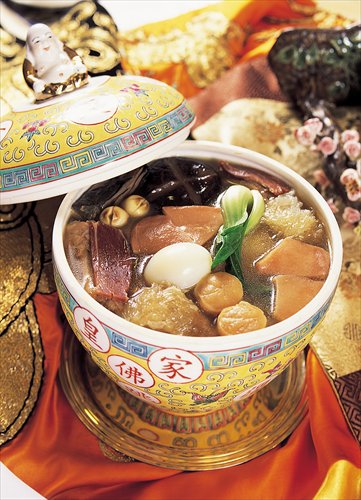
Fotiaoqiang, a dish once served only to emperors, is now quite common at upscale restaurants. Photo: Courtesy of Royal Restaurant
Zhao Guangyou, 39, started his chef's career in 1993 by cooking Shandong dishes, but for the last six years, his tastes have taken a different turn. "I became fascinated by the delicacies of imperial cuisine - their taste, their appearance, their fragrance," he said.Zhao now cooks imperial dishes at a high-end private club in Chaoyang district after learning culinary skills and recipes that date back to an imperial chef of the Qing Dynasty (1644-1911). The lore had been handed down from master to student over generations.
These sumptuous dishes were once served only to members of the royal family. "Each royal had their own kitchens, and ate their meals separately," Zhao explained. "The first three emperors of the Qing Dynasty were austere; their meals comprised merely four to five dishes. As life became more prosperous, later emperors started to request more elaborate and hearty courses."
Of all the dishes in his repertoire, Zhao is most proud of wanzi kourou, a dish made of pork belly, minced venison and salted greens, seasoned with soy sauce, scallions and star anise. "To reduce the greasiness of the pork, the cook carefully cuts the meat into one long thin ribbon to let the fat render equally."
Wanzi kourou was invented for the celebration of Empress Dowager Cixi's 60th birthday. The name literally refers to the character for the number 10,000, which symbolizes longevity and continuity, as the pork must be dexterously cut without being torn, Zhao explained. He acknowledged that the cuisine has had to adapt to the times. "For example, I've tried my best to retain the traditional flavor of wanzi kourou, but the fact is that the breed of the pigs has a slight influence on the cooking method as well as the taste of this dish," he said.
Suancai yuchi (pickled cabbage with shark fin) is also offered at Zhao's restaurant. To prevent controversy over the use of shark fin, however, vegetarian ingredients have been substituted.
By the 17th century, when the Manchu people conquered China, imperial cookery had become very refined. "Generally speaking, it was a mixture of the Eight Great Cuisines, with influences from Fujian, Zhejiang, Anhui, Jiangsu and so on," said June Wang, the general manager of Royal Restaurant in Chaoyang district.
Palace cuisine adapted to fit the eating habits of the new rulers. "Manchu people preferred grilled meat. In the traditional Manchu-Han Imperial Feast, the ingredients included bear paw and leopard fetus," Wang said. "Nowadays, since these animals are endangered, we use camel hoof and deer fetus instead." Because the gaminess of such meats is not appealing to most people's palates, complicated cooking and spicing techniques are employed, she told Metropolitan.
Aside from these exotic dishes, Wang said that some imperial dishes have become quite widely served, such as fotiaoqiang (steamed abalone with shark fin and fish maw in broth). "It's the most famous Fujian dish, and contains more than 20 ingredients. We use powdered scallop instead of salt or monosodium glutamate, which gives the dish a multilayered flavor."
In the wake of the central government's recent frugality campaign, these upscale restaurants have had to make other adjustments. Both have begun offering homestyle dishes such as muxu rou (sliced pork, eggs and wood ear) and gongbao jiding (spicy diced chicken with peanuts). Even wanzi kourou, usually priced at 168 yuan ($27), has felt the pinch. "We now also offer a single-sized portion, which costs only 38 yuan," said Zhao.
Posted in: Metro Beijing