Best of the west
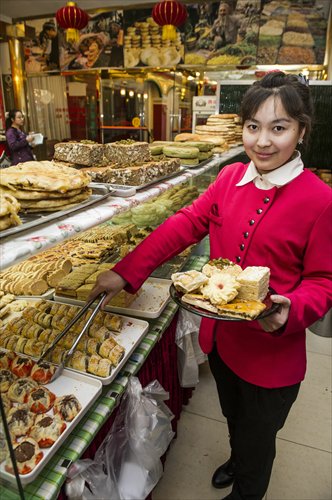
A waitress at the Xinjiang Restaurant affiliated with Urumqi's liaison office in Beijing poses with local pastries. Photo: Li Hao/GT
Few cuisines seduce Beijingers' taste buds more readily than Xinjiang food. From skewered mutton roasted over hairdryer-blown coals to roasted lamb served in fancy restaurants, Xinjiang cuisine's spicy flavors, generously sized portions and refreshing fruits are a mouthwatering temptation for Beijing diners.
Xinjiang cuisine reflects cooking styles and influences from Uyghur, Han, Kazakh, Tajik and other ethnic groups of the region. Food is predominantly halal because of the Muslim population.
Many people associate Xinjiang cuisine with roast lamb and the popular Uyghur chicken stew dapanji, but it also includes foods more common in Central Asia including horse and camel meat. With its sprawling Uyghur community and hundreds of Xinjiang restaurants, Beijing offers plenty of options for people eager to savor the best food from West China here in the capital.
Mutton but the best
Searching the term "Xinjiang cuisine" on consumer review website dianping.com returns listings of more than 400 restaurants in Beijing. The highest ranked one with a more than 90 percent approval rating based on 6,000 reviews is the restaurant of Urumqi's liaison office, known simply as the Xinjiang Restaurant, on Sanlihe Lu, Xicheng district.
Each morning chefs at the Xinjiang Restaurant prepare lambs for the day's dishes. The lambs are roasted in a nangkeng, or pit oven. First, lambs are marinated in a sauce made of onions, peppers and cumin for several hours before they are slow-cooked over two hours in the nangkeng over a charcoal-fueled fire.
There are six varieties of lamb chops at the Xinjiang Restaurant: xiangsu (pot-stewed), suanxiang (garlic), yipinxiang (tender, flavored), shousi (ground), nangkeng kaoyangbei (roasted) and balangza (whole). Two of these varieties, shousi and nangkeng kaoyangbei, are limited to 78 and 28 portions daily respectively due to limited resources, meaning diners have to either eat early or risk missing out.
Daxiong, the pseudonym of a well-known food critic on Internet portal sohu.com, said roasted whole lamb is the "most solemn and precious" food in Xinjiang cuisine.
"It's always best to use lambs bred in Altay [a city in northern Xinjiang]. The slaughter method used for these lambs differs from elsewhere," said Daxiong, who has 1.7 million followers on Sina Weibo. "Effort is made to keep the lamb's appearance intact. The slaughterman makes a 10-centimeter incision to the lamb's stomach and cuts the artery internally rather than slitting the lamb's throat."
The lamb is later glazed in a sauce made of flour, salt, eggs, ginger and peppers and stuffed with scallion, star anise and fennel before being cooked for four to five hours in a nangkeng.
"Xinjiang-style whole lamb is different from that of Inner Mongolia because it is roasted in a nangkeng instead of over an open fire," said Zhou Shilin, head chef at the Xinjiang Restaurant. "Compared with Inner Mongolia-style lamb, Xinjiang-style lamb is softer and tenderer. The lamb doesn't come into contact with the fire directly, but skill is needed to control the heat."
After it is cooked, the lamb is placed on a wooden plate before a red ribbon is tied around its neck and green vegetables are placed in its mouth to create the impression it is grazing.
Zhou, 42, learned Xinjiang cuisine as an apprentice chef in Urumqi from 1992 to 1996. He began working at the Xinjiang Restaurant in 2006, and since then has gradually introduced subtle variations of classic Xinjiang dishes to cater to Beijing diners' taste.
Zhou's specialty dish is yipinxiang yangpai (tender, flavored lamb chops), which are smaller than regular lamb chops and marinated for longer.
"There are many interesting names in Xinjiang cuisine," noted Zhou. "There is a dish called yangwazi gaibeizi (literally "little sheep tucked under a blanket"), which are braised lamb chops served in a large, thin floury wrap."
Another is balangza, the Uyghur term for "young man," which in Xinjiang cuisine refers to large lamb chops.
Skewered mutton garnished with Chinese tamarisk is another famous delicacy from Xinjiang. "Chinese tamarisk is a very common shrub in Xinjiang," explained Zhou. "It brings out special flavors in the mutton and promotes good health because it lowers blood pressure."
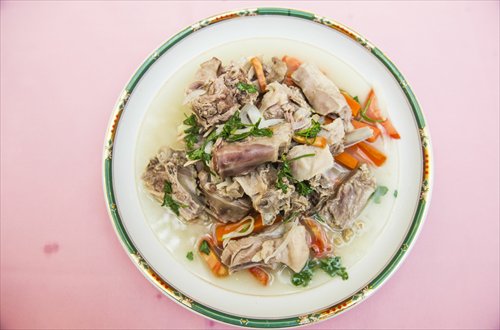
Balangza lamb chop. Photo: Li Hao/GT
Breaking bread
When talking about flatbreads from Xinjiang, the first thought that often springs to mind is the oven-baked naan. A traditional staple in West, Central and South Asia among a multitude of ethnic groups, naan has a history dating back more than 1,200 years. Made of wheat flour, corn flour or white-sorghum flour, it is a crispy accompaniment for almost every meal in Xinjiang.
There are more than 50 varieties of naan in Xinjiang, according to Daxiong. The original and most common naan is made using plain flour and seldom goes stale. Other naan varieties can be made using flour mixed with sheep oil, stuffed with lamb or garnished with sesame seeds, nuts and raisins.
Many traditional Uyghur homes in Xinjiang have a nangkeng. After a fire is lit under the nangkeng, the wall behind it becomes so hot that naan can be fixed to it. Best of all it is quick and easy, with a naan batch typically taking only 10 minutes to bake.
"People in Xinjiang working outdoors often take naan with them," said Daxiong. "Some put their naan in small rivers upstream and walk downstream to wash their hands and face. When their softened naan floats by, they simply retrieve it and eat it."
Other types of traditional sides served at the Xinjiang Restaurant include baklava (rich, sweet pastry with raisin and walnut fillings), yutaza (steamed, multi-layer bread made using flour and sheep oil), sanzi (deep-fried noodles), kaobaozi (grilled bun with lamb and onion stuffing); and fried rice-flour noodles.
Many food critics attribute the wide diversity of Xinjiang cuisine to the region's assimilation of a variety of regional cuisines. Wang Yi, owner of Xinjiang Specialized Fried Rice-flour Noodles, a small but popular hutong restaurant near shopping hub Xidan, claimed fried rice-flour noodles were popularized in Xinjiang after coming from Southwest China's Guizhou Province.
"Our grandparents know that these noodles weren't originally from Xinjiang, but were introduced by a master cook many years ago from Guizhou Province," said Wang. "It was just like how [Journey to the West character] Xuanzang transferred other regions' cultural achievements to faraway places."
Wang's restaurant spans fewer than 20 square meters, but every day she sells more than 50 kilograms of rice-flour noodles. "People of Han and other ethnic groups love the extreme spicy, hot flavors," said Wang. "We serve diners from Xinjiang every day. They say eating noodles here is like experiencing the taste of home."
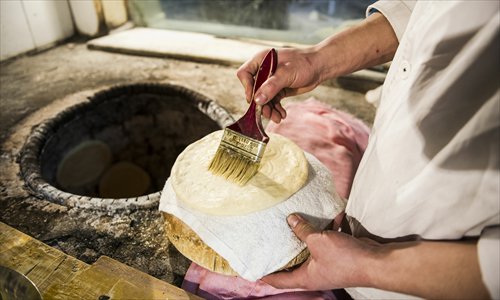
A chef at a Xinjiang restaurant makes a naan. Photo: Li Hao/GT
Be your own Xinjiang chef
Sultan Uqkun, a 29-year-old Uyghur who works for the China International Exhibition Group, has lived in the capital since graduating from Beijing Normal University. Uqkun's only regret is that he doesn't have a nangkeng here like the one he grew up with in Urumqi.
"It's a pity that I don't have a nangkeng, because it means I can't make naan and kaobaozi," said Uqkun. "But every time I invite friends to my home [in Beijing], I always make dapanji, banmian (noodles served with soy sauce) and zhuafan (Xinjiang-style pilaf). Every friend of mine, Han, Uyghur and other ethnic groups, says my cooking is unforgettable."
Zhou said you don't need the skills of a super chef or a fancy nangkeng to prepare classic Xinjiang dishes in your own kitchen. In some parts of Xinjiang, a roasted whole lamb can be prepared in 18 steps.
"It depends on what kinds of lamb and seasonings you use," said Zhou, who recommends chaokaorou (fried roast lamb) as an easy delicacy people can try at home.
"The seasoning is easy to make and there is no secret sauce needed, like we use for our lamb chops at the restaurant. The procedure is simple. You just roast the lamb with your oven or microwave and then add more cumin to intensify the flavor when frying."
"We Xinjiang people are very hospitable, and we like to eat and have fun together," said Uqkun, adding he often cooks hometown specialties for friends served with Yili Laojiao, a type of strong, white spirit distilled in Ili, a city in western Xinjiang.
"But I never urge anyone to drink. We sing, dance and play games while eating and drinking, until we are exhausted."
Beijing's top 5 Xinjiang restaurants
Roxingul
Where: 3/F Dingxin Building No. 27 Guangqumennei Dajie, Dongcheng district
Specialty: Dapanji (Uyghur chicken stew)
Attila Western-style Restaurant
Where: No. 25 Chunxiu Lu, Chaoyang district
Specialty: Noodles served with eggplant and lamb
Gebirenjia Rice Noodles
Where: 7/F Hailong Technical Building, No. 1 Zhongguancun Dajie, Haidian district
Specialty: Fried rice-flour noodles with beef
Jinjiang Western-style Restaurant
Where: No. 411 Beichendong Lu, Chaoyang district
Specialty: Zhuafan (Xinjiang-style pilaf)
Khan Tengeryn Halal Restaurant
Where: No. 1 Sanlihe Lu, Xicheng district
Specialty: Barbecued lamb