Praying to get lucky
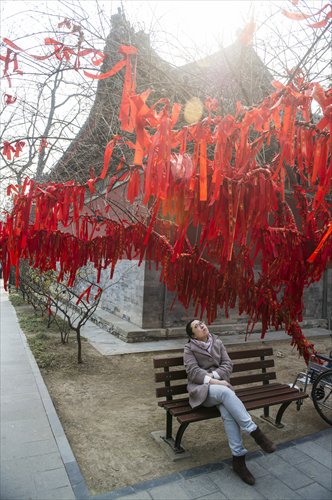
A woman sits below a tree bearing ribbons scrawled with wishes of mostly young people hoping to study abroad or get a good job at Wofo Temple, Haidian district. Photo: Li Hao/GT
Meng Xinyue keeps some of her most prized possessions in the drawer of her dressing table. It isn't love letters, precious stones or rare coins that she treasures, but talismans including bracelets and pendants scattered among ticket stubs from various temples. The 29-year-old bank employee has visited almost every famous temple in Beijing to pray for one thing: a boyfriend.
Until recently, Meng's favorite talisman was a wooden amulet inscribed with the phrase "qiuyuan jianxi" ("request help to meet happiness") for female temple-goers seeking spiritual assistance in finding Mr Right or bearing children. She bought the amulet at Baiyunguan, a Taoist monastery in Xicheng district, but has shunned it since a friend touched it and caused it to "lose its power."
"It seems that each temple has shrines for gods who oversee different aspects of life," said Meng, an atheist. "Because I am still single, I want help from the god who can most effectively help me get a boyfriend."
Chinese have been visiting temples for centuries to pray for bountiful harvests, good health and, in more recent times, high test scores for their children taking the gaokao (national college entrance exam). In a city with a history dating back 3,000 years that was once home to more than 300 temples, Beijing today has 27 Buddhist and Taoist temples that remain popular among tourists, devotees and the superstitious masses seeking divine intervention to improve their fortunes.
An offer they can't refuse
In Beijing, almost all students planning to study abroad or new graduates seeking their first job are familiar with Wofo (Reclining Buddha) Temple, which is conveniently located in university hub Haidian district. With its name sounding similar to the word "offer," visitors swarm there to pray for good luck in the hope they might receive a much coveted offer of their own related to education or employment.
Wofo Temple was built during the reign of the Zhenguan Emperor (627-649) in the Tang Dynasty (618-907). Its main attraction is a 5.2-meter, 25-ton bronze statue of the reclining Buddha Shakyamuni depicting the scene when he was about to give his final lecture to his disciples before death. However, nowadays the temple's religious and historical significance is lost on many visiting youths hoping for good fortune.
Xiao Xue paid a trip to the temple shortly after graduating from Beijing Normal University in 2012. He recalled that his job-hunting efforts had left him feeling "completely exhausted" at the time, persuading him to join his classmates in turning to Buddha for help.
"I think that Buddha himself never could have imagined this phenomenon, which is kind of strange," said Xiao. "Deep down I know that the two words (Wofo and offer) are only similar in pronunciation, but I prayed to try and get some spiritual comfort."
Gao Wei, a well-known Beijing folklorist, described the Chinese custom of temple worship as being in a state of "utilitarianism," whereby gods only feel in need of people "when they have wishes."
"Traditionally, scholars who aspired for great achievements or high-level postings would pray in front of Wenquxing (God of Wisdom), which is not very common in Beijing. Now, you can find the statue [of Wenquxing] in Taoranting Park, but his 'job' seems to have been 'stolen' by the reclining Buddha," joked Gao.
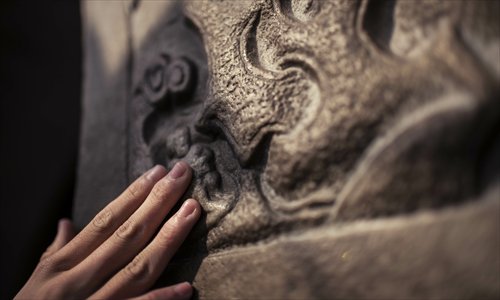
People touch the stone monkey on the gate at Baiyunguan. Photo: Li Hao/GT
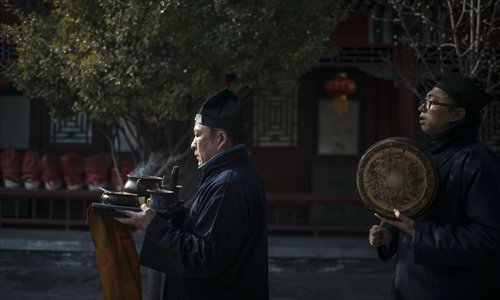
Taoist priests at Baiyunguan. Photo: Li Hao/GT
Importance of a pure heart
Baiyunguan, one of China's most famous Taoist temples, is renowned for allegedly being a source of good fortune to many people. Old Beijing folklore holds that there are three monkeys carved out of stone at the temple. The monkeys, which stand only 10 centimeters high, are difficult to find; one is at the main gate, another is on a wall, and the third is at the base of a stone stele.
Good fortune is said to come to any person who touches the three monkeys with their hands. "A Taoist priest at Baiyunguan told me that I should touch the body part of the monkeys that corresponds with where I feel pain in order to gain relief," said Wang Yu, a 29-year-old who has a PhD in applied mathematics. "But I question the hygiene. Thousands of people touch the monkeys with their hands daily. They must be overrun with bacteria!"
Looking for love
Dating back to the Eastern Jin (317-420), Hongluo Temple in Huairou district enjoys a modern reputation for being the best place for women to go and pray if they want luck in love or becoming pregnant. The Buddhist temple fell on hard times during the Cultural Revolution (1966-76) when many of its statues and relics were destroyed, but it has thrived since the 1990s when it was restored.
Hongluo Temple's main attraction for female visitors is its Guanyin Shrine to Buddhism's namesake goddess of mercy. To show piety, visitors must make an arduous climb up Hongluo Mountain. On route to the Guanyin Shrine is the 900-meter Guanyin Road built in 2010 that is lined by 33 white-marble statues of Guanyin in various poses.
Shuzhu (Buddhist beads) Guanyin holds a chaplet, while Jingshui (pure holy water) Guanyin holds a jade bottle and a willow branch. Lianchi (lotus pond) Guanyin sits on a lotus leaf, while Qili (carp-riding) Guanyin stands on a carp sailing across a sea. The peaceful, solemn sight of the statues is enough for some visitors to forget their fatigue climbing the mountain.
However, most visitors gather at the front of two Guanyin statues: Tongzibai (child praying to the goddess) Guanyin and Songzi (child-delivering) Guanyin. Most women paying respects to the goddess begin praying on the road to the shrine.
Gao attributes the feminine, amiable image of Songzi Guanyin to her popularity among women hoping to find a spouse or become pregnant.
"There are also some other goddesses worshipped for the same reason. For example, Bixia Yuanjun, a Taoist goddess, is said to be the spiritual head of Taishan Mountain's daughter," said Gao, referring to a famed Taoist mountain in Shandong Province.
"Beijing people call her 'niangniang' (empress) or 'nainai' (grandmother) to show respect, and hold a grand temple fair on Miaofeng Mountain [in Mentougou district] to celebrate her birthday on the first day of the fourth month of the lunar year."
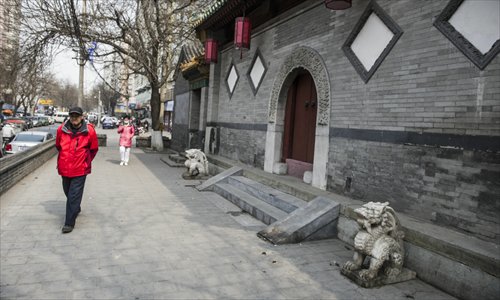
The site of former ancient nunnery Sansheng'an. Photo: Li Hao/GT
Relationships grow on trees
Legend has it there used to be a nunnery built more than 1,000 years ago called Sansheng'an in Taoranting, Xicheng district. In the nunnery's yard was a giant locust tree planted during the reign of the Wanli Emperor (1573-1620) in the Ming Dynasty (1368-1644) by a princess in memory of her lover. The tree, which still stands today, is known as Yinyuanshu (sacred tree blessing people's happy relationship).
"People used to tie red ribbons to the branches of the tree to pray for a happy relationship and marriage. Thousands of red ribbons would cover the tree's leaves in summer," said Fang Xueting, a tour guide who specializes in taking foreign tourists to Beijing's cultural and historical sites.
"I used to visit the tree in 1993, but now I hear the yard has been converted into a private recreational club," added Fang, who credits the tree with helping her get married and give birth to her daughter, now aged 10. "I feel a bit sad because I will never be able to see that tree again. I think my marriage was granted by it, but future generations won't be able to pray in front of it any more."
Master Xuecheng, an abbot at Longquan Temple in Haidian district, said people often turn to different Buddha statues for "better results" depending on their desires.
"Many people pray to Buddha asking for his help to solve immediate difficulties," said Master Xuecheng, "But digesting the essence of Buddhist doctrine takes a long time. Understanding it unlocks eternal happiness and inner peace. People praying at temples need to bring an earnest heart, not just incense to burn and money to donate."