HOME >> METRO BEIJING
Guiding grief
By Li Lin Source:Global Times Published: 2014-3-30 19:43:01
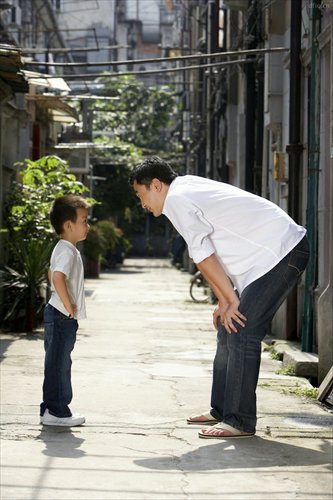
According to experts, when children ask difficult questions, adults should never deny the reality of what children already know. Photo: IC
Zhu Yimin was rather unsettled recently when her 8-year-old daughter began to ask a lot of difficult questions about airplane disasters and death. "Mom, isn't it dangerous to take a plane? Did the people on that plane all die? If not, where did they go?"Her questions, referring to the missing Malaysia Airlines flight MH370, came just as Zhu was about to book them a flight to Kunming, Yunnan Province during spring break. Stunned into awkward silence, Zhu did not know what to say.
The missing MH370 flight was announced on March 24 to have "ended" in the southern Indian Ocean. Since the plane was Beijing-bound and 154 out of the total 239 passengers were Chinese, the tragedy has hit home for many Beijingers. With so much media coverage of the tragedy, this may be the first time that some children have had to confront the reality of disaster and death.
According to Hu Zhaolong, psychologist at Beijing United Family Hospital and Clinics, parents should be prepared to talk to their kids about death. When children ask this kind of questions, he said, parents should acknowledge what happened and never deny the reality of what the children already know, and never make things up. "It is a great opportunity to show how we parents deal with it. It's good to identify the people who helped as well as the silver linings," said Hu, who has a 3-year-old son. "Be natural and try not to avoid answering the questions. If you don't know, just say so."
If, after parents acknowledge the reality of loss, the children feel distress and start to grieve, then it is important to help them express their feelings. Art will be a good way to do this. "Let the children draw 'sadness' for you on a piece of paper, and then also draw themselves on the same paper," said Hu. "Pay attention to the size of the 'sadness' and the self-portrait, as well as the distance and relationship between the two. Remind them to draw the 'sadness' outside the self-portrait so that you can tell the child that even if the feelings do exist, they won't hurt him or her."
Zhu said her daughter also heard about the recent terrorist attack at the railway station in Kunming, their hometown. After the attack, Zhu called every relative in Kunming to make sure they were safe. "That incident did not worry my daughter as much as MH370, because after a few days she learned that the 'bad people' in Kunming were caught and she believed that she and other 'good people' were safe again," said Zhu. "But now that she knows that the people [on the flight] are 'all dead and will never come back again,' she is refusing to fly." In the end, Zhu decided that they would travel to Kunming by train instead of plane.
Hu believes that the fear of death is normal - and that not reacting or even feeling pleasure about disasters or death would be a real cause for concern. "You must let your children know they are safe," stressed Hu. "Assure them that you love them, you will protect them, and keep them safe even in an unstable world."
"My own first memory of death was vague," recalled Zhu. "When I was very little, a neighbor child drowned in the reservoir." She forgot whether she asked her parents about it, but she is certain that she was given no explanation about the poor boy's death. "But now I have decided to face my daughter's fear and doubts with her, to help her to understand, fight against and finally conquer them."
Posted in: Metro Beijing