Fish in a barrel
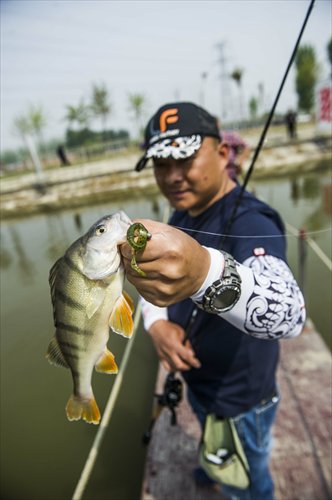
A fisherman shows off a fish he caught in a concrete pond in Shunyi district. Photo: Li Hao/GT
The first weekend after coming back from a five-day sea fishing trip in Malaysia, 28-year-old Zhang Chiyu could not wait to tell his friends about the first time he tried fly fishing in the ocean.
"At first, I was seasick. But for the rest of the trip, I was completely immersed and thrilled. It's quite different from fishing on the shore back in Beijing," recalls Zhang.
He says reeling in a big, strong fish from 200 meters under the sea took all of his energy. He succeeded in hauling in a largehead hairtail, over 2 meters long and weighing 7.5 kilograms. One of his companions caught a 60 kilogram shark.
Like Zhang, more and more Chinese anglers have turned their eyes from traditional fishing with bait to fly fishing, which they think is more thrilling and environmentally friendly. However, despite their great passion, they face the problems of limited rivers and lakes that have not been polluted, and competition from poachers using poison and electricity in the few bodies of water where fish still survive.
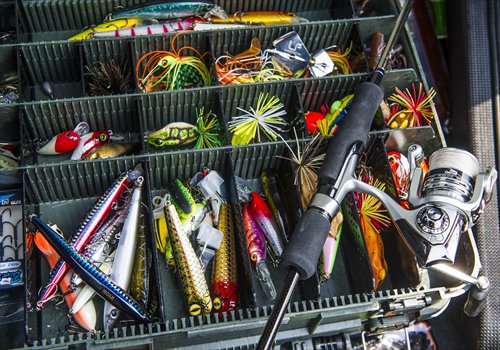
A tackle box, full of colorful lures. Photo: Li Hao/GT
Lured by fishing
Fly fishermen use man-made lures that resemble the natural food of fish, and cast them into the water. Skill is required to make the lure seem like a living, moving creature that can attract the fish.
This is in contrast with bait fishermen, who snare their prey using live bait and have a greater tendency to sit and wait for hungry fish to come and take a bite.
"Fly fishing is the most exciting way to catch a fish," says Zhang. He also appreciates the catch-and-release ethic of many fly fisherman, who will return a fish to the water after enjoying the sport of catching it.
Zhang once tried traditional bait fishing, but found it boring. A friend took him fly fishing for the first time in September.
"You devise a strategy to lure the 'enemy' into a trap by disguising your artificial lures as their prey, leading to the final fight," explains Zhang.
Concrete pond
Full of enthusiasm after his trip to Malaysia, Zhang invited his friends to go fishing with him and have a barbecue at a fishing ground in Shunyi district last Saturday.
"Though they do not try it before, many were interested in this amazing sport and my dazzling tackle box. It is fantastic to enjoy fly fishing with your friends," says Zhang.
At the 300-square-meter concrete pond, he cast a dark green plastic lure that looks like a fish onto the surface of the water, then started to reel the lure until it sank under the water several meters, giving one or two quick snaps of the rod. The lure appeared to swim like a real fish, in an attempt to draw one of the bass stocked in the pond to bite it.
After several failed casts, Zhang moved along the cement walkways to the other side of the pond, and caught a 2-kilogram bass. Following the sport's environmental ethos, he quickly took the fish off the hook, released it into the pond and continued to cast his line.
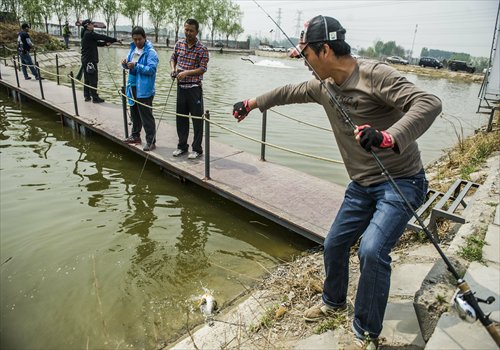
As fly fishing grows in popularity, pressure on officials to protect fish in their natural habitat is starting to increase. Photo: Li Hao/GT
Golf on the water
Known in local fishing circles as "golf on the water," proponents boast fly fishing is one of the Big Four noble sports in foreign countries. (The others are tennis, equestrianism and golf.)
Since fly fishing was introduced into China in 2005 from abroad, more and more people, especially young people, have started to experience the joy of "lure fishing," as it is known locally. The sport relies on complicated techniques that take into account the external environment and the habits of the fish.
"Traditional fishing is seen as recreation by most Chinese people, but fly fishing is more like a sport, with movement of your whole body. You have to keep constantly moving, seeking big game like perch and trout, rather than staying put at a certain location, because the sunlight and temperature change," explains 32-year-old Wang Xuan, a professional black bass angler.
Wang started with bait fishing in 2003 and turned to fly fishing in 2007. In 2012, he became sponsored by N.S Black Hole, a South Korean rod manufacturer.
Fly fishermen have to keep moving, because they come across different problems and need to change their strategies, considering factors like wind direction, water conditions, temperature and air pressure to choose a good spot where fish will gather.
However, "playing golf on the water" is not a sport everyone can afford to enjoy.
"You need different fishing tackles for freshwater and seawater. A good fishing tackle including the lure, rod, fishing line will cost 7,000 yuan ($1,100) on average," explains 30-year-old Zhang Jie, who started fly fishing in 2011.
Zhang Chiyu now has four fishing tackle boxes for seawater fishing and another two for freshwater fishing, which cost a total of 15,000 yuan.
Catch and release
Another attraction of fly fishing for many anglers like Zhang is its environmentally friendly reputation.
"Live bait or bait powder is very dirty, whereas the artificial lure is very clean," explains 28-year-old Song Tao, who has been fly fishing for four years.
On average, an artificial lure made of silicone or rubber costs around 7 yuan. "Though it is more expensive than live bait, its use can reduce the use of bait species, which are often overharvested, and will damage the marine food chain," says Song.
"The white floccules caused by bait powder will gather on the water's surface, which will cause heavy pollution," says Jin Hui, vice director of the fly fishing committee of the China Angling Association.
Another advantage of fly fishing is that its catch-and-release ethic cherishes fish as a precious creature.
"The meaning of fishing is not that one can catch a fish and own it. The meaning is improving the survival of fish by releasing them after they are caught," says Jin.
"Every time I catch a fish, I will let it go as quickly as I can in case it dies from being without water for long time," says Zhang Chiyu, who sometimes can catch more than 20 bass or other fish during a fly fishing trip.
But Zhang Chiyu found that some anglers do not care whether there are sufficient fish for the development of environment and for the anglers, and still take them away, which makes him feel very annoyed.
Poachers poison natural habitat
Zhang and other anglers are particularly frustrated by the poor consciousness of protecting fish among common people, leading to their rapid depletion and destroying their prospects for fly fishing.
Because of overfishing and the general destruction of the environment, most anglers in Beijing are limited to man-made ponds, or the Qingshui Fly Fishing Base in the Baodi district of Tianjin, on an artificial lake.
"There are less and less natural lakes, rivers and streams where we can catch wild fish including freshwater bass, Chinese hooksnout carp and predatory carp," says Zhang Jie.
He used to go fishing in the streams of Huairou district, but stopped last year because there were no more fish.
He says he previously went in the spring, and found fish, but the local people would follow him, then come back later to poach. "The local people just go to catch the fish by electrocuting and poisoning them at every part of the stream."
For this reason, he and his friends prefer to go to man-made ponds now, so as not to lead the villagers to the good fishing spots to wreak havoc.
"Though local governments are beginning to protect the species of some water areas, including rivers, reservoirs and lakes, law enforcement is inadequate," says Zhang Jie.
"The country should adopt fishing laws like in America to regulate heavy fishing outside of the fishing season," suggests Jin.
"Some foreigners think that Chinese can not go fly fishing in China due to the bad natural environment. As more and more people join us, the bad situation will be improved," says Zhang Chiyu.