Domestic craft
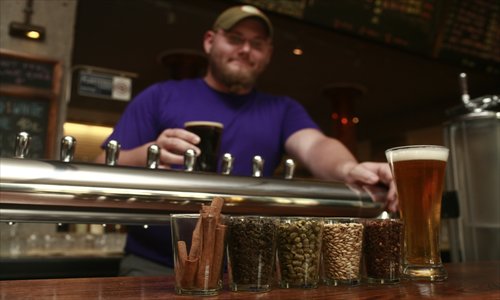
Carl Setzer, the proprietor of Great Leap Brewing, uses domestic ingredients in his beers. Photo: Li Hao/GT
The first time Xiaotie (pseudonym) ever tried drinking Honey Ma Gold, a craft beer flavored with Sichuan peppercorn and honey, it was an experience "sweet with excitement."
"It's kind of weird at first, but it's great. You can taste the Chinese elements," said Xiaotie, who now only orders the Honey Ma Gold whenever she goes to Great Leap Brewing, the microbrewery opened by American Carl Setzer and his Chinese wife Liu Fang nearly four years ago.
"We spent 18 months to create the Honey Ma Gold," Liu said. "It emphasizes the fragrance of ale and peppercorns. It was inspired by our favorite restaurant for spicy chicken wings."
The unusually flavored ale is the most popular and among the first batch of craft beers created by the couple, who now own two locations, one in the Gulou area of Dongcheng district and the other in the Xingfucun neighborhood of Chaoyang district.
Prior to opening Great Leap Brewing, Setzer had worked in the IT industry and had no brewing experience. "We can learn brewing methods from countries like American, Austria and Germany, all of which have good craft beer. But we're in China, so we should use domestic ingredients," he said.
Setzer has lived on the Chinese mainland for eight years and spent two years in Taiwan. "As a brewer, you can't avoid being influenced by what you eat. I came up with the idea of putting certain ingredients into my beers by learning the cuisine."
On the blackboard on the wall of Great Leap Brewing, most of the craft beers listed feature Chinese ingredients. Cinnamon Rock Ale is flavored with cinnamon and rock sugar. Iron Buddha Blonde is infused with tieguanyin, a variety of oolong tea, and Silver Needle White Ale is made with baihao yinzhen, a type of white tea.
According to Liu, star anise was one Chinese ingredient that resisted all efforts to be integrated into a beer recipe. "It has a combination of bitter, sweet and puckery tastes that stick to your tongue," said Liu.
As for whether these ingredients are added before or after fermentation, Liu said the process varies by recipe and is a closely guarded trade secret.
Belgian Dieter Vanonckelen, 29, has also tried his hand at making craft beer with Chinese ingredients. Vanonckelen, who used to work as a real estate agent, began brewing beer two years ago. After living in Chengdu, Sichuan Province, for six years, he now describes himself as "half-Chinese."
"Belgium has a tradition of craft beer with diverse ingredients like fruits. But in China, I think I need to integrate local characteristics into the beer," he told Metropolitan, adding that most of his brewing knowledge was gained from the Internet and from his part-time jobs in Belgian pubs.
Based on his belief that ginger and peppercorns are the best representatives of Sichuan food, Vanonckelen made a craft beer with those two ingredients two years ago, which has proved to be quite successful.
"My bar [The Beer Nest] is just over 100 square meters, but each week, we sell five kegs of that beer," said Vanonckelen, who added that each batch takes about two to three weeks to brew.
Setzer said that for a beginner to judge the quality of the craft beer, there are general rules: amount of foam, clear liquid, no taste of chemicals or dairy-like butteriness. Nor should it taste of acid or cause a stinging sensation in your throat after drinking.
"This month we will launch a new beer with Chinese tea and chrysanthemum. And we're continuing to focus on the development of the Beijing market," said Setzer.